
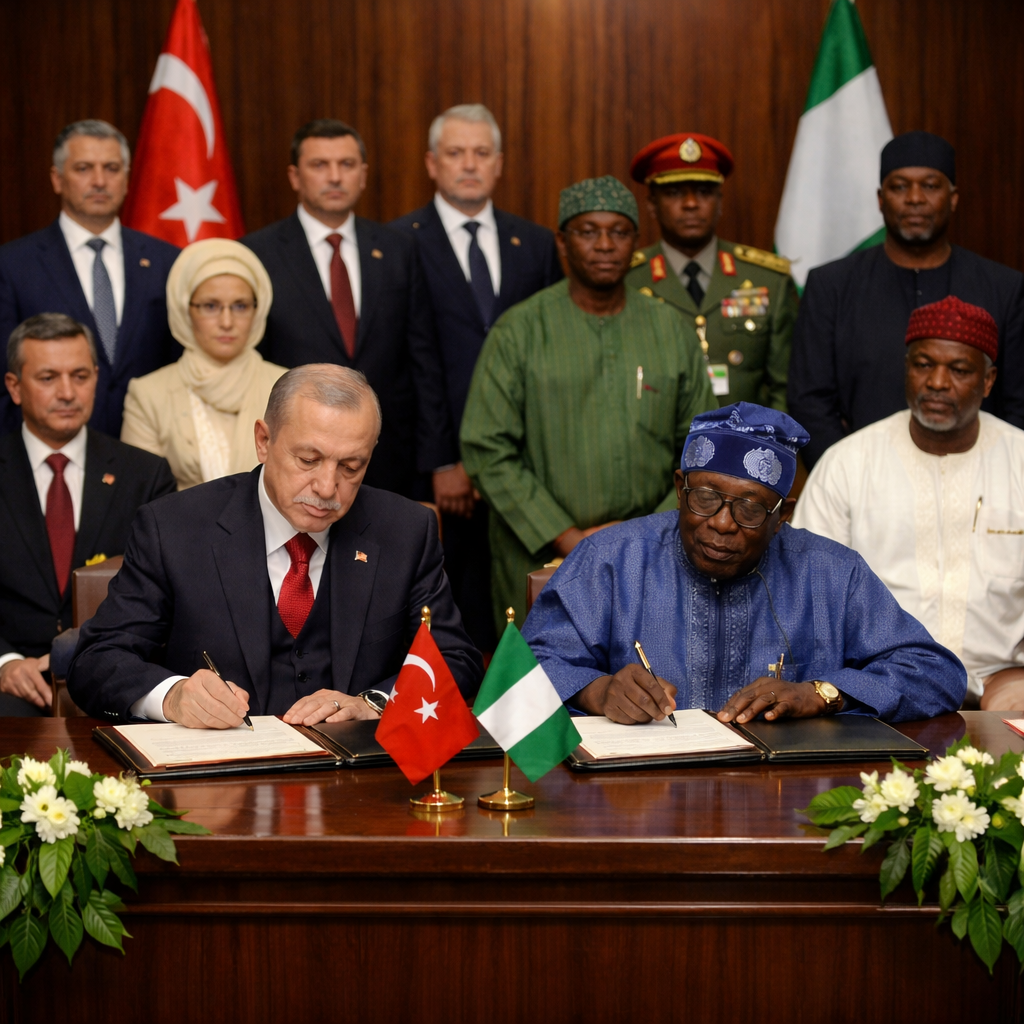

Beijing / Abuja / Ankara — In a significant push toward deepening economic ties between two of Eurasia and Africa’s most dynamic economies, Turkish President Tayyip Erdogan and Nigerian President Bola Tinubu agreed on an ambitious strategy to expand bilateral trade to $5 billion — more than double current levels — alongside broader cooperation on defense, infrastructure and investment. The announcements followed a high-level meeting in Abuja this week that culminated in a new set of government-to-government agreements.
What Was Agreed
• Erdogan and Tinubu signed a suite of agreements spanning defense cooperation, infrastructure development, and trade and investment promotion.
• Both states launched formal discussions toward a trade volume increase from approximately $2 billion to $5 billion, anchored in expanded market access and investment facilitation.
• Allied cooperation on security and military training was also affirmed, with Nigeria signaling engagement with Turkish defense firms.
Why It Matters Economically
The Ankara-Abuja agreements mark a step change in economic diplomacy between Turkey and Africa’s largest economy:
• Trade expansion at scale: A $5 billion target signals a strategic pivot for Turkish exporters — especially in machinery, automotive and consumer goods — toward the West African market, where Nigeria’s rising consumer class offers long-term demand.
• Investment flows: Formalizing trade and investment frameworks reduces commercial risk and gives confidence to private sector capital, creating pipelines for Turkish direct investment into Nigerian infrastructure and energy.
• Defense and technology cooperation: Agreements on military training and intelligence can catalyze ancillary industrial linkages and technology transfer, deepening the economic footprint beyond trade.
Implications for Capital and Business Confidence
• Foreign capital mobilisation: Clear targets and state-backed cooperation mechanisms reduce uncertainty for institutional investors looking to African markets, especially in sectors like construction, logistics and defence manufacturing.
• Regional trade integration: Nigeria’s leadership within the African Continental Free Trade Area (AfCFTA)multiplies the potential impact of a stronger Turkey-Nigeria partnership, offering Turkish firms a gateway into a continental market of over 1.3 billion consumers.
• Diplomatic balancing: The deal underscores a broader trend of emerging-market states forging diversified partnerships beyond traditional Western economic centres, particularly amid global geopolitical realignment.
What Comes Next
Technical working groups between Ankara and Abuja are expected to define tariff schedules, investment protection provisions, and sector-specific cooperation roadmaps over the next quarter. Observers note that private sector engagement — alongside state actors — will be critical in converting diplomatic agreements into tangible trade growth and cross-border capital flows.


