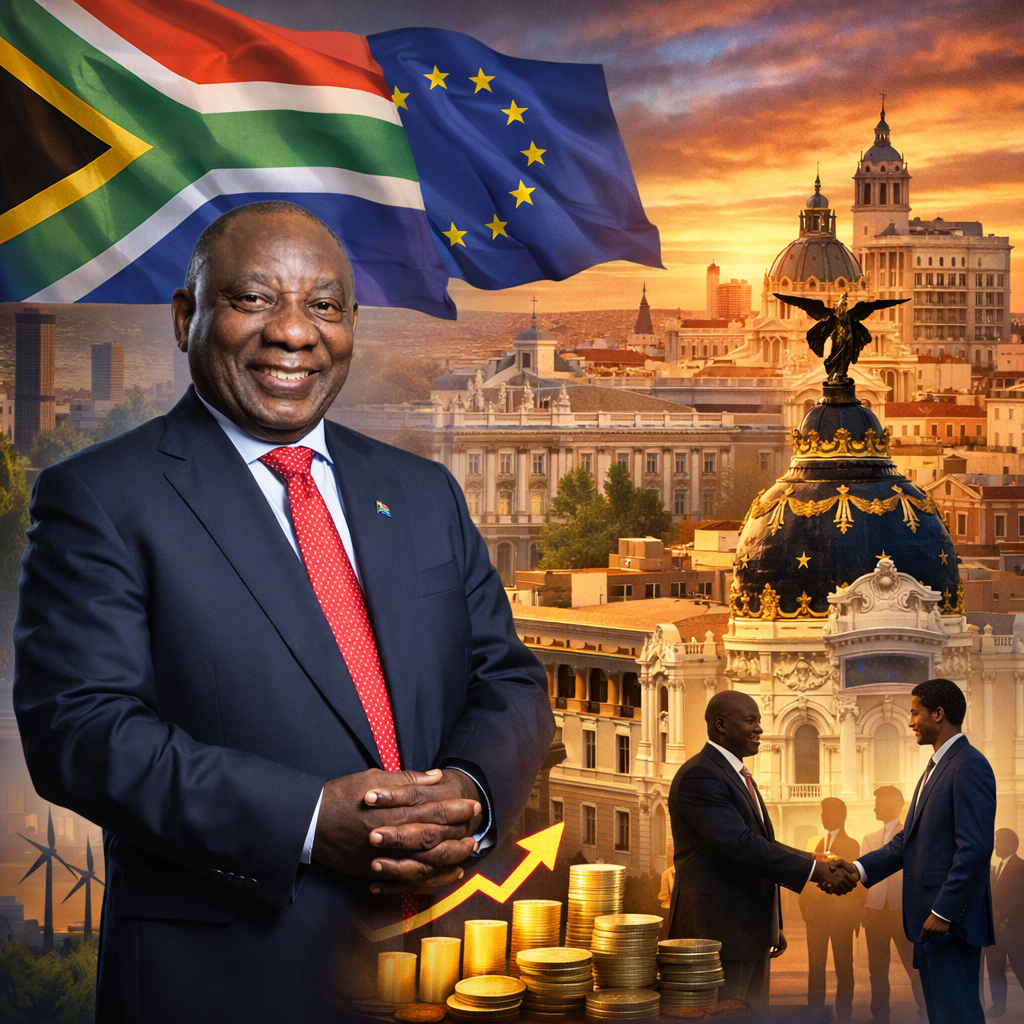

When President Cyril Ramaphosa touched down in Madrid on 16 April 2026, the visit carried a weight that went well beyond diplomatic protocol. Arriving directly off the back of South Africa’s sixth Investment Conference, which secured close to R890 billion in new project commitments, poised to create more than 230,000 permanent jobs across all nine provinces, the working visit to Spain represents something qualitatively different from the investment roadshows of years past. This is not a government in search of credibility. It is a government leveraging credibility already earned, in a global environment where that distinction matters enormously.
The President’s programme in Madrid includes championing South Africa’s investment drive through engagements with Spanish companies and addressing the South Africa–Spain Business Forum, before travelling to Barcelona for bilateral talks with Prime Minister Pedro Sánchez and participation in the In Defence of Democracy Initiative. Accompanying Ramaphosa are the Minister of International Relations and Cooperation, Ronald Lamola, and the Minister of Trade, Industry and Competition, Parks Tau, a ministerial configuration that signals this visit is as much about commercial architecture as it is about democratic optics.
The Trade Baseline and What It Understates
The bilateral relationship between South Africa and Spain is growing, if unevenly. Bilateral trade between South Africa and Spain increased by 8.3% from US$2.9 billion in 2024 to US$3.1 billion in 2025. That momentum is meaningful, but the trade profile, concentrated in the automotive sector and characterised by intra-industry flows, leaves substantial runway unexplored. South Africa’s export diversification ambitions, particularly in renewable energy components, processed minerals, and agricultural value-chains, align directly with Spain’s documented interests in the African continent.
During Prime Minister Sánchez’s 2022 visit to South Africa, he declared the country a “key player” in Spain’s global strategy toward Africa, as outlined in the Third Africa Plan and the Africa Focus 2023, which identifies South Africa as an “anchor country.” That designation is not rhetorical. It places South Africa at the centre of Spain’s institutional framework for African engagement, a position that, if capitalised upon, opens access not only to Spanish bilateral capital but to EU-linked financial mechanisms for which Spain exercises considerable influence.
Why This Visit Is More Than a Business Forum
The strategic context of Ramaphosa’s Spain visit is inseparable from South Africa’s recent macroeconomic repositioning. Three milestone events in late 2025 and early 2026, the FATF grey list exit, S&P’s sovereign credit upgrade, and EU high-risk list removal, have materially improved South Africa’s investment environment. These are not soft signals. They are institutional validations that directly reduce the risk premium European investors apply to South African assets and business relationships. Ramaphosa is arriving in Madrid as the head of a government that has demonstrably moved the needle on governance credibility, and the timing is deliberate.
Over the past decade, more than 150 Spanish companies have invested in South Africa, creating over 20,000 jobs. The Business Forum engagement is therefore not about introducing South Africa as a destination, it is about upgrading the terms of an existing relationship. The industries on the table, trade and investment, education, renewable energy, the digital economy, tourism, multilateralism, and peace and security, map almost precisely onto the sectors in which South Africa has recorded the largest pledges at its 2026 Investment Conference, including Sasol’s industrial commitments, Valterra Platinum’s critical minerals expansion in Limpopo, and MTN’s digital infrastructure investment.
The Democracy Signal and Its Economic Subtext
Ramaphosa’s participation in the In Defence of Democracy Initiative, an international effort initially launched by Brazil and Spain in 2024 to confront the rise of extremism, polarisation, and disinformation, carries a direct economic implication that is often underestimated in business coverage. Institutional stability is not peripheral to investment decisions. It is central to them. South Africa’s visible alignment with multilateral democratic frameworks, particularly at a time of global geopolitical fracture, sends a calibrated message to institutional investors: this is a jurisdiction with a credible rules-based posture, not a government lurching between policy positions.
South Africa’s business confidence index climbed to a decade-high of 47 points in early 2026, while consecutive quarters of economic growth, stabilising inflation, and an improved sovereign credit outlook have reinforced the view that the country is on a steadier, upward trajectory. The In Defence of Democracy forum provides Ramaphosa with a multilateral platform, alongside leaders from Brazil, Colombia, Uruguay, and the European Council, to anchor South Africa’s reform narrative within a broader progressive governance framework. That positioning matters to European capital allocators who are increasingly applying environmental, social, and governance screens to sovereign exposure.
The R3 Trillion Ambition Requires a European Leg
South Africa has set its sights on mobilising R3 trillion in investment over the next five years, with a substantial share expected from domestic sources alongside strong international participation. Achieving that target at the scale required demands more than domestic capital deepening and conference pledges. It requires sustained bilateral engagement with capital-exporting economies, and Europe, led by its largest institutional investors and green transition financing vehicles, represents one of the most consequential pools of long-term patient capital available to emerging markets.
Spain’s own strategic posture toward Africa is accelerating. Pedro Sánchez returned to South Africa in November 2025 to participate in the Johannesburg Summit during South Africa’s G20 Presidency, demonstrating a consistency of engagement that is not accidental. Both governments appear to have concluded that the bilateral relationship is underperforming relative to its structural potential. The Madrid Business Forum and the Barcelona bilateral are, in this reading, the beginning of a more institutionalised European capital mobilisation effort — not a one-off diplomatic courtesy.
What Must Follow
The risk embedded in South Africa’s investment drive, as formidable as its recent momentum is, is the gap between pledges and execution. The economy is expected to grow by 1.6% in 2026, up from 1.4% in 2025, with real GDP growth forecast to reach 2% by 2028, supported by continued momentum on structural reforms, improving confidence, lower interest rates, and higher investment. That trajectory is credible but modest. Closing the gap between credible and transformative will depend on whether South Africa can translate bilateral political goodwill, now in abundant supply, into bankable project pipelines with contracted European partners.
The renewable energy corridor, critical minerals beneficiation, and digital infrastructure are the three sectors most capable of attracting European institutional capital at meaningful scale. South Africa already has the policy framework, the resource base, and as of 2026, the governance credibility. What Madrid must produce is a structured pipeline, not a declaration of intent.
President Ramaphosa’s arrival in Spain is not the headline. The headline is what comes after Barcelona.