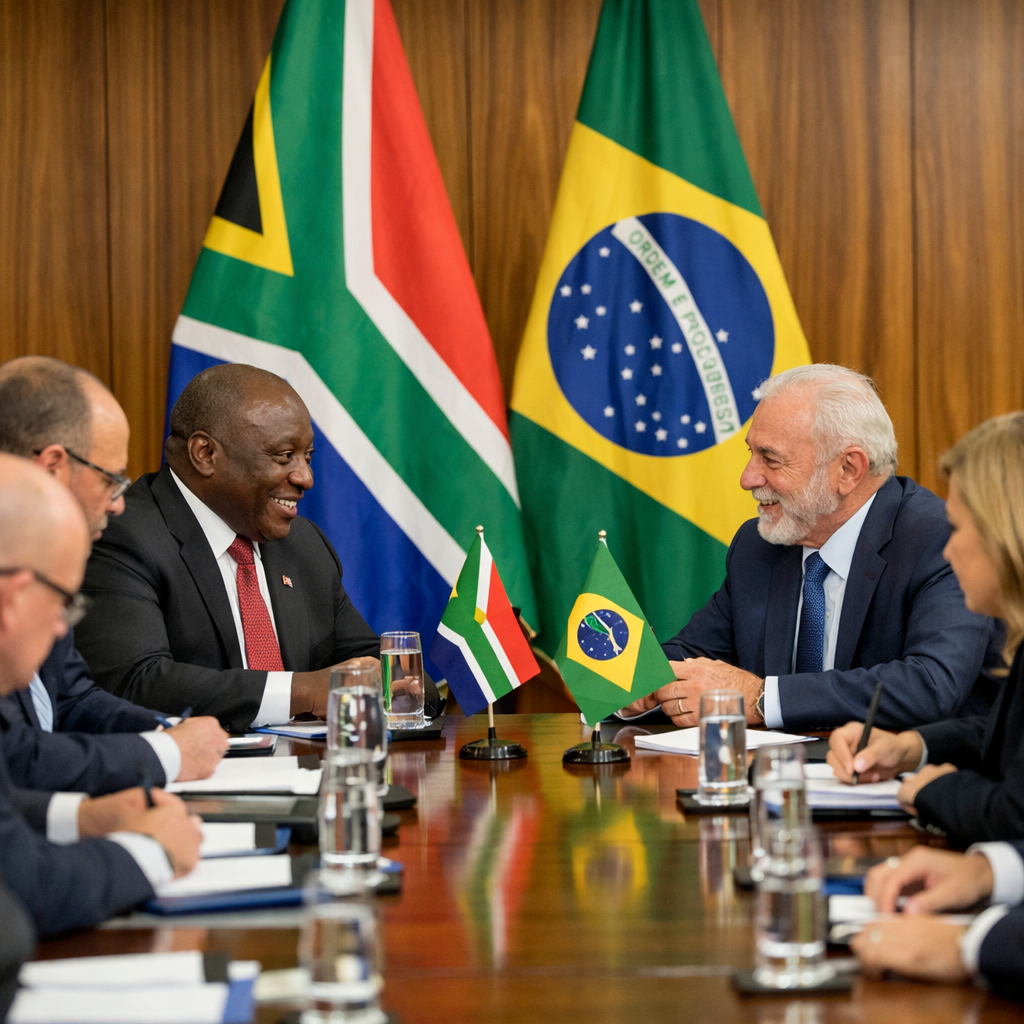

South African President Cyril Ramaphosa began a two-day state visit to Brazil on 9–10 March 2026 at the invitation of Brazilian President Luiz Inácio Lula da Silva, marking a renewed push to deepen bilateral trade, industrial cooperation, and political coordination between two of the largest economies in the Global South.
The visit, confirmed by the South African Presidency in an official statement, includes high-level meetings between the two heads of state and senior government delegations to review cooperation across trade, energy, agriculture, and multilateral diplomacy.
Both countries are founding members of BRICS and the G20, and the meeting is expected to strengthen economic alignment between Africa and Latin America at a time when emerging economies are seeking to diversify trade flows and build new industrial supply chains.
Strategic South-South Trade Alignment
South Africa and Brazil maintain one of the most established diplomatic relationships between Africa and Latin America, built on decades of cooperation in multilateral institutions and South-South economic collaboration.
The state visit is designed to accelerate practical economic outcomes in areas including:
- Agriculture and food production cooperation
- Energy and industrial technology partnerships
- Trade and investment facilitation
- Scientific and technological collaboration
Officials from both governments have indicated that bilateral engagements will focus on unlocking new opportunities for businesses and investors operating across the two markets.
The diplomatic engagement is particularly significant given Brazil’s position as the largest economy in Latin America and South Africa’s role as Africa’s most industrialised economy, making the partnership a key bridge between the two regions.
Mobility, Tourism, and Business Connectivity
Beyond industrial cooperation, mobility and tourism facilitation are also expected to feature prominently in the discussions.
Officials have highlighted the recent rebound in air connectivity between Johannesburg and São Paulo, as well as Brazil’s inclusion on South Africa’s 90-day visa-exemption list, both of which support growing travel, business exchange, and tourism flows between the two countries.
Improved travel access is increasingly viewed by policymakers as a practical step toward strengthening cross-continental trade and investment, particularly in sectors such as aviation, services, tourism, and professional exchange.
Why This Matters for Global Capital
For investors and multinational companies, the Ramaphosa-Lula engagement signals continued momentum behind South-South economic integration, an area attracting increasing strategic attention from emerging market policymakers.
Brazil and South Africa collectively represent:
- Two major commodity and agricultural exporters
- Large industrial manufacturing bases
- Significant consumer markets
- Key political actors in BRICS and G20 economic governance
Strengthening bilateral cooperation between the two economies has the potential to open new investment channels in energy, agribusiness, infrastructure, and advanced manufacturing, while also reinforcing diplomatic coordination across emerging market alliances.
The outcomes of the visit will likely shape the next phase of Brazil–South Africa cooperation within BRICS economic initiatives, as well as broader trade engagement between Africa and Latin America.