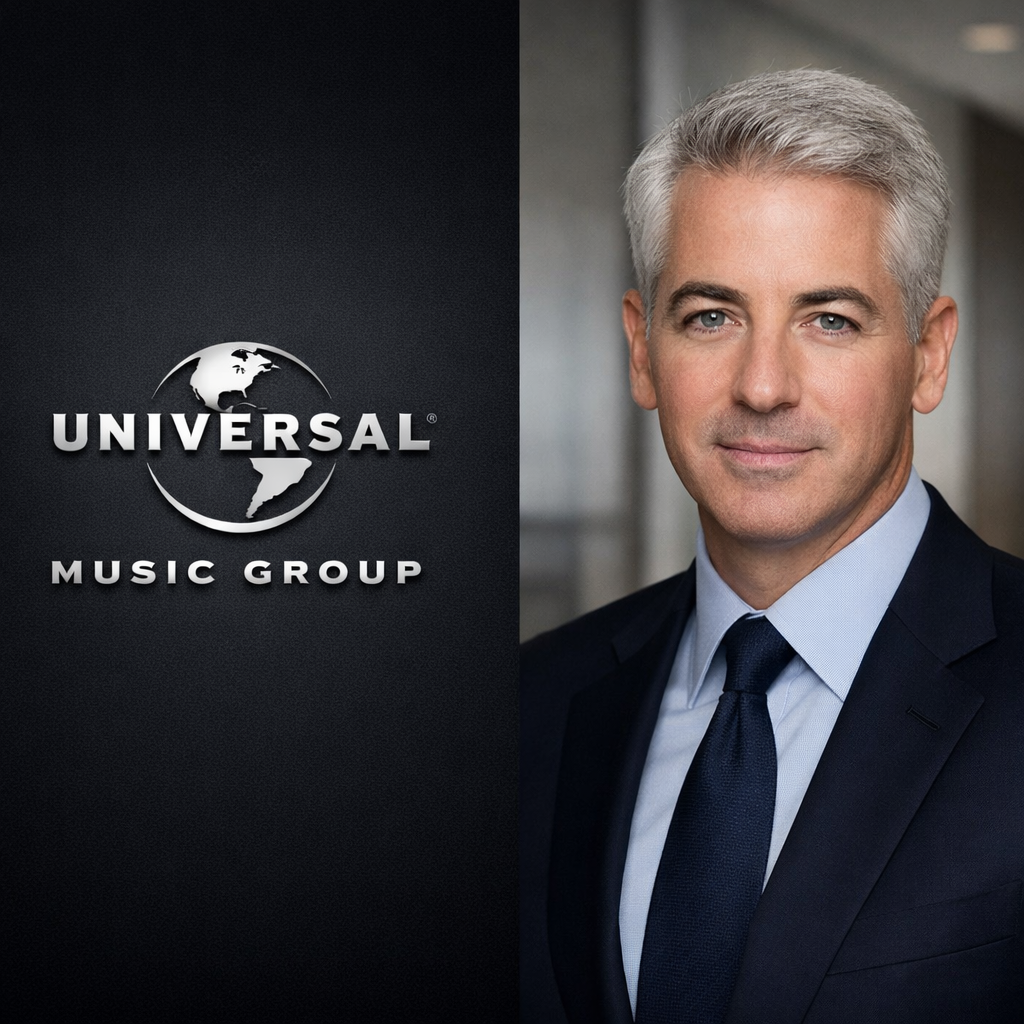

Bill Ackman has moved. On Tuesday, April 7, 2026, Pershing Square Capital Management formally proposed a takeover of Universal Music Group, the Amsterdam-listed label behind Taylor Swift, Billie Eilish, and Kendrick Lamar, in a deal valued at approximately $64.31 billion. The offer represents a 78 percent premium to UMG’s last closing price and marks the most aggressive capital manoeuvre of Ackman’s five-year pursuit of the company.
The proposal, submitted via Pershing Square SPARC Holdings, Ackman’s dedicated acquisition vehicle, offers €30.40 per share, against a prior close of €17.10. The plan values the Amsterdam-listed group at €56 billion and anticipates a merger that would redomicile UMG as a Nevada corporation listed on the New York Stock Exchange.
A Five-Year Campaign Reaches Its Apex
Ackman first set his sights on Universal Music Group in 2021, when Pershing Square Tontine Holdings — a shell vehicle designed to take a private company public, identified UMG as its primary target. That deal collapsed under heavy US regulatory scrutiny. Rather than walk away, Ackman repositioned: Pershing bought a 10 percent stake in UMG from Vivendi ahead of its 2021 Amsterdam IPO and Ackman took a board seat, which he relinquished last year. Pershing Square currently holds a 4.7 percent stake, ranking it as UMG’s fourth-largest shareholder.
The shift from board participant to outright acquirer signals a deliberate escalation in strategy. Ackman is no longer content to nudge from within. He is positioning to own.
The Capital Thesis
Ackman contends that UMG’s share price has failed to reflect its operational strength, pointing to what he characterises as an underutilised balance sheet. His proposal outlines plans to unlock €15 billion over five years through more efficient capital deployment, covering acquisitions, investments, and share buybacks. He has been particularly critical of management’s handling of UMG’s €2.7 billion investment in Spotify Technology.
UMG’s shares have lost almost a third of their value since its 2021 IPO, even as global music revenues have continued to grow year after year. Ackman’s argument is that the discount is structural and correctable — not a reflection of the underlying business. The proposed New York listing, he believes, would attract index fund capital and improve liquidity in ways Amsterdam simply cannot replicate.
Governance Ambitions
The proposal includes significant governance reform. Former Walt Disney president Michael Ovitz, who managed the careers of Madonna and Michael Jackson, would become chairman of the new combined entity. Two Pershing Square representatives would also join the board. Ackman has stated that current UMG chief executive Lucian Grainge would remain in his role post-transaction, framing this as a capital and governance intervention rather than a management overhaul.
The approach is notably collaborative for an investor whose reputation was built on adversarial activism. Ackman disclosed that he and Ovitz met Grainge for dinner weeks before the formal submission, and that Grainge encouraged them to put the proposal in writing.
The Structural Obstacle: Bolloré
The deal faces a formidable gatekeeper. French billionaire Vincent Bolloré’s family controls approximately 80 percent of UMG’s voting rights through Bolloré Group, which holds an 18.5 percent equity stake, and Vivendi, which holds 13.4 percent. Tencent is also a significant shareholder. Analyst Nicolas Marmurek of Square Global described the offer as potentially dead on arrival without Bolloré’s endorsement, noting that had the family been aligned, they would already be recommending the transaction.
Neither UMG nor any of its major shareholders had commented publicly on the proposal at time of publication.
Despite the uncertainty, markets responded decisively. UMG shares rose 13 percent on Tuesday, while Bolloré Group climbed 5 percent and Vivendi gained more than 10 percent.
What This Signals
Ackman’s $64 billion bid is not merely a corporate M&A event. It is a statement about where dynastic capital sees value in the creative economy. UMG and the broader major label industry are contending with a dual disruption: streaming platforms capturing an ever-larger share of music economics, and the rise of AI-generated music creating new copyright and revenue challenges.
For Ackman, the discount is the opportunity. A New York-listed UMG, restructured and recapitalised under Pershing Square’s ownership, would be a fundamentally different asset, one accessible to a broader institutional investor base and positioned to deploy capital more aggressively into the next phase of the music industry’s evolution.
Whether the Bolloré family agrees is the only question that matters now.