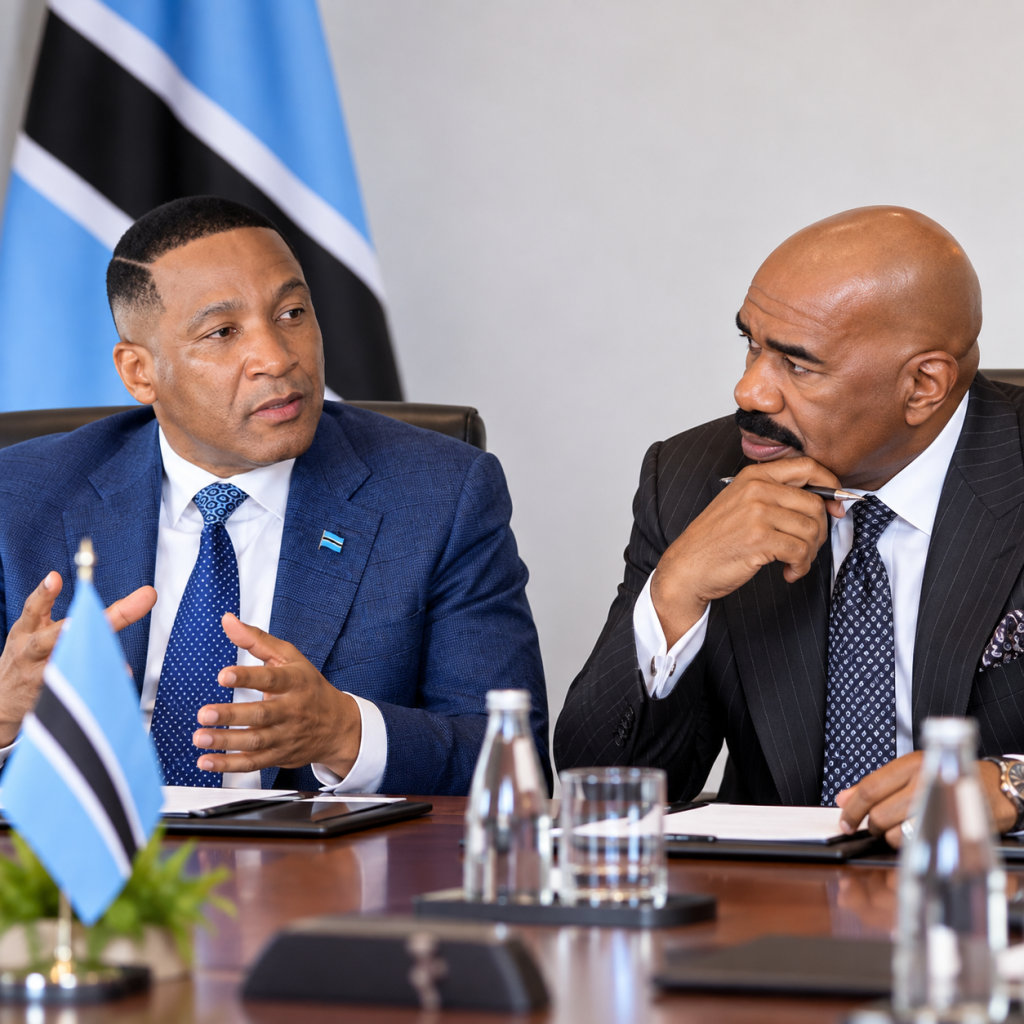

Botswana’s government is facing a strategic decision over the future of its partnership with Steve Harvey Global after President Duma Boko publicly stated that the arrangement could represent a total exposure of approximately P1.7 billion while acknowledging that the agreement remains legally binding.
The disclosure has renewed national discussion around the Botswana Ignite initiative, a programme originally designed to develop the country’s television, film and creative industries through collaboration with Steve Harvey Global. Government officials previously informed Parliament that approximately P355 million had already been paid under the first phase of the project, with contractual deliverables reported as completed.
President Boko has indicated that his administration is assessing available legal and policy options regarding the agreement, while Minister Moeti Mohwasa has confirmed that the contract remains in force as consultations continue with both Steve Harvey Global and stakeholders within Botswana’s creative sector.
A Test of Public Investment Priorities
The debate surrounding Botswana Ignite extends beyond the contract itself.
The broader issue concerns how governments evaluate large-scale investments intended to stimulate creative industries, attract international expertise, and accelerate sector development.
Creative economies worldwide are becoming increasingly important contributors to employment, tourism, digital exports and intellectual property creation. Governments across Africa are therefore exploring different models to strengthen local creative ecosystems and improve global competitiveness.
The Botswana Ignite project was initially positioned as part of that ambition, with objectives that included skills development, industry training and television production capabilities.
The Strategic Question
The challenge now facing Botswana is not simply whether the project should continue.
The more important question is how governments balance long-term development goals with accountability, transparency and value-for-money considerations.
For policymakers across Africa, the situation highlights the growing importance of measuring outcomes rather than inputs.
Large investments are increasingly judged by tangible results such as skills transferred, local enterprises supported, jobs created and sustainable industry growth.
As public finances face pressure across many emerging markets, scrutiny over major development partnerships is likely to increase.
What Decision-Makers Should Watch
Three factors will determine the significance of this case.
First, the legal pathway available to government if changes to the agreement are pursued.
Second, the measurable economic impact already achieved through completed project phases.
Third, the lessons Botswana may apply when designing future partnerships involving international brands, media companies and creative industry development.
Regardless of the eventual outcome, the Botswana Ignite debate has become a case study in how African governments evaluate large-scale innovation and creative economy investments.
The final decision will matter not only for Botswana’s creative sector but also for future public-private partnerships across the continent.