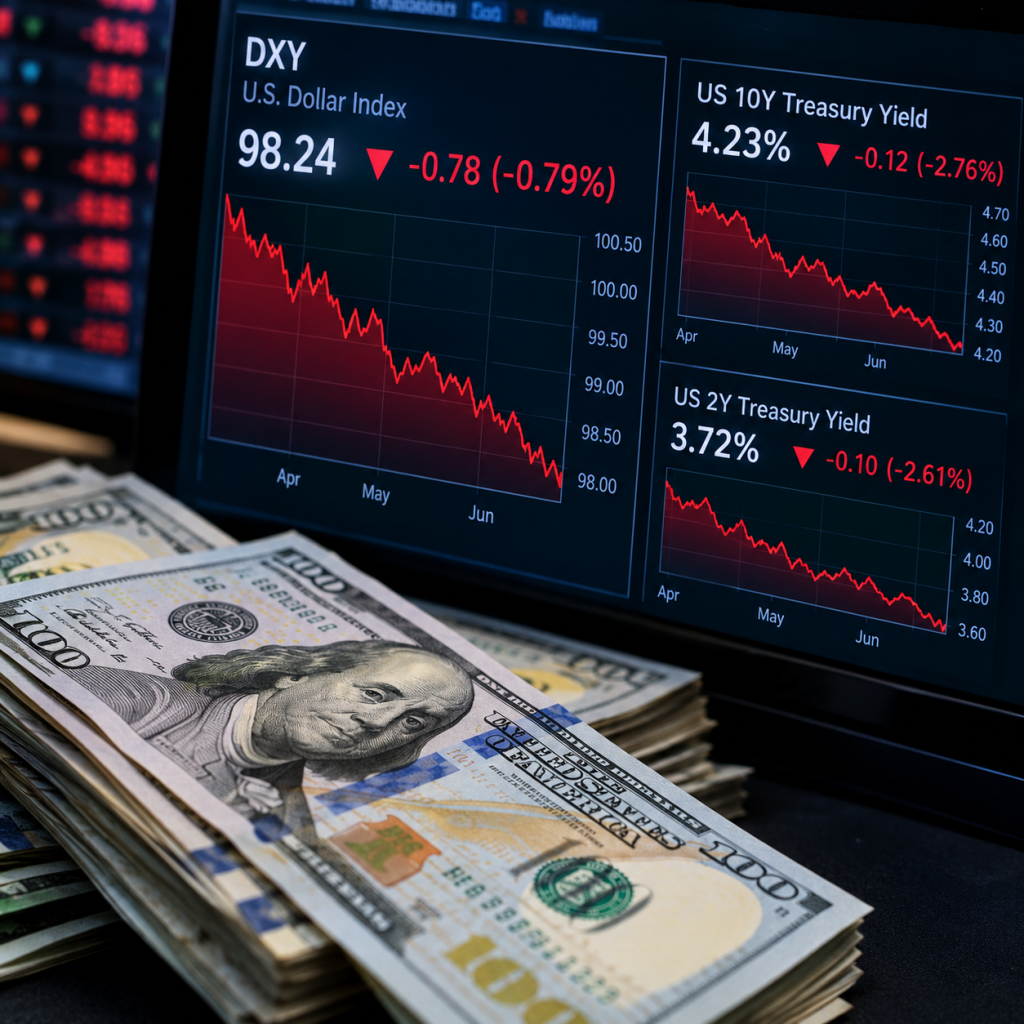

Global currency markets are heading into the end of the week with renewed uncertainty as the US dollar faces its first potential weekly decline in five weeks. Investor concerns over artificial intelligence (AI) infrastructure financing, falling US Treasury yields and changing expectations for Federal Reserve policy are reshaping market positioning.
In a report published on 16 October 2026, Reuters reported that the dollar was on course for its first weekly decline in five weeks as investors reassessed the financial risks surrounding the AI investment boom.
The movement reflects a shift in market priorities. Strong US inflation and retail sales data have supported expectations that interest rates could remain elevated, but concerns over heavily indebted AI infrastructure companies have encouraged investors to seek safer assets.
AI financing concerns trigger a shift towards bonds
The recent sell-off in AI-linked equities has raised questions about whether data-centre operators can generate sufficient returns to justify their substantial spending on computing infrastructure, land and electricity.
Reuters reported on 15 October that fundraising plans for several major AI infrastructure businesses had been delayed, paused or withdrawn as investors became more selective about valuations, borrowing costs and projected revenues.
The developments have consequences beyond technology stocks. Data-centre projects require significant upfront capital, often supported by debt and long-term revenue expectations. If financing costs rise or investors become less confident in future earnings, developers may face more expensive funding, lower valuations and delayed expansion plans.
The shift in sentiment has supported demand for US government bonds. As bond prices rise, yields generally fall, reducing some of the upward pressure on the dollar that had followed stronger inflation data.
Inflation complicates the Federal Reserve outlook
The currency movement comes against a challenging US inflation backdrop.
US producer prices recorded their largest increase in four and a half years in September, according to Reuters reporting published on 15 October. Retail sales also exceeded expectations, reinforcing evidence of resilient consumer demand.
These indicators complicate the Federal Reserve’s policy outlook. Persistent inflation could limit the central bank’s ability to reduce interest rates, while weaker financial-market sentiment and uncertainty around AI investment create competing pressures.
Federal Reserve officials have also signalled that policymakers can wait for greater clarity before making their next decision. This helped reduce market expectations of an immediate October rate increase, according to Reuters.
For investors, the result is a more complicated relationship between economic data and currency performance. Stronger inflation can ordinarily support a currency by increasing expectations of higher interest rates. However, concerns about economic sustainability and financial-market risk can offset that effect.
Why the dollar’s movement matters globally
The US dollar plays a central role in international trade, commodity pricing, cross-border borrowing and investment flows. Changes in its value can influence financing conditions and the cost of imported goods across emerging markets.
For South Africa, movements in the dollar are relevant to the rand, imported fuel costs, commodity prices and foreign investor appetite for domestic bonds and equities. A weaker dollar can provide support to emerging-market currencies under favourable conditions, although the rand’s direction will also depend on domestic economic developments, global risk appetite and commodity-market movements.
A softer dollar does not automatically mean a stronger rand. If investors become more risk-averse, emerging-market assets can still face selling pressure even as the US currency retreats.
Businesses with foreign-currency exposure should therefore monitor exchange rates alongside changes in borrowing costs and energy prices. Importers, exporters and companies with dollar-denominated liabilities may experience different effects from the same market movement.
What the latest market shift signals
The immediate signal is that investors are weighing financial risk more carefully across the AI investment cycle. Demand for AI infrastructure remains an important driver of capital expenditure, but access to funding increasingly depends on whether businesses can demonstrate sustainable revenues and manage their debt obligations.
The next phase of currency and bond-market movements will depend on incoming inflation data, Federal Reserve communications, Treasury yields and evidence of whether the AI-related sell-off deepens or stabilises.
For now, the dollar’s retreat highlights a key market dynamic: strong economic data does not guarantee currency strength when investors are simultaneously reassessing the risks embedded in a major investment boom.