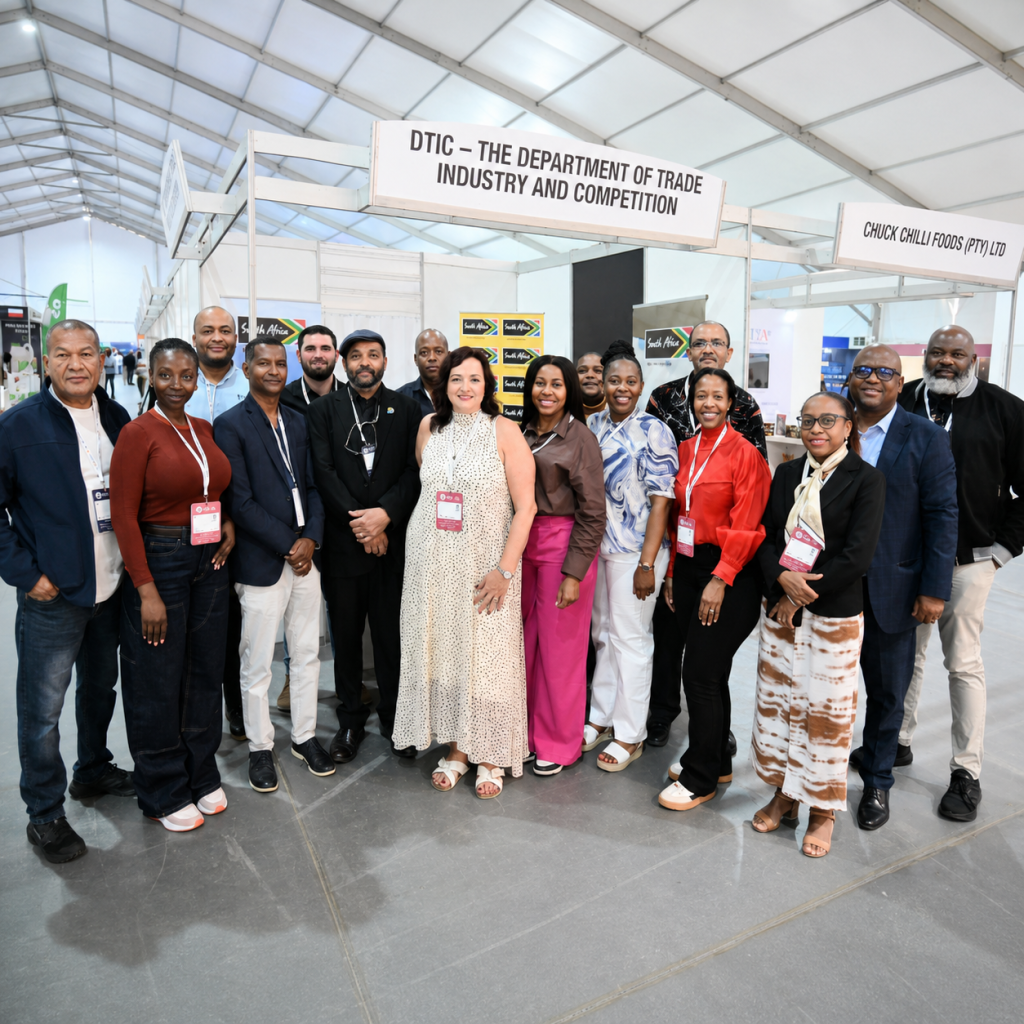

South African food and agro-processing companies have emerged from Angola’s largest international trade exhibition with new distribution, investment and export prospects, strengthening the commercial pathway for locally manufactured food products into Angola and neighbouring African markets.
The Department of Trade, Industry and Competition confirmed on Monday, 27 July, that the South African delegation concluded its participation at Feira Internacional de Angola, or FILDA 2026, with 82 trade leads, meetings with 341 buyers and 55 business-to-business engagements. More than 2,000 visitors passed through the South African pavilion during the exhibition, which ran in Luanda from 21 to 26 July.
The delegation included companies from agro-processing alongside steel fabrication, engineering, mining and chemicals, with the government supporting participating exporters as part of its strategy to expand South African products into African markets.
Food Producers Target Angola and Regional Distribution
For South Africa’s food industry, one of the most significant outcomes was the interest generated by Eastern Cape-based Analit Africa Consumer Brands, which manufactures food brands in-house alongside organic premium skincare products.
Founder and Brand Development Executive Lungisa Lutshaba said the company identified prospective distributors and commercial partners interested in both establishing relationships and potentially investing in the business.
The company also held discussions with a major bank that requested a business plan, while retailers and packaging companies expressed interest in further engagement.
The development moves the opportunity beyond simply displaying South African products at an international exhibition. Distribution partnerships, packaging relationships and retailer engagement are critical components of the infrastructure required to establish sustainable food exports in a new market.
Angola Could Become a Gateway for South African Products
South African producer La RicMal Wines also reported strong interest from Angolan importers and distributors, with owner Malcolm Green pointing to product quality, pricing and packaging as factors behind the response.
Importantly, the commercial interest extended beyond Angola itself.
Green said businesses operating in Angola and serving the Democratic Republic of Congo, Zambia and Namibia had shown interest, potentially creating a route through which South African products entering Angola could subsequently reach additional regional markets.
That regional dimension matters for South Africa’s broader agro-processing sector.
Rather than treating individual African countries as isolated export destinations, producers able to secure relationships with distributors operating across several markets can potentially build wider supply networks from a single commercial entry point.
Government Support Targets Export Expansion
The dtic supported South African companies participating at FILDA through its Export Marketing and Investment Assistance programme, which is designed to develop export markets for South African goods and services and attract foreign investment.
Ahead of the exhibition, the department identified expanded exports, investment attraction and new commercial partnerships as key objectives of the mission. FILDA’s 2025 edition attracted approximately 1,800 companies from 18 countries and generated more than $60 million in business volume, illustrating the scale of the platform South African exporters were targeting.
The latest results provide measurable evidence of the commercial pipeline created in 2026, although the 82 leads announced by government remain prospective opportunities rather than completed contracts.
What It Signals for South Africa’s Food Industry
The immediate significance is the opening of additional routes for South African processed products into Angola.
The longer-term opportunity is larger.
Successful conversion of the leads into distribution and retail agreements would support South Africa’s strategy of exporting more value-added products, connecting domestic manufacturing with growing consumer markets elsewhere on the continent.
For food manufacturers, that means economic value can extend through production, packaging, logistics, distribution and retail rather than ending at the farm gate.
FILDA 2026 has therefore produced a new commercial pipeline. The next test will be execution, specifically how many of the 82 trade leads, 341 buyer engagements and 55 business-to-business meetings translate into orders, distribution agreements, investment and sustained exports.