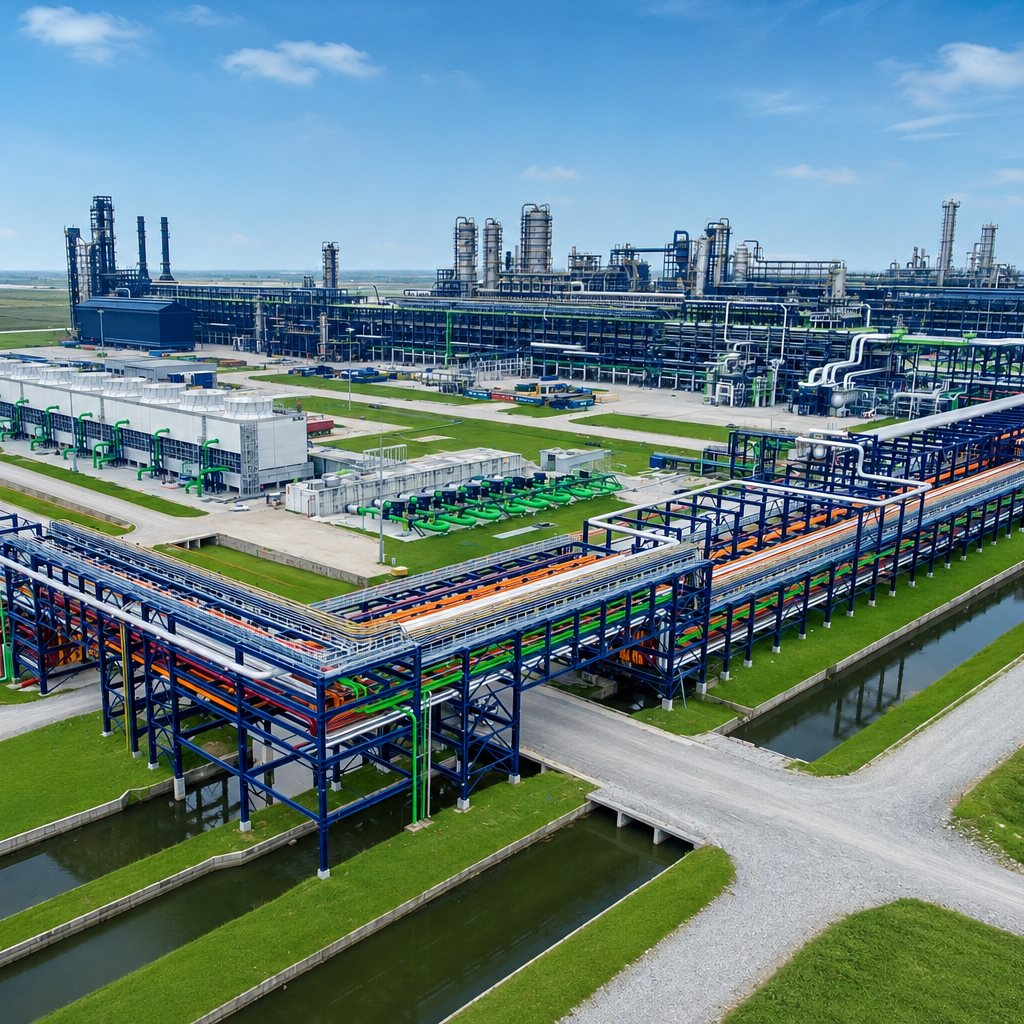

Honeywell Technologies has announced the launch of its Forge Plant Cognition industrial artificial intelligence platform at Nigeria’s Dangote Petroleum Refinery, targeting more than $60 million in annual gross operational benefits when the facility operates at full capacity.
Announced on 26 October 2026, the initiative brings together Honeywell’s industrial process expertise, NVIDIA’s AI capabilities and Dell Technologies’ computing infrastructure to improve refinery performance. The deployment places advanced AI technology directly into one of Africa’s most strategically significant industrial facilities.
Honeywell estimates that AI-enabled optimisation could deliver operational benefits exceeding $0.29 per barrel processed at the Lekki refinery. At full-capacity throughput, the company estimates that these gains could exceed $60 million annually for the facility. The figures are preliminary estimates, not guaranteed financial outcomes, and exclude implementation costs. Actual results will depend on operating conditions, equipment configuration, data quality and other factors.
How the Industrial AI Platform Works
Forge Plant Cognition is designed to integrate operational data, industrial automation, engineering expertise and AI-powered analysis to identify production constraints and improve decision-making.
Unlike conventional monitoring systems that primarily report operating conditions, the platform is designed to help operators identify bottlenecks, anticipate equipment or process problems and translate analytical insights into actions that improve plant performance.
The technology targets three main operational priorities: improving throughput and product yield, reducing unplanned downtime, and making specialised engineering knowledge more accessible to plant operators and technical teams.
The system is powered by Dell AI Factory infrastructure with NVIDIA, including AI models and simulation technologies designed to support operational analysis, anomaly detection and digital-twin-based planning. These capabilities are intended to help refinery teams evaluate operating scenarios and identify opportunities to improve efficiency.
Honeywell and Dangote have positioned the initiative as an extension of their existing industrial relationship, with the technology intended to improve the performance of existing assets rather than relying exclusively on additional physical infrastructure.
Why the $60 Million Estimate Matters
For large industrial operators, even modest improvements in processing efficiency can translate into substantial financial gains when applied across high-volume operations.
The estimated benefit at Dangote’s refinery illustrates the commercial case for deploying AI in environments where small changes in throughput, energy use, production yield or equipment reliability can affect operating margins.
The potential return is particularly relevant to refining and petrochemicals, where interconnected production processes make it difficult to optimise individual operations in isolation. AI systems that combine plant data with engineering models can help operators identify constraints that conventional monitoring tools may not reveal as quickly.
However, the projected $60 million represents gross operational benefits rather than net profit. The financial outcome will depend on the platform’s realised performance, implementation expenses and the refinery’s operating conditions.
Building Industrial Capability in Nigeria
The initiative also has a workforce development dimension. Dangote Petroleum Refinery has stated that the platform will help engineers and operators access specialised process knowledge, accelerate troubleshooting and make more informed operational decisions.
The refinery has also identified workforce development as a strategic priority, including a goal of building a workforce that is 70% Nigerian. AI-assisted engineering tools could support that objective by helping local teams build technical capabilities while operating complex industrial infrastructure.
This matters beyond one facility. The ability to combine advanced automation with local technical expertise is increasingly important for African industrial operators seeking to expand capacity, improve productivity and strengthen operational independence.
What It Signals for Industrial Technology
The announcement highlights a shift in industrial AI from isolated analytics towards systems integrated with real operating environments.
For refinery operators, manufacturers and other asset-intensive businesses, the commercial question is no longer simply whether AI can analyse industrial data. It is whether that intelligence can consistently improve production, reduce downtime and generate measurable returns.
Honeywell’s initiative at Dangote provides a concrete example of how technology providers, AI infrastructure companies and industrial operators are combining capabilities to pursue those outcomes.
The next measure of success will be verified operational performance. If the projected benefits materialise, the project could strengthen the business case for similar AI deployments across refining, petrochemicals and other complex industrial operations.
For Africa, the strategic opportunity is to translate advanced technology adoption into higher industrial productivity, stronger technical capabilities and greater value from existing infrastructure.
The central test is execution: whether AI can turn operational data into sustained, measurable improvements in industrial performance.
Source note: Based on Honeywell Technologies’ official announcement dated 26 October 2026 and contemporaneous reporting by Reuters. Financial projections are attributed to the company and should not be presented as realised savings.