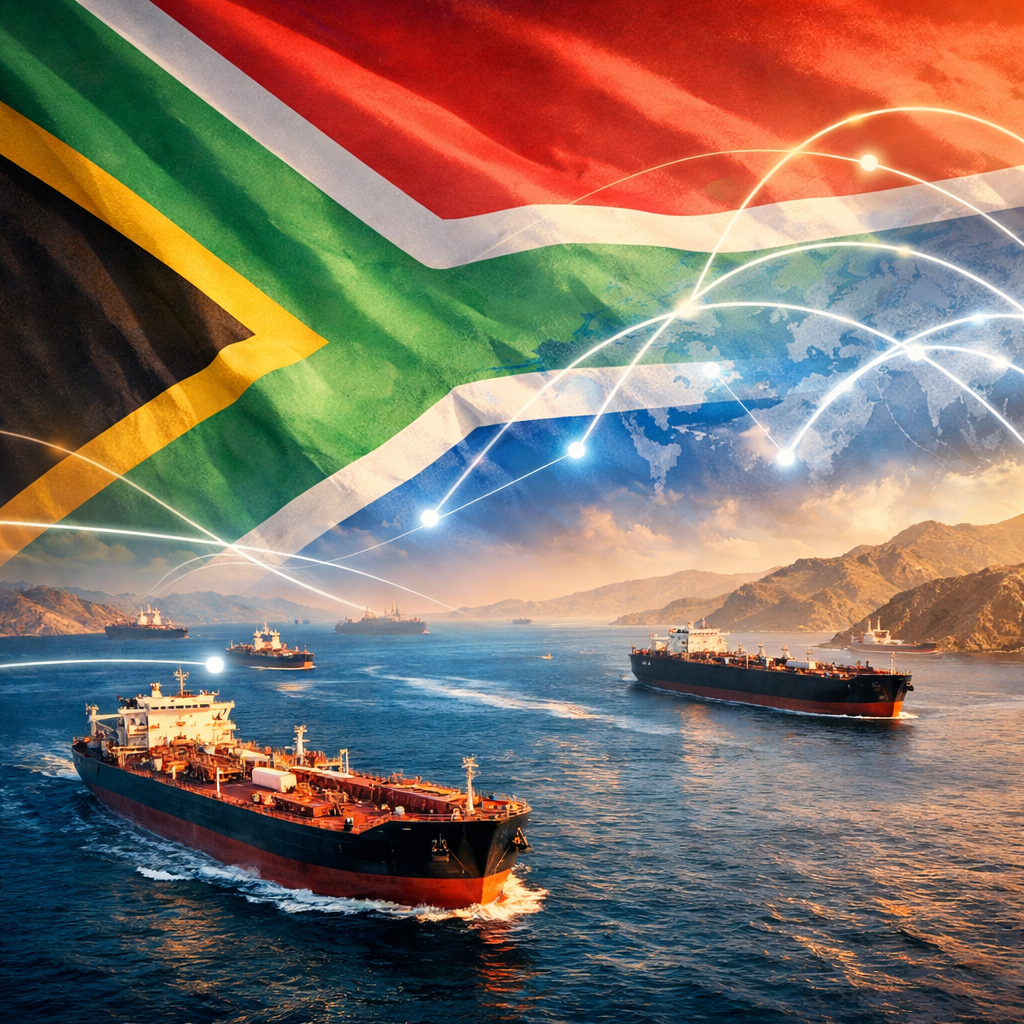

South Africa’s neutral positioning in global trade corridors is emerging as a strategic advantage, as renewed tensions around the Strait of Hormuz begin to influence shipping risk pricing and energy market sentiment in March 2026.
While no formal restrictions or exemptions have been officially confirmed, market participants are increasingly factoring differentiated geopolitical risk exposure into shipping and insurance decisions — a shift that places neutral trading nations like South Africa in a more favorable position.
Market Reaction: Risk Premiums Begin to Differentiate
Energy and shipping markets have started to reflect early-stage repricing:
- Oil price volatility has increased, driven by chokepoint sensitivity
- War risk insurance premiums are adjusting based on vessel exposure
- Shipping operators are reassessing routes and affiliations
In this environment, vessels linked to countries perceived as non-aligned face relatively lower scrutiny and operational friction.
Trigger: Rising Sensitivity Around Hormuz Transit
The Strait of Hormuz remains one of the world’s most critical oil transit routes, handling a significant share of global energy flows.
Recent geopolitical signaling in the region has reinforced:
- The strategic importance of diplomatic alignment
- The growing role of political neutrality in trade continuity
- The market’s responsiveness to perceived access risks
Even without formal policy shifts, the perception of selective access risk is enough to influence capital and logistics decisions.
South Africa’s Position: Trade Continuity Advantage
South Africa’s established diplomatic and trade relationships across multiple global blocs are now translating into practical trade advantages.
For South African-linked cargo:
- Lower perceived geopolitical friction
- Reduced likelihood of disruption in sensitive corridors
- More stable insurance and routing conditions
This positions the country as a reliable participant in global trade flows, particularly in energy and bulk commodities.
Capital and Trade Implications
The implications extend beyond shipping into broader economic positioning:
- Import Stability: More predictable access to energy shipments
- Cost Efficiency: Reduced exposure to extreme insurance premiums
- Trade Competitiveness: Improved reliability in global supply chains
- Investor Confidence: Stability in external trade routes supports macro outlook
In a market environment increasingly shaped by geopolitical alignment, neutrality is becoming an economic asset.
What It Signals for Markets
The current developments reinforce a critical shift in global markets:
Trade routes are no longer purely logistical — they are geopolitical assets.
For investors and policymakers, this signals:
- Increased importance of diplomatic positioning in trade strategy
- Growing divergence in shipping costs based on geopolitical alignment
- Structural integration of political risk into commodity pricing
South Africa’s position, in this context, reflects a broader opportunity:
To leverage neutrality into sustained trade reliability and economic advantage.