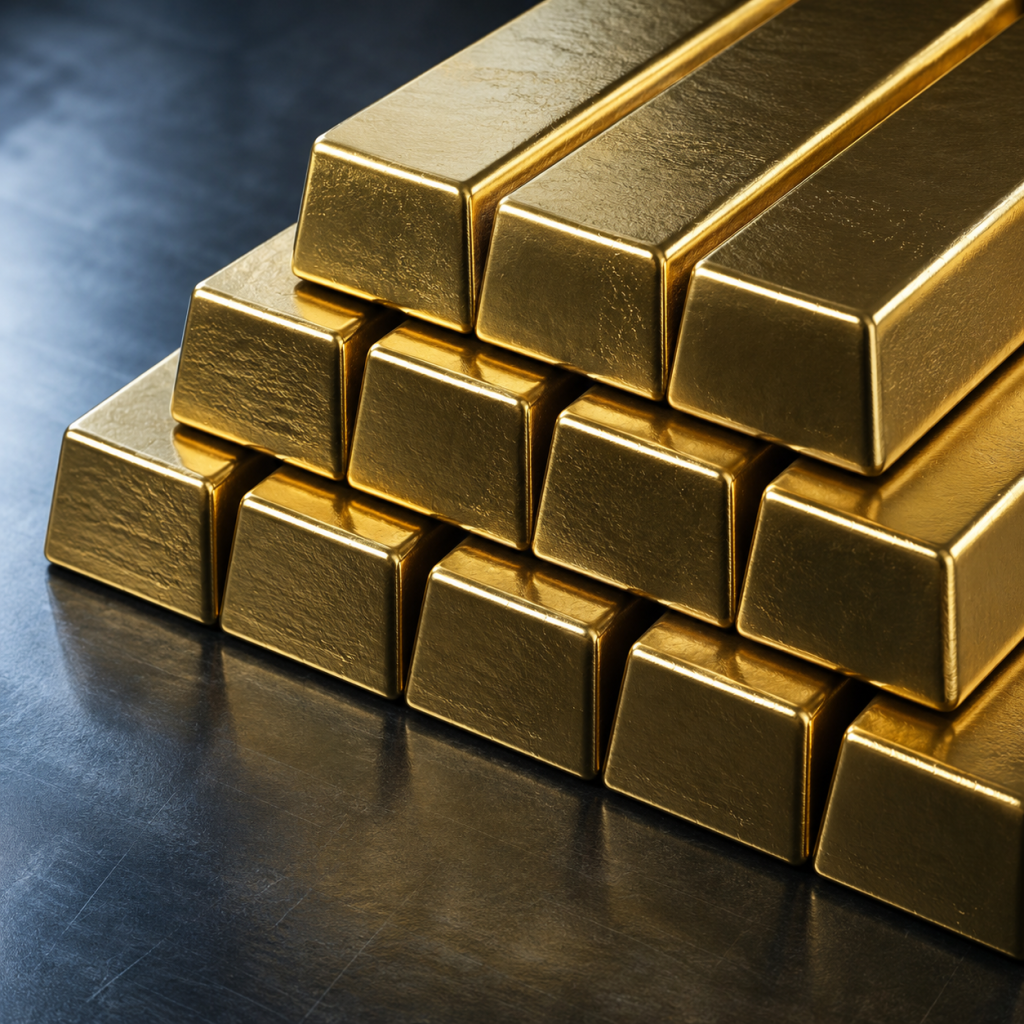

Gold closed at its lowest level in six weeks on Friday, June 20, retreating to $4,150 per troy ounce as a hawkish pivot by the Federal Reserve, a surging US dollar, and a collapsed diplomatic schedule aligned to strip the precious metal of its remaining near-term support.
The decline extended gold’s third consecutive weekly loss, placing the metal roughly 26 percent below its January all-time high of $5,589, and deepening what has become one of the most significant reversals in bullion’s multi-year bull run.
What Moved
Gold fell to $4,150 per ounce on Friday, its lowest level since June 11, and was on track for a third consecutive weekly decline as a stronger US dollar and rising expectations for tighter monetary policy weighed on demand.
The sell-off was not driven by a single catalyst. It was the convergence of three distinct forces arriving in the same trading window.
What Triggered the Move
The first trigger came from the Federal Reserve. The dollar climbed to a one-year high after the Federal Reserve left interest rates unchanged but signaled a more hawkish outlook. Nine of the Fed’s 19 policymakers now expect at least one rate hike later this year, while markets currently assign a roughly 70 percent probability of a rate increase by September.
Chair Kevin Warsh, leading his first FOMC meeting, delivered a statement that was shorter and more hawkish than the market anticipated. Officials altered their views on the economy, raising their outlook on inflation for 2026 to 3.6 percent on headline and 3.3 percent for core, which excludes food and energy. At the last update in March, committee members anticipated 2.7 percent rates for both measures. The removal of any easing bias from the post-meeting statement sent Treasury yields higher and pulled capital toward the dollar, raising the opportunity cost of holding non-yielding bullion.
The second trigger was a significant institutional rerating. Goldman Sachs lowered its year-end gold price forecast to $4,900 per ounce from $5,400 previously. The revision is material. Goldman had held its $5,400 target through weeks of geopolitical turbulence and inflation volatility. Walking it back signals that the bank’s conviction in a near-term recovery has narrowed, at least until the inflation and rate trajectory becomes clearer.
The third trigger was diplomatic. The decline came despite ongoing geopolitical uncertainty after Switzerland announced that the planned US-Iran talks would not take place on Friday. The collapse of the Geneva meeting, which had been expected to serve as the formal signing ceremony for the US-Iran interim peace agreement, removed a near-term resolution catalyst and increased uncertainty around both energy price trajectories and broader geopolitical risk premiums.
Why It Matters
Gold’s relationship to the current macro environment is more complex than at any point in recent memory. The metal has simultaneously lost its safe-haven premium, as the Iran peace framework reduced tail-risk demand, and its inflation-hedge premium, as higher real yields and a stronger dollar have made Treasuries comparatively more attractive.
Gold is down 25 percent from its January 28 all-time high of $5,589 and has closed below its 200-day moving average for the first time since October 2023. That technical breach matters to institutional positioning. Funds that use the 200-day moving average as a trend filter are now technically justified in reducing exposure, compounding the selling pressure.
Greg Shearer, head of Base and Precious Metals at JP Morgan, described gold as stuck “in a bit of a technical no-man’s land,” adding that “amid this sideways plod, and with growing worries that the Fed might have to respond to energy-driven inflation with hikes, gold is on the back burner for most investors at the moment.”
Central bank demand, which had been the structural floor beneath gold’s multi-year bull market, has also moderated. Central banks sold 129 tonnes of gold in the first quarter of the year, headlined by Turkey’s sale of 60 tonnes in March, while net reported purchases amounted to only 16 tonnes, a sharp drop in momentum. China has continued buying, but the pace has not been sufficient to offset broader institutional outflows.
What It Signals for Markets
The week ahead is pivotal. The Federal Reserve’s preferred inflation gauge, the Core PCE Price Index for May, is scheduled for release on June 25, alongside US first-quarter GDP data and Initial Jobless Claims. A print that confirms inflation above the Fed’s 2 percent target would likely reinforce the case for tightening and put additional pressure on gold, bond prices, and rate-sensitive equities simultaneously.
The US dollar’s move to a one-year high has direct implications for African and emerging market economies. A stronger greenback tightens financial conditions across commodity-exporting nations, raises the cost of dollar-denominated debt service, and compresses import purchasing power. For South Africa, which is both a significant gold producer and an active participant in international capital markets, the dynamics are material on both sides. A sustained gold price correction reduces rand-denominated revenue flows for the mining sector, while a stronger dollar raises the external financing burden at a time when the country is managing a complex fiscal consolidation path.
The immediate market question is whether the $4,150 level holds as support, or whether the convergence of the hawkish Fed, a stronger dollar, Goldman’s downgrade, and suspended diplomatic progress creates the conditions for a move toward $4,000. Citigroup cut its three-month gold price target to $4,000 and believes there is room for further downside in gold prices.
What is clear is that the environment that drove gold from $3,000 to $5,589, a combination of rate-cut expectations, safe-haven demand, and central bank accumulation, has materially shifted. The next catalyst is data-dependent, and the Core PCE release on June 25 is the most important number on the immediate calendar.