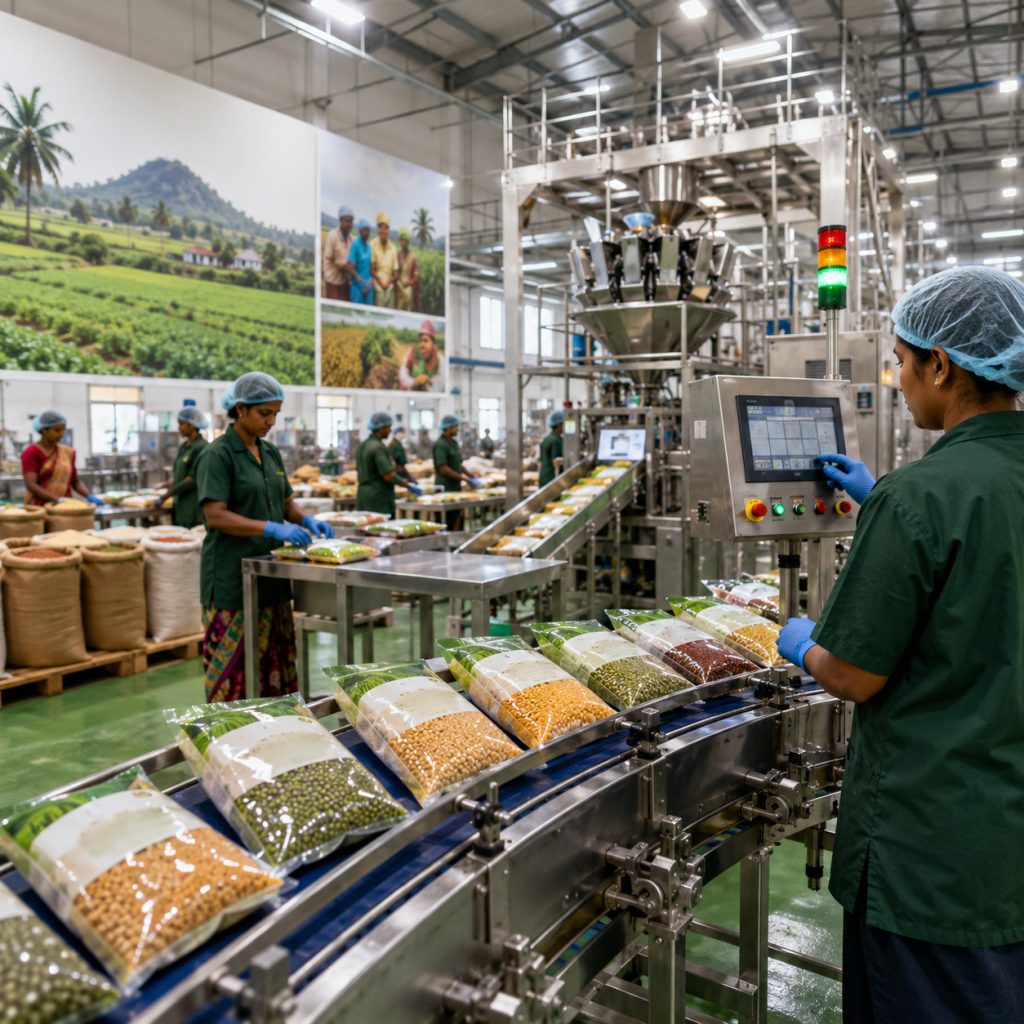

India’s southern state of Karnataka has announced that it has supported more than 10,500 micro food processing units through government-backed programmes, helping generate an estimated 80,000 to 100,000 jobs across the state’s food economy. The update was disclosed by the Karnataka Agro Processing and Export Corporation (KAPPEC) on 23 June 2026.
The development highlights the growing importance of food processing as a driver of agricultural value addition, rural industrialisation, and employment creation in emerging markets.
Expanding the Food Processing Base
According to KAPPEC, the supported enterprises span a wide range of food-processing activities, creating new opportunities for farmers, local entrepreneurs, and small manufacturers to participate in higher-value segments of the food supply chain.
The initiative forms part of a broader effort to strengthen links between agricultural production and consumer markets by encouraging processing capacity closer to production regions.
Rather than relying solely on raw commodity sales, food processing allows agricultural economies to retain greater value domestically through packaging, manufacturing, branding, and distribution.
Employment Impact Reaches Rural Communities
The reported creation of up to 100,000 jobs demonstrates the labour-intensive nature of food processing, particularly among micro and small enterprises operating in rural and semi-urban areas.
Food processing facilities often generate employment beyond factory operations, supporting transportation providers, packaging suppliers, storage operators, distributors, and retail networks.
This multiplier effect is increasingly attracting public-sector support as governments seek scalable models for rural economic development and agricultural transformation.
Strategic Importance for Agricultural Value Chains
The expansion of food processing infrastructure is becoming a critical component of food-system resilience globally.
As agricultural producers face pressure to improve productivity and profitability, investments in processing capacity help reduce post-harvest losses, improve shelf life, and increase market access for producers.
For export-oriented regions, stronger processing capabilities can also enhance competitiveness by enabling higher-value food products to reach international markets instead of exporting raw agricultural commodities.
What It Signals
Karnataka’s latest figures underscore a broader trend across emerging economies: food processing is increasingly being viewed as strategic infrastructure rather than simply manufacturing activity.
The scale of support provided to more than 10,500 enterprises demonstrates how targeted public investment can accelerate industrial growth within agricultural economies while supporting employment, supply-chain development, and food security objectives.
As governments seek to strengthen domestic food systems and create rural jobs, value-added food production is likely to remain a major destination for both public and private investment.