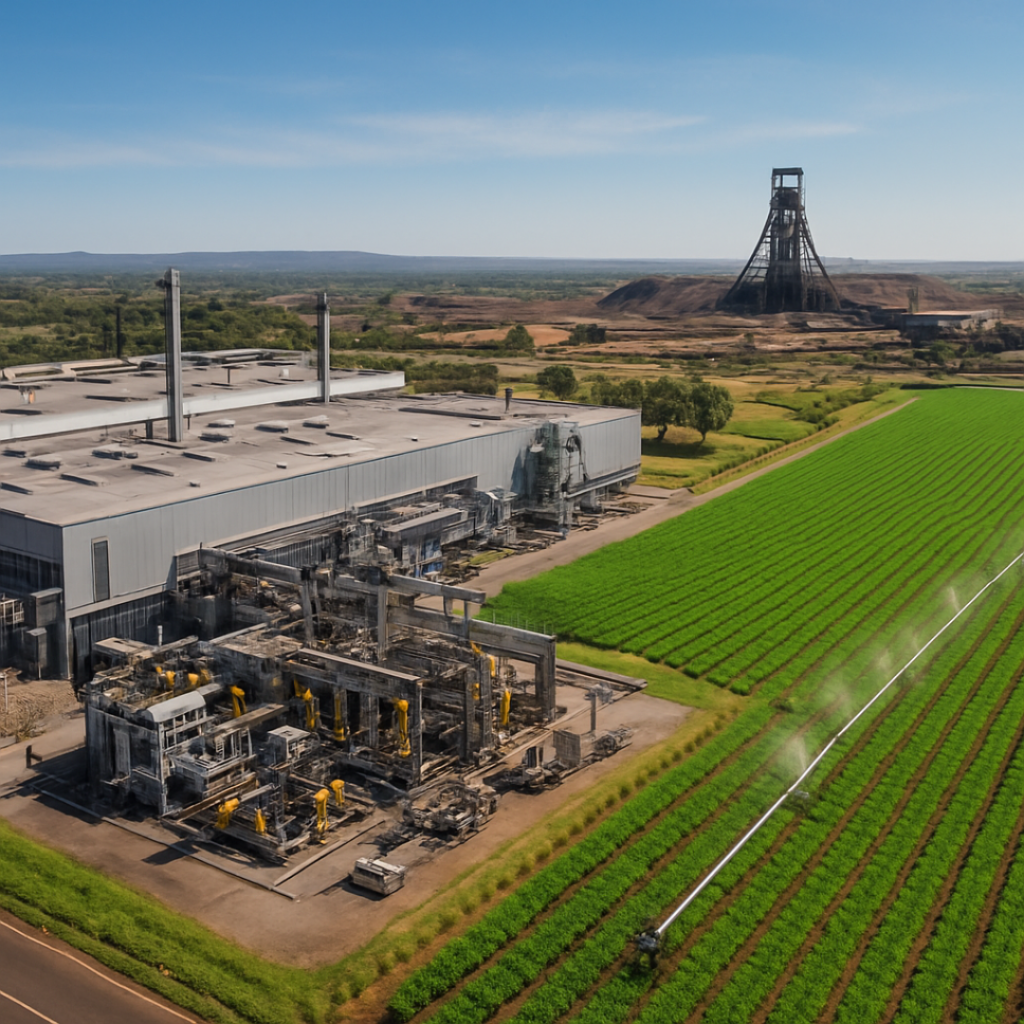

The first week of 2026 has presented a starkly divided industrial landscape in South Africa. While the manufacturing sector is currently navigating its steepest contraction since the 2020 pandemic, the mining and agricultural sectors are showing signs of a robust, weather-driven, and commodity-backed recovery. This “multi-speed” economy is forcing industrial leaders to pivot between defensive consolidation and aggressive expansion as the South African Reserve Bank (SARB) settles into its new 3% inflation anchor.
Manufacturing: Navigating the Deepest Dip
The manufacturing sector enters 2026 in a state of cautious recalibration. The Absa Purchasing Managers’ Index (PMI)plummeted to 42 in late 2025, with critical sub-indices like business activity (36.7) and new sales orders (35.6) hitting five-year lows. Manufacturers have cited high fuel costs and volatile domestic demand as primary inhibitors.
However, there is a silver lining: the outlook index for the next six months has crept back above the neutral 50-point mark to 50.8, suggesting that industrial players are betting on a recovery fueled by lower interest rates and improved port efficiency throughout 2026. The automotive and furniture sectors, in particular, are expected to benefit from the R-CFTL masterplan and recent investments by global anchors like Ford in the Gauteng special economic zones.
Mining: The Commodity Surge
In sharp contrast to manufacturing, South Africa’s mining production has entered 2026 with significant momentum. Output surged by 5.8% year-on-year in late 2025, marking the strongest growth period since early 2024. This rally has been spearheaded by a massive 24.8% spike in iron ore production, alongside steady gains in manganese ore (15.1%)and chromium ore (14.1%).
Gold mining is also undergoing a technological renaissance. Projections indicate that South African gold miners will maintain a 9–10% global production share through 2026 as new technological upgrades and deeper-level resource discoveries come online. The sector is now focused on “unblocking the arteries” of the economy—specifically scaling third-party rail access and securing critical energy corridors to sustain this export-led growth.
Agriculture: A La Niña Windfall
The agricultural sector is perhaps the most optimistic as 2026 dawns. Following a volatile 2024, excellent La Niña-induced rainfall since late 2025 has notably improved soil moisture across the country. Forecasters expect these favorable conditions to persist through February 2026, covering the critical flowering stages for summer crops.
Beyond the weather, the livestock subsector is entering a long-awaited recovery phase. The national foot-and-mouth disease (FMD) vaccination drive for 12 million head of cattle has officially commenced. While the logistics are daunting, the inclusion of domestic private labs in vaccine manufacturing marks a shift toward biosecurity independence. In the horticulture space, high fruit and vegetable yields are expected to drive export growth, provided port efficiency gains at the Western Cape and Durban hubs are maintained.
The Strategic Outlook
The industrial story of 2026 is one of structural reform meeting natural fortune. The successful implementation of Masterplans in poultry, sugar, and steel is beginning to “pull industries back from the brink” by aligning government funding with private sector investment. As the African Continental Free Trade Area (AfCFTA) matures—already accounting for 40% of manufactured exports—the focus for South African industry is shifting from mere survival to continental dominance.