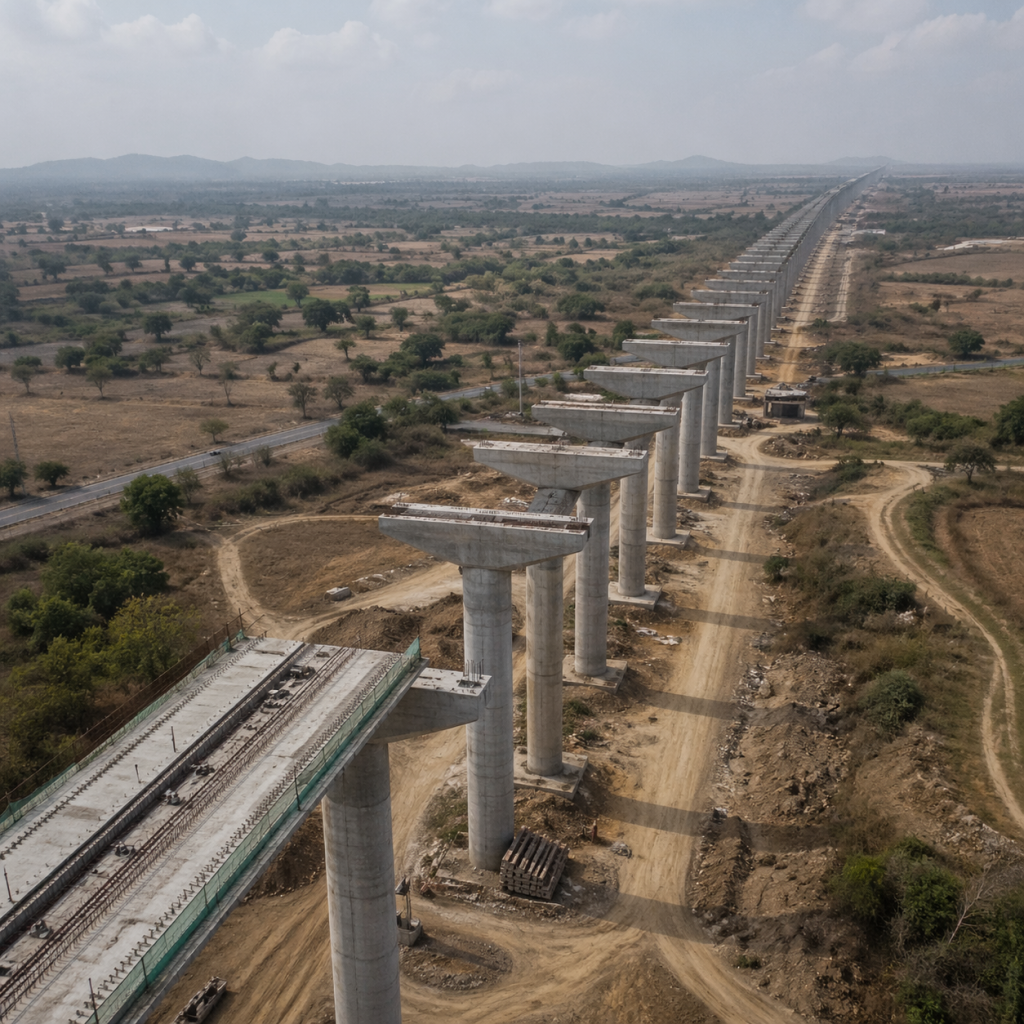

The image circulating across social media is striking in its simplicity: a half-built rail corridor stamped with the word “CANCELLED.” But what it represents is far more complex than a funding dispute between Washington and Sacramento. It is a window into a governing philosophy, one with consequences not just for American commuters, but for every nation watching how the world’s largest economy decides what is worth building.
The Full Scope of the Retreat
This is not a story about $175 million. That figure, a second tranche withdrawn in August 2025, was the closing chapter of a much larger decision. In July 2025, the Trump administration’s Federal Railroad Administration terminated approximately $4 billion in federal funding commitments to the California High-Speed Rail Authority, concluding after a 315-page compliance review that the project had no viable path to completion on its agreed timeline.
By December 2025, California had dropped its legal challenge entirely. The California High-Speed Rail Authority, in formally abandoning the lawsuit, stated that the federal government had proven itself to be neither a reliable nor trustworthy partner. The project now moves forward, if it moves forward, on state funding alone, anchored by a $1 billion annual commitment through 2045 drawn from the state’s cap-and-trade programme, and a bid for private international investment.
That is the current state of play. And it raises a question that extends well beyond California.
The Numbers That Frame the Contradiction
The Trump administration presented the $4 billion withdrawal as fiscal discipline. The framing deserves scrutiny in full context.
The official U.S. Department of Defense budget for FY2025 stands at approximately $886 billion. When Veterans Affairs, nuclear weapons programmes, intelligence agencies, and interest on war debt are included, the true national security expenditure exceeds $1.4 trillion annually. Against that backdrop, $4 billion is not a rounding error, it is a political signal dressed as an accounting decision.
President Trump has since proposed boosting defence spending to $1.5 trillion in his 2027 budget, the largest such request in decades, while simultaneously reducing spending on non-defence domestic programmes by 10%. The same budget cancels more than $15 billion from the Biden-era bipartisan infrastructure law.
Since the September 11 attacks, the U.S. has appropriated and is obligated to spend an estimated $8 trillion on post-9/11 wars. In fiscal year 2026, national defence spending is set to push beyond the $1 trillion mark, an increase of over 13% from the prior year.
The pattern is not ambiguous. War infrastructure is funded. Civilian infrastructure competes for scraps, and loses.
The Governance Question That Transcends Politics
What played out in California is not merely a fight between a Democratic governor and a Republican president. It is a live demonstration of a structural tension every government in the world eventually faces: the allocation of finite public capital between the long horizon of infrastructure and the immediate logic of security spending.
When public trust in institutional capital allocation erodes, it weakens the social contract that makes large-scale public investment politically viable at all. Citizens across political lines are noticing, and that noticing is itself a governance risk. The frustration visible in viral posts and comment threads is not irrational. It reflects a genuine and growing dissonance between what governments say they value and where capital actually flows.
What makes this moment particularly instructive is how it ended. California did not win in court. It did not secure a political reversal. It accepted the loss, reoriented toward private capital, and pressed on. That pivot, from federal dependency to blended finance, is the real story.
What the Global South Should Read in This Moment
For African policymakers, infrastructure ministers, and institutional investors watching this unfold, the lessons extend well beyond American domestic politics.
The first is structural: no government, however wealthy, is immune to the infrastructure trap. When security spending expands and compounds over decades, it crowds out long-duration, low-yield investments that determine a country’s productive capacity a generation from now. Rail, energy grids, ports, and broadband do not register in the electoral cycle. Wars do.
Africa is building its infrastructure architecture right now. The African Development Bank, African Union development frameworks, and bilateral investment corridors from the Gulf to China to Europe are all shaping what the continent’s connective tissue looks like in 2040. The lesson from California’s cancelled federal funding is not that infrastructure fails, it is that infrastructure without politically insulated, long-term funding commitments is perpetually vulnerable to the next administration’s priorities.
The second lesson is institutional. California’s response to losing $4 billion in federal support was to lock in $1 billion per year through a dedicated state mechanism and to go looking for international private partners. That is a model worth studying. Infrastructure anchored in dedicated fiscal mechanisms, levies, ring-fenced funds, blended finance structures, survives political transitions in ways that budget-line allocations simply do not.
South Africa’s Infrastructure Fund, the National Infrastructure Plan, and emerging frameworks across the continent need precisely this kind of structural insulation. Not because the projects are necessarily better than their American counterparts, but because the political economy of delivery is identical: short-term governments making long-term commitments that their successors can cancel.
The Credibility Cost
There is a third dimension to this story that rarely surfaces in fiscal debates: what it costs a nation’s credibility when its infrastructure commitments prove reversible.
After 16 years and roughly $15 billion spent, not one high-speed track had been laid by the California High-Speed Rail Authority at the time the federal funding was terminated. That execution failure, more than the politics, is what gave the administration its rhetorical opening. Cost overruns and missed timelines do not just burn money. They burn the institutional credibility that future infrastructure programmes will need to attract private capital.
This is where Africa’s infrastructure ambitions face their sharpest test. Projects that miss timelines and exceed budgets by significant margins, whether in rail, energy, or logistics, do not just fail on their own terms. They poison the well for the next generation of financing conversations with institutional investors, development finance institutions, and sovereign wealth funds. Execution credibility is not a soft metric. It is the foundation on which capital decisions are made.
The Forward View
California’s rail project will continue, scaled back, privately financed, federally abandoned. But the underlying dynamic it exposed, a superpower systematically defunding civilian infrastructure while expanding its military posture, has consequences that ripple outward.
For emerging markets, it signals that the era of looking to Western public infrastructure as a model is closing. The opportunity and the obligation are shifting: build frameworks that are domestically anchored, institutionally durable, and capable of attracting patient capital from multiple directions.
For decision-makers in Pretoria, Nairobi, Lagos, Accra, and Addis Ababa, the California rail moment is not a cautionary tale about ambition. It is a reminder that ambition without structural protection is temporary, and that the window to build differently, and more durably, is now.