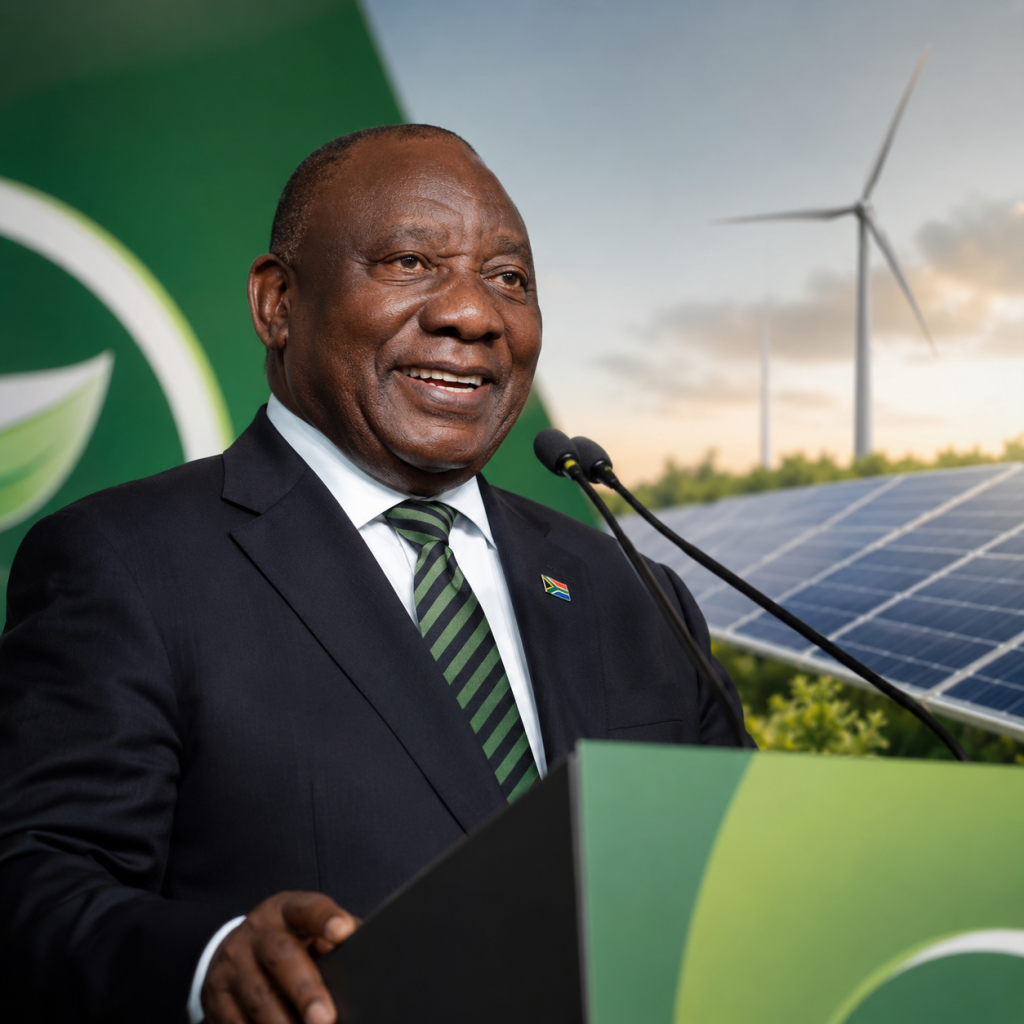

South Africa’s investment story received another significant boost as President Cyril Ramaphosa welcomed Seriti Green’s R10 billion investment commitment during the 6th South Africa Investment Conference. The announcement coincided with the commencement of commercial operations at the Ummbila Emoyeni Wind Energy Facility, demonstrating that previously announced investments are now translating into operational infrastructure.
The event is more than another renewable energy announcement. It represents a broader shift in how South Africa is positioning itself as an investment destination for long-term infrastructure capital.
The Event That Triggered This Analysis
The Presidency announced that Seriti Green has committed R10 billion towards renewable energy investment, while simultaneously celebrating the commercial launch of the Ummbila Emoyeni Wind Energy Facility.
This combination of fresh capital commitment and project execution is important. Markets pay closer attention when investment announcements are supported by completed infrastructure rather than future promises alone.
Why This Matters Beyond Renewable Energy
South Africa’s energy transition has often been discussed primarily through the lens of electricity shortages.
That narrative is increasingly incomplete.
Renewable energy is becoming an industrial investment strategy rather than simply an energy solution.
Large-scale renewable projects stimulate demand across multiple sectors, including engineering, manufacturing, logistics, construction, financial services and digital infrastructure. Every major renewable asset creates an ecosystem of suppliers, contractors and service providers that extends well beyond electricity generation.
As these projects mature, they also improve the country’s investment profile by reducing one of the largest risks previously identified by investors, namely energy security.
The Bigger Shift Investors Should Watch
The significance of Seriti Green’s announcement lies less in the R10 billion itself than in what it represents.
Institutional investors are increasingly directing capital towards jurisdictions capable of delivering bankable renewable infrastructure at scale.
South Africa possesses several structural advantages:
- Excellent wind and solar resources.
- An established financial sector capable of supporting infrastructure finance.
- Growing private sector participation in electricity generation.
- Expanding transmission and energy market reforms.
If execution continues improving, renewable energy could evolve into one of South Africa’s strongest long-term investment sectors alongside mining, financial services and manufacturing.
Challenging Conventional Thinking
For years, discussions around South Africa’s electricity sector have focused almost exclusively on load shedding.
While grid reliability remains important, decision-makers should begin viewing energy infrastructure through a different lens.
Renewable energy is becoming an exportable economic capability.
The country is building expertise in project finance, engineering, environmental management, grid integration and infrastructure development. These capabilities can become competitive advantages across Africa as neighbouring countries pursue similar energy transitions.
In other words, the opportunity extends beyond generating electricity. It includes exporting knowledge, services and investment expertise.
What Could Follow Next
If investment commitments continue converting into operational projects, several developments become increasingly likely:
- Greater international infrastructure investment into South African renewable assets.
- Increased demand for transmission infrastructure upgrades.
- Expansion of battery storage and grid balancing technologies.
- Growth in local manufacturing linked to renewable energy supply chains.
- Stronger participation by pension funds and institutional investors in long-term infrastructure financing.
These developments would deepen capital markets while creating higher-value employment opportunities.
What Decision-Makers Should Understand
The most valuable signal from this announcement is execution.
South Africa’s competitiveness will increasingly depend not on announcing investment commitments, but on consistently converting them into operational infrastructure.
For government, this means maintaining policy certainty and accelerating regulatory processes.
For investors, it highlights a market where infrastructure opportunities are becoming increasingly investable.
For businesses, it signals growing demand across renewable energy supply chains, from engineering and logistics to technology and professional services.
Seriti Green’s R10 billion commitment is therefore more than another investment headline. It reflects a broader transition in which renewable energy is becoming a strategic pillar of South Africa’s long-term economic competitiveness.