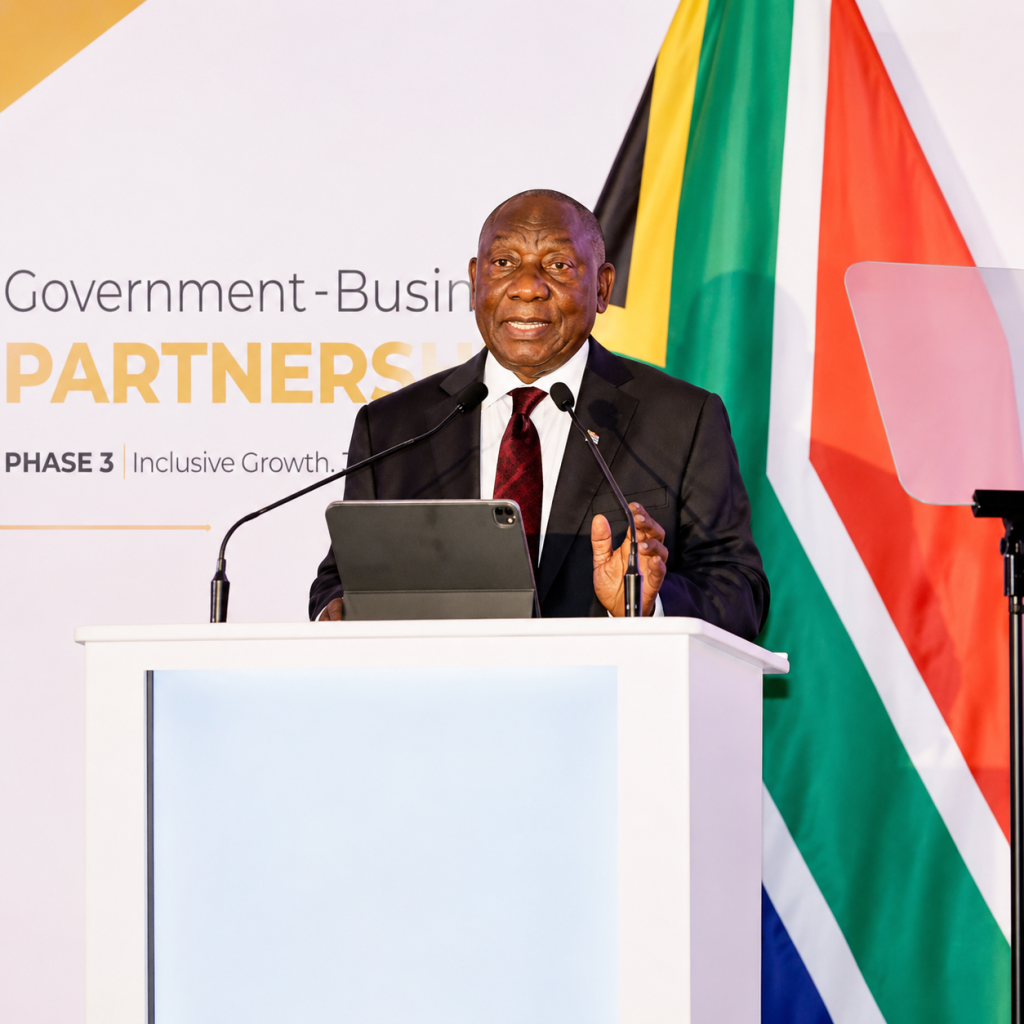

South Africa’s Cabinet this week formally endorsed Phase 3 of the Government-Business Partnership, an initiative designed to attract investment, accelerate economic growth, and support the creation of more than one million jobs by 2030. The announcement was included in Cabinet’s official statement released on 28 August 2026, making it one of the country’s most significant economic policy developments of the past 32 hours.
On the surface, the announcement appears to be another government-business cooperation framework.
The deeper significance is that it may represent the emergence of a fundamentally different model of economic governance in South Africa.
The real question is no longer whether reforms are necessary.
The question is whether South Africa has entered an era where growth is increasingly delivered through coordinated execution between government and the private sector rather than through government action alone.
The Event Behind the Analysis
Cabinet confirmed that Phase 3 of the partnership will focus on expanding energy capacity, improving freight and logistics performance, unlocking investment opportunities, and strengthening investor confidence. Government highlighted progress already achieved through earlier phases, including the end of loadshedding, improvements in rail and port performance, South Africa’s exit from the FATF grey list, and credit rating upgrades from S&P and Fitch.
The significance of the announcement lies not only in the targets being set but in the institutional model being reinforced.
Unlike traditional economic plans, this framework places business leaders, state institutions, and policymakers inside a shared implementation structure.
That distinction matters.
Why This Matters Long Term
Many emerging markets have historically struggled not because of a lack of strategy, but because of a gap between policy design and policy execution.
South Africa’s economy has spent much of the past decade confronting exactly that challenge.
The partnership model seeks to narrow that gap.
Rather than treating business as an external stakeholder, the framework increasingly positions private sector expertise as part of national economic delivery.
If successful, this approach could become one of the most important governance innovations in South Africa’s democratic era.
The long-term prize is not simply higher GDP growth.
It is the creation of a more predictable investment environment where capital deployment becomes less dependent on political cycles and more dependent on institutional collaboration.
For investors, predictability often matters as much as policy.
A Broader Global Trend Is Emerging
South Africa is not operating in isolation.
Across the world, governments are increasingly moving toward partnership-driven economic models.
Infrastructure development, energy transitions, advanced manufacturing, logistics modernization, artificial intelligence deployment, and industrial competitiveness all require levels of capital and expertise that governments alone rarely possess.
The era of purely state-led development strategies is fading.
The most competitive economies are increasingly becoming ecosystems where governments coordinate, businesses invest, and institutions execute together.
South Africa’s latest announcement places the country firmly within that global trend.
The significance is particularly important for Africa.
As infrastructure demands grow and fiscal pressures increase across the continent, collaborative execution models may become more influential than traditional state-led approaches.
The Opportunity Ahead
Cabinet’s statement highlighted major infrastructure ambitions, including nearly R2 trillion worth of projects across various stages of development and implementation. It also pointed to continuing reforms in energy, logistics, tourism, and investment attraction.
These initiatives create a potential multiplier effect.
Improved logistics supports exports.
Expanded energy capacity supports manufacturing.
Tourism growth supports employment.
Infrastructure investment attracts additional private capital.
The strategic value lies in how these systems reinforce one another.
South Africa’s economic opportunity is no longer confined to isolated sectors.
The opportunity increasingly exists within interconnected growth ecosystems.
The Risk Remains Execution
History offers a clear warning.
Economic plans often fail not because objectives are wrong but because implementation weakens over time.
Momentum can fade.
Institutional coordination can deteriorate.
Political priorities can shift.
The true test of Phase 3 will not be measured by announcements, targets, or memorandums.
It will be measured by freight volumes moving through ports, megawatts added to the grid, factories expanding production, investors deploying capital, and workers entering employment.
Execution remains the ultimate economic indicator.
What Decision-Makers Should Understand
Business leaders, investors, policymakers, and development institutions should view this announcement as more than another government programme.
It reflects an increasingly important shift in how economic growth may be delivered in South Africa.
The country’s next phase of competitiveness will likely depend less on policy creation and more on implementation partnerships.
The emerging investment story is therefore not simply reform.
It is coordinated execution.
If Phase 3 achieves its objectives, South Africa could provide one of the strongest examples in the emerging world of how government and business can jointly accelerate growth, rebuild investor confidence, and expand economic opportunity.
That possibility is what makes this week’s Cabinet endorsement strategically important.