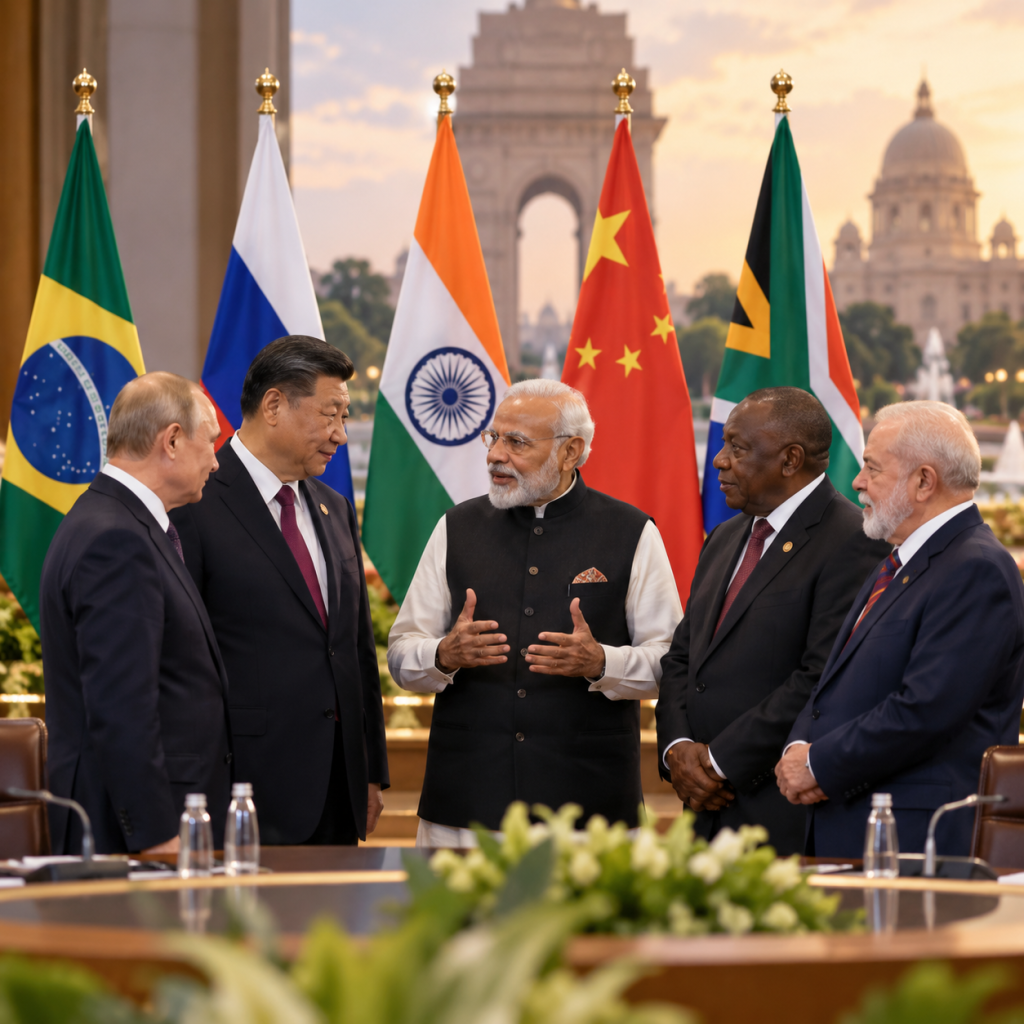

Leaders of the expanded BRICS alliance concluded their summit in New Delhi on 13 September with the approval of a joint declaration that advances cooperation in trade, finance, artificial intelligence, infrastructure and global governance reform, marking one of the most significant diplomatic outcomes for the bloc since its recent expansion.
The agreement was reached by BRICS members including Brazil, Russia, India, China, South Africa, Egypt, Ethiopia, Indonesia, Iran and the United Arab Emirates. The declaration also reflected consensus among a broader group of partner nations participating in the summit.
China Pushes New Economic Initiatives
Chinese President Xi Jinping used the summit to outline a series of proposals designed to deepen economic integration across what Beijing calls “Greater BRICS”. The initiatives include a BRICS AI Open Source Zone, a future Service Trade Forum and a Special Economic Zone partnership framework intended to strengthen investment and commercial links among member states.
The proposals arrive as governments across emerging markets seek to strengthen supply chains, expand digital trade and reduce vulnerability to geopolitical disruptions affecting global commerce.
India Positions BRICS as a Platform for the Global South
Indian Prime Minister Narendra Modi highlighted the need for stronger cooperation among developing economies, citing geopolitical tensions, supply chain shocks and growing competition over technology and critical minerals. The summit declaration called for reforms to international institutions and greater representation for developing nations within global decision-making structures.
For South Africa, the summit aligns with Pretoria’s objective of expanding intra-BRICS trade, attracting investment and mobilising capital for African infrastructure projects linked to the African Continental Free Trade Area.
Diplomatic Breakthrough Amid Regional Tensions
One of the most notable developments was the ability of member states to agree on a common position despite ongoing tensions in the Middle East. Iran and the United Arab Emirates backed a joint statement calling for restraint, de-escalation and protection of civilian populations. The summit also facilitated a high-level meeting between Iranian President Masoud Pezeshkian and Abu Dhabi Crown Prince Sheikh Khaled bin Mohamed bin Zayed.
The diplomatic engagement demonstrated BRICS’ growing ambition to serve as a platform for dialogue among countries with differing geopolitical interests.
Why It Matters
The New Delhi declaration signals that BRICS is evolving beyond a political forum into a more coordinated economic and strategic bloc. The focus on trade facilitation, AI cooperation, financial integration and institutional reform could increase economic connectivity across emerging markets that collectively represent a significant share of global population and economic activity.
For investors, infrastructure developers, technology companies and exporters, the summit points to increased opportunities linked to cross-border trade, digital services, critical minerals and industrial development throughout Africa, Asia, the Middle East and Latin America.
The outcome also reinforces the growing influence of emerging economies in shaping the future architecture of global trade, finance and governance.