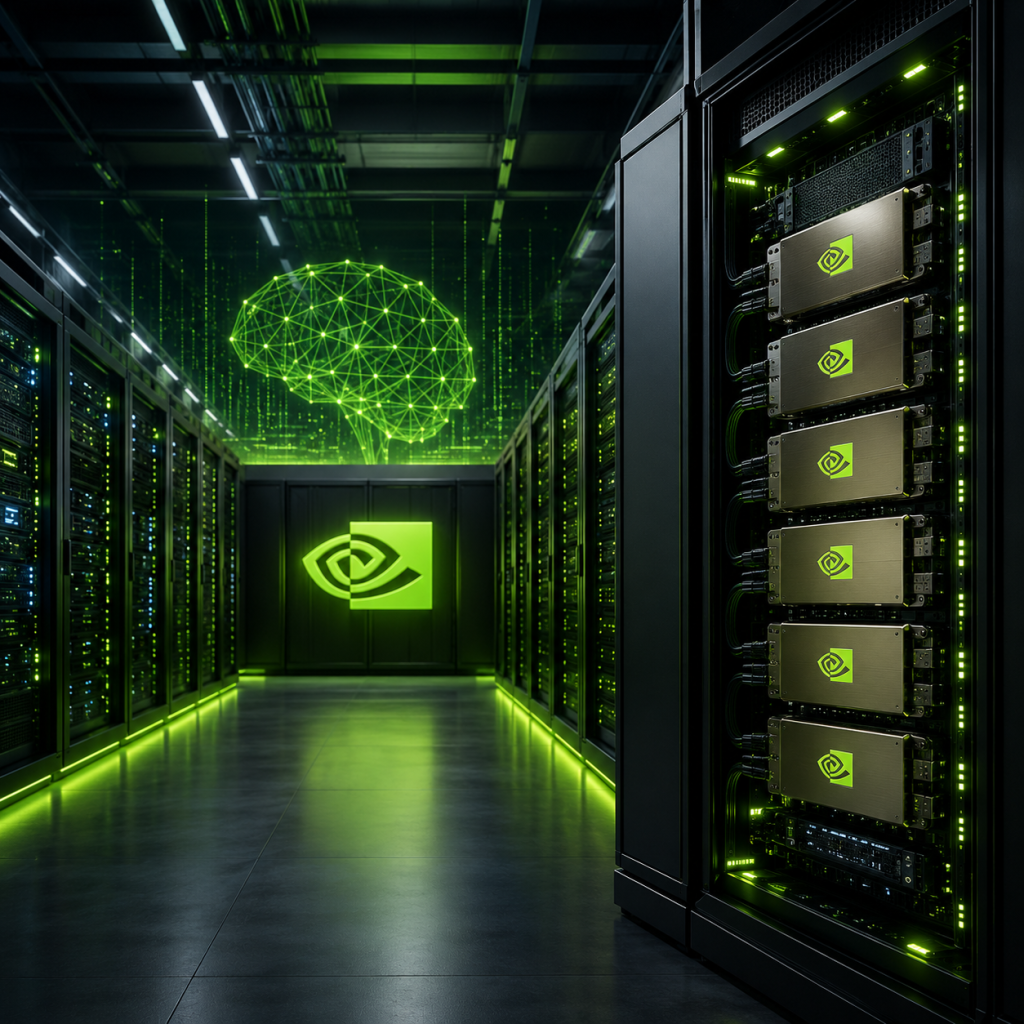

NVIDIA has officially moved its next-generation Vera Rubin AI platform into full production, marking one of the most significant infrastructure deployments in the global artificial intelligence industry this year.
The announcement was made at NVIDIA GTC Taipei on May 31, where the company confirmed that manufacturing partners across Taiwan and its global supply chain network have begun scaling production of Vera Rubin-based systems for AI laboratories, cloud providers, and hyperscale data centre operators.
The deployment represents a major transition from AI experimentation toward industrial-scale AI operations, as technology companies race to build what NVIDIA describes as “AI factories” capable of supporting the next generation of autonomous and agentic AI systems.
AI Infrastructure Moves Into Industrial Scale
According to NVIDIA, Vera Rubin delivers up to ten times the agent processing throughput of the previous Grace Blackwell platform when deployed at scale. The architecture is designed specifically for large AI workloads that require continuous reasoning, automation, and enterprise-level deployment.
The company confirmed that hundreds of ecosystem partners are participating in the production ramp-up, including more than 150 partners in Taiwan alone across over 350 factories operating in 30 countries.
This transforms Vera Rubin from a technology roadmap project into an operational manufacturing programme with global deployment capability.
New Networking Technology Targets Million-GPU AI Systems
A major component of the rollout is NVIDIA Spectrum-X Ethernet Photonics, which has now entered production alongside the Vera Rubin platform.
The technology combines co-packaged optical networking with AI data centre switching infrastructure, allowing operators to connect and scale AI systems across extremely large computing clusters. NVIDIA says the architecture is designed to support future AI facilities containing up to one million GPUs.
The networking layer is becoming increasingly important as enterprises and cloud providers attempt to move beyond isolated AI models and toward interconnected AI agents capable of handling complex operational tasks across entire organisations.
Why the Deployment Matters
The significance of the Vera Rubin production launch extends beyond hardware performance.
The announcement signals that the AI industry is entering a new phase where competitive advantage will increasingly depend on infrastructure scale, deployment speed, energy efficiency, networking capacity, and manufacturing execution.
Global cloud operators, enterprise software providers, financial institutions, industrial manufacturers, and governments are all investing heavily in AI infrastructure capable of supporting production-grade autonomous systems.
For technology markets, the deployment reinforces the growing shift from AI model development toward AI operationalisation, where the winners may be determined less by algorithms and more by the ability to build, deploy, and manage large-scale AI infrastructure reliably.
Implications for Africa and Emerging Markets
For African technology ecosystems, the acceleration of AI factory infrastructure highlights the growing importance of data centre investment, cloud capacity expansion, and digital infrastructure readiness.
As global AI platforms become more powerful and widely deployed, emerging markets that invest in connectivity, cloud infrastructure, and AI-enabled enterprise systems could gain faster access to advanced automation capabilities without needing to build foundational models independently.
The Vera Rubin rollout demonstrates that the next phase of AI competition is increasingly being defined by deployment infrastructure rather than research alone.
With production now underway across multiple countries, the global race to industrialise artificial intelligence has moved into a new operational stage.