
The rapid expansion of artificial intelligence infrastructure emerged as a major strategic theme at Enlit Africa 2026 this week, where industry leaders argued that AI and data centre growth could become a powerful catalyst for renewable energy investment, transmission expansion and private capital mobilisation across Africa. The discussions highlighted a growing view that digital infrastructure should be seen not merely as a technology sector opportunity, but as a driver of broader economic and energy transformation.
For many observers, the immediate story is about data centres. The more important story may be about electricity.
The event signals a potentially significant shift in how Africa’s next generation of infrastructure investment could be financed and developed.
The Event Behind the Analysis
At Enlit Africa 2026, executives from the energy and digital infrastructure sectors highlighted the growing electricity demand associated with artificial intelligence, cloud computing and data centres.
Industry participants argued that AI-related infrastructure could accelerate investment into renewable energy generation, wheeling frameworks and transmission networks. South Africa was repeatedly identified as one of the continent’s strongest candidates for large-scale AI infrastructure due to its fibre connectivity, technical skills base and renewable energy potential.
This discussion arrives at a critical moment.
Globally, AI infrastructure is rapidly becoming one of the largest sources of new electricity demand. Countries that can provide reliable, scalable and competitively priced power are increasingly positioning themselves to attract digital infrastructure investment.
Why This Matters Beyond Technology
Most discussions around artificial intelligence focus on software, models and productivity gains.
The infrastructure reality is different.
AI requires enormous computing capacity. Computing capacity requires data centres. Data centres require electricity.
As a result, the next phase of AI competition may increasingly be determined by energy availability rather than software capability alone.
This creates a unique opportunity for Africa.
Historically, many renewable energy projects struggled to secure sufficient long-term industrial demand to justify large-scale investment. AI infrastructure changes that equation by creating predictable, long-duration electricity demand that investors can model with greater certainty.
The consequence is that data centres may become anchor customers for renewable energy projects, transmission upgrades and battery storage deployment.
In effect, AI could become the customer that helps finance the energy transition.
Challenging Conventional Thinking
Conventional thinking often portrays Africa as a future consumer of artificial intelligence technologies developed elsewhere.
That assumption deserves reconsideration.
Africa currently represents a very small share of global data centre capacity despite accounting for a significant portion of the world’s population. Industry leaders argue that this imbalance creates substantial room for expansion.
The strategic question is no longer whether Africa will use AI.
The strategic question is whether Africa will host the infrastructure that powers AI.
Those are fundamentally different outcomes.
Hosting infrastructure attracts investment, creates construction activity, stimulates energy development, expands telecommunications networks and generates long-term economic spillovers.
Simply consuming AI services delivers far fewer economic multipliers.
The Broader Shift That May Follow
Three major shifts could emerge over the next decade.
Energy Markets Become Digital Infrastructure Markets
The traditional distinction between technology investment and energy investment is beginning to disappear.
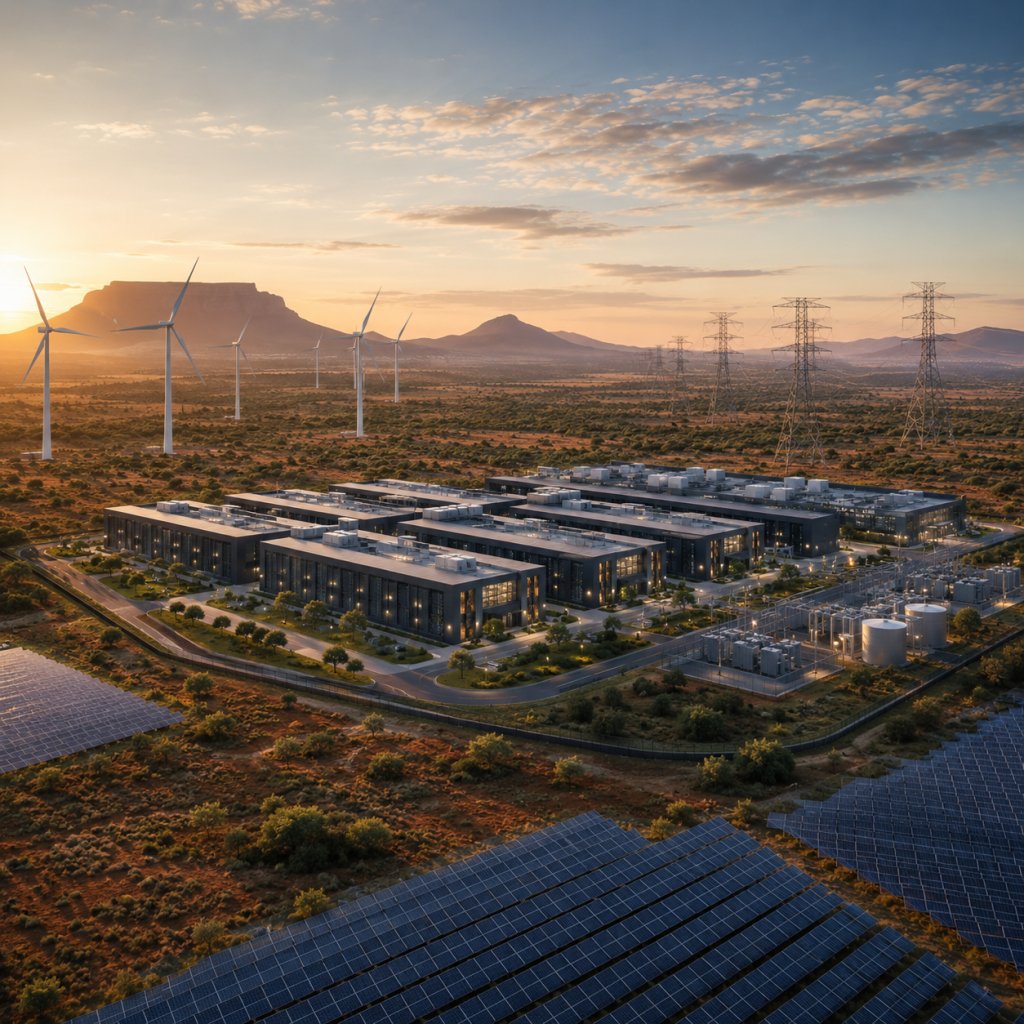
Future renewable energy projects may increasingly be developed alongside digital infrastructure corridors, fibre networks and AI campuses.
The strongest investment destinations may become those capable of integrating power generation, transmission and digital connectivity into a single investment proposition.
Sovereign Data Infrastructure Becomes Strategic
As AI systems process larger volumes of sensitive information, questions around data sovereignty are becoming increasingly important.
African governments are showing growing interest in domestic data processing capabilities rather than relying entirely on infrastructure located outside the continent.
This trend could encourage further investment in regional data centres and cloud infrastructure.
Private Capital Flows Accelerate
AI infrastructure investors require certainty.
Countries capable of providing clear regulatory frameworks, stable energy policy and scalable infrastructure pipelines are likely to attract disproportionate levels of private investment.
The beneficiaries may not necessarily be the largest economies.
They may be the economies that execute most effectively.
What Decision-Makers Should Understand
The opportunity is not simply about attracting data centres.
The opportunity is about using AI-related demand as a mechanism to accelerate broader infrastructure development.
For policymakers, this means energy planning and digital policy can no longer operate in separate silos.
For investors, it suggests that future growth opportunities may sit at the intersection of energy, telecommunications and digital infrastructure.
For South Africa, the message is particularly significant.
The country’s renewable energy resources, financial markets, telecommunications networks and growing digital ecosystem provide a foundation that many competitors are still developing. The challenge will be maintaining execution speed while ensuring that infrastructure expansion keeps pace with demand.
The AI race is often described as a contest between technology companies.
The next phase may be a contest between infrastructure ecosystems.
And in that contest, the countries that can deliver reliable power, scalable connectivity and investment certainty may hold the strongest competitive advantage.