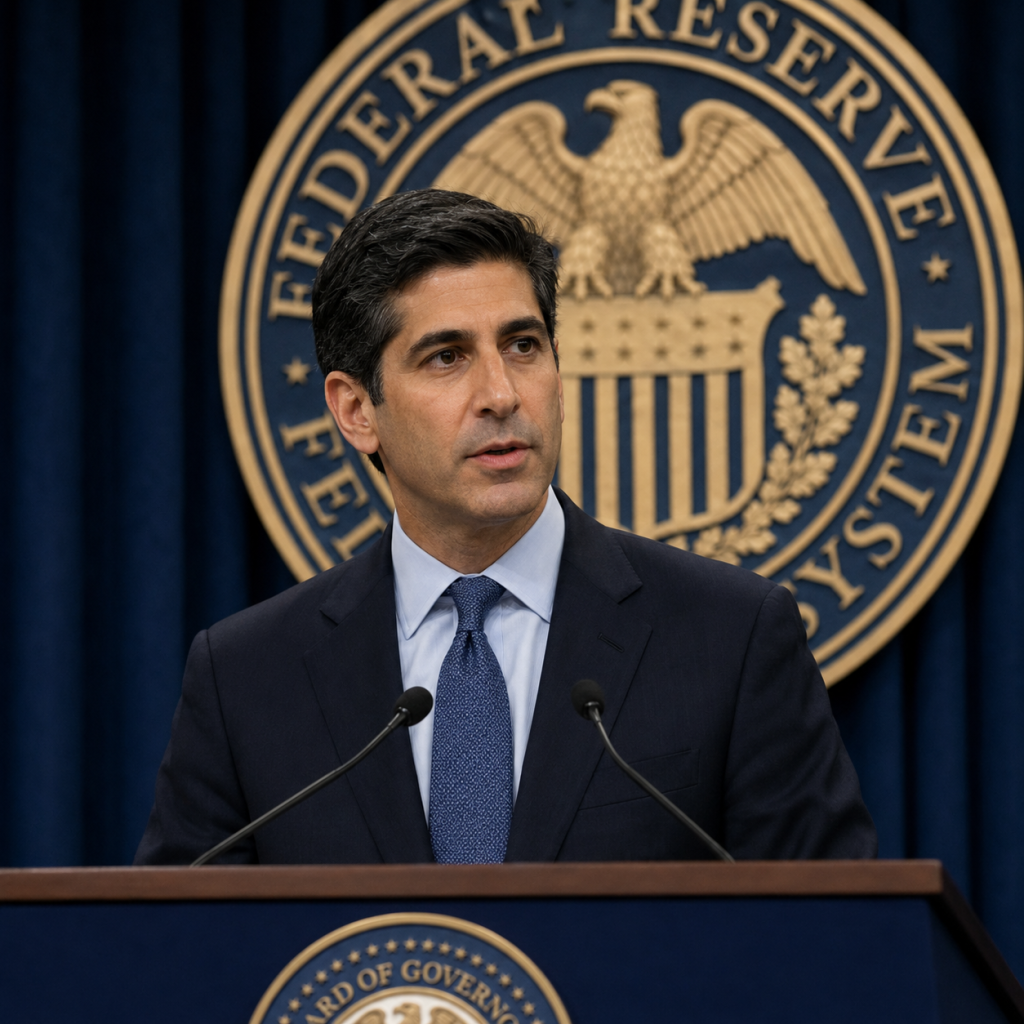

The Federal Reserve held its benchmark interest rate unchanged at 3.50% to 3.75% on Wednesday, June 17, 2026, in the first policy decision presided over by Chair Kevin Warsh since he was sworn in as the 17th Chair of the Federal Reserve on May 22.
The outcome was widely anticipated. Futures pricing tracked by CME FedWatch put the odds of no change at roughly 97% as of June 13, making the rate hold itself the least consequential element of the meeting. What markets were watching was everything around it: the updated dot plot, the removal of easing bias language, and Warsh’s first press conference as Chair.
A Fourth Consecutive Hold in a Deteriorating Inflation Climate
The Fed has held its target federal funds rate in the 3.50% to 3.75% range for the fourth consecutive meeting. The last time the committee moved rates was the December 2025 cut, which brought the target to its current range.
That hold is now taking place against a materially changed economic backdrop. Inflation rose to a three-year high, and the US economy added 172,000 jobs, far above expectations. After that, Goldman Sachs dropped its forecast for a December 2026 rate cut and pushed its expected cuts to 2027.
The consumer price index reached 4.2% in May, the highest level since April 2023. Energy prices, elevated by geopolitical tensions in the Strait of Hormuz, drove a significant portion of that reading. The engine of that 4.2% reading was almost entirely energy, which accounted for over 60% of the monthly CPI increase in May. Strip out energy, and core CPI on a monthly basis came in at 0.2%, below even the consensus forecast of 0.3%.
That distinction matters. It creates room for Warsh to hold a firm institutional line on inflation without triggering an outright hike, while still signalling that the easing cycle is functionally over.
The Easing Bias Is Gone
The policy statement released alongside Wednesday’s decision was expected to reflect a significant shift in tone. JPMorgan economists led by Michael Feroli wrote that given the inflation backdrop and a stronger labor market, the FOMC should remove the easing bias from its post-meeting statement, replacing it with either a neutral sentence or no forward guidance at all.
The removal of the “easing dot” from the dot plot would amount to a formal signal that the committee is done assuming rates will only go down. The implication: the path forward is either hold or hike. There is no longer a third option. Inflation did the work before Warsh walked in the room.
Bank of America flagged at least three members projecting 2026 rate hikes, a communication overhaul that could reprice rate-sensitive assets well before any actual rate move.
Warsh’s Communication Regime: A Structural Shift
The June 17 press conference marked Warsh’s first public address as Chair, and markets treated it as the most consequential communication event in American finance this year.
Warsh has signalled that future FOMC meetings may become less frequent, potentially dropping from eight per year to as few as four, and that post-meeting press conferences will not automatically follow every session. He has told the International Monetary Fund that “the central bank should find new comfort in working without applause and without the audience at the edge of its seats.”
The June meeting is underway with Warsh expected to withhold his own dot plot entry, a move that would reinforce his long-stated skepticism about the usefulness of forward projections. If confirmed, that decision would be largely symbolic but institutionally significant: a Fed Chair declining to anchor market expectations through the very mechanism the institution has relied on for over a decade.
Warsh took the oath of office as the 17th Chair on May 22, 2026, and investors have been studying his first post-meeting press conference for early signals on tone, forward guidance, and how he frames the balance between inflation and the labour market. A new Chair’s debut tends to draw extra scrutiny precisely because the market has less history to anchor on.
The Political Dimension
Warsh’s debut is not taking place in a political vacuum. Trump picked Kevin Warsh because he wanted lower interest rates. He had repeatedly criticised Jerome Powell for not cutting fast enough. Trump still went public before Warsh’s first meeting, saying there was no reason to raise rates and that the Fed should lower them. That puts Warsh in a difficult position. If he sounds tough on inflation, Trump may see it as a betrayal.
Warsh was confirmed by the Senate on May 13 in a 54-45 vote, the most partisan confirmation of a Federal Reserve chair in history. The political context is inescapable, which makes Wednesday’s communication choices far weightier than a standard hold.
What It Means for Emerging Markets, Including South Africa
For South Africa and other emerging market economies, the Fed’s posture carries direct and immediate consequences. A prolonged hold at elevated US rates, combined with the removal of easing bias, supports a stronger dollar and applies pressure to commodity-linked currencies, including the rand. Capital flows that had begun pricing in Fed cuts earlier in 2026 will need to be repriced.
South Africa’s own monetary policy path at the South African Reserve Bank is not immune to this recalibration. A hawkish-leaning Warsh Fed that removes forward guidance and signals a potential hike trajectory narrows the space for the SARB to ease further without risking rand depreciation and imported inflation.
For African sovereigns with dollar-denominated debt and for corporates with US dollar exposure across the continent, the strategic signal from Washington today is clear: the cost of capital is not coming down in 2026. Planning horizons and financing structures must reflect that.
The Warsh Era Begins
EY-Parthenon chief economist Gregory Daco commented that while Warsh is generally seen as dovish, he will inherit a Committee that has become noticeably more hawkish. Several policymakers have recently argued that rate hikes should remain an option if inflation stays above target.
The Fed under Warsh is signalling an institutional recalibration: fewer interventions, less forward guidance, more data-dependence, and a firmer line on inflation tolerance. For decision-makers across boardrooms and government treasuries, from Johannesburg to Lagos to Nairobi, the message from Washington today is that the environment of cheap and abundant dollar liquidity is not returning.
The era of easy monetary accommodation is over. The decisions made in its absence will define the next cycle.