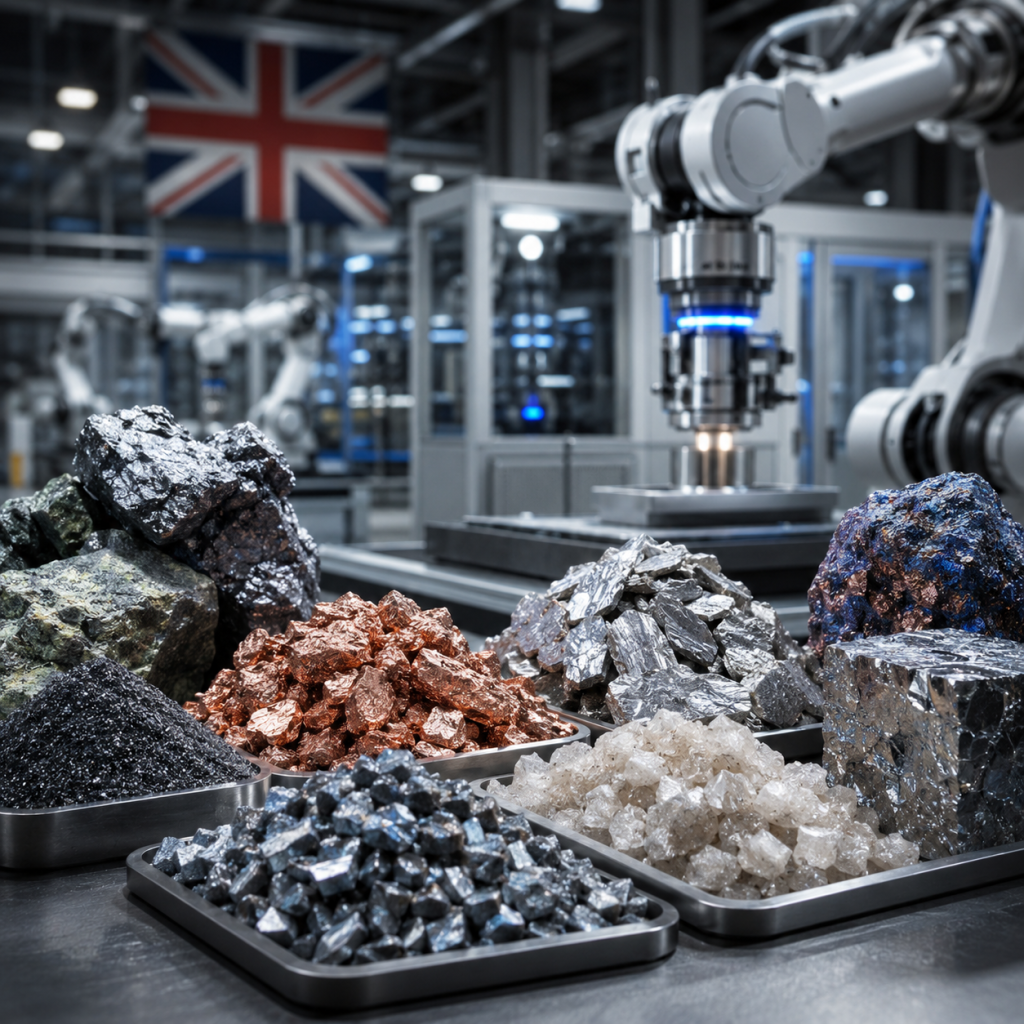

The United Kingdom’s decision to invest £50 million in domestic critical minerals production is modest in financial scale, but significant in strategic intent.
Announced on 22 June, the initiative aims to reduce Britain’s reliance on imported supplies of minerals essential for electric vehicles, defence technologies, semiconductors, renewable energy systems, and artificial intelligence infrastructure.
Viewed in isolation, the investment may appear limited. Viewed within the context of recent G7 commitments to build more resilient critical mineral supply chains, it represents something much larger: the acceleration of a global competition for resource security.
This is no longer simply a mining story. It is an industrial strategy story.
It is also a geopolitical story.
From Globalisation to Strategic Supply Chains
For decades, governments assumed that efficient global markets would deliver reliable access to critical resources.
That assumption has broken down.
The disruptions caused by geopolitical tensions, export controls, energy shocks, and growing strategic rivalry between major powers have exposed the vulnerabilities created by concentrated supply chains.
Today, control over critical minerals increasingly determines competitiveness across industries ranging from aerospace and defence to clean energy and advanced computing.
Governments are responding accordingly.
The United Kingdom’s latest investment follows similar initiatives across the European Union, the United States, Canada, Japan, and Australia. The common objective is clear: reduce dependence on single suppliers and build secure access to strategic inputs.
This marks a fundamental shift from a market-led model to a state-enabled model of industrial development.
The New Industrial Competition
The race for critical minerals is often framed as a contest over extraction.
In reality, the greater opportunity lies further down the value chain.
Refining, processing, recycling, manufacturing, logistics, and technology development generate significantly higher economic returns than the export of raw materials alone.
Countries that secure these capabilities will shape the next generation of industrial growth.
Countries that fail to move beyond extraction risk repeating the economic patterns of previous commodity cycles.
This distinction matters deeply for emerging markets.
Resource-rich economies are increasingly demanding greater local value creation, skills development, technology transfer, and domestic processing as conditions for market access.
The global market is shifting from a model based on resource ownership to one based on value chain participation.
Why This Matters for South Africa
South Africa enters this new era with significant advantages.
The country possesses globally important reserves of platinum group metals, manganese, vanadium, and other minerals that are critical to energy transition technologies and industrial manufacturing.
However, mineral abundance alone is no longer sufficient.
The strategic question facing policymakers is not whether South Africa can supply the world with critical minerals.
It is whether South Africa can become an indispensable partner in processing, manufacturing, and innovation.
The answer will depend on the country’s ability to create investment certainty, improve logistics performance, expand energy capacity, accelerate exploration activity, and support competitive beneficiation industries.
Global demand is creating a rare opportunity to align industrial policy with long-term economic transformation.
If executed effectively, critical minerals could become a catalyst for export diversification, infrastructure investment, and industrial expansion.
The Emerging Geography of Capital
The UK’s announcement demonstrates that governments are no longer waiting for markets to solve supply chain vulnerabilities.
Public capital is increasingly being deployed to attract private investment, secure offtake agreements, and reshape industrial ecosystems.
This trend will influence where future capital flows.
Investors will increasingly prioritise jurisdictions that combine geological potential with stable regulation, reliable infrastructure, and clear industrial strategies.
Resource diplomacy is evolving into investment diplomacy.
Countries that offer trusted partnerships and predictable operating environments will capture a larger share of global capital.
What Decision-Makers Should Understand
The critical minerals race is not about who owns the largest reserves.
It is about who builds the strongest ecosystems around those reserves.
The next decade will reward countries that integrate mining policy with energy planning, industrial development, trade strategy, technology deployment, and workforce development.
Britain’s £50 million commitment is another signal that the competition for critical minerals has entered a new phase.
The winners will not necessarily be the countries with the most resources.
They will be the countries that move fastest to convert resources into resilient, value-added industries.