
A $70 million investment expands Nigeria’s agricultural manufacturing capacity
Olam Agri is expanding Nigeria’s agricultural processing infrastructure with a US$70 million investment in a new integrated animal feed manufacturing facility in Ogwashi-Uku, Delta State. The development adds substantial production and storage capacity to the country’s poultry and aquaculture supply chains, positioning the facility to serve farmers and livestock producers across southern and southeastern Nigeria.
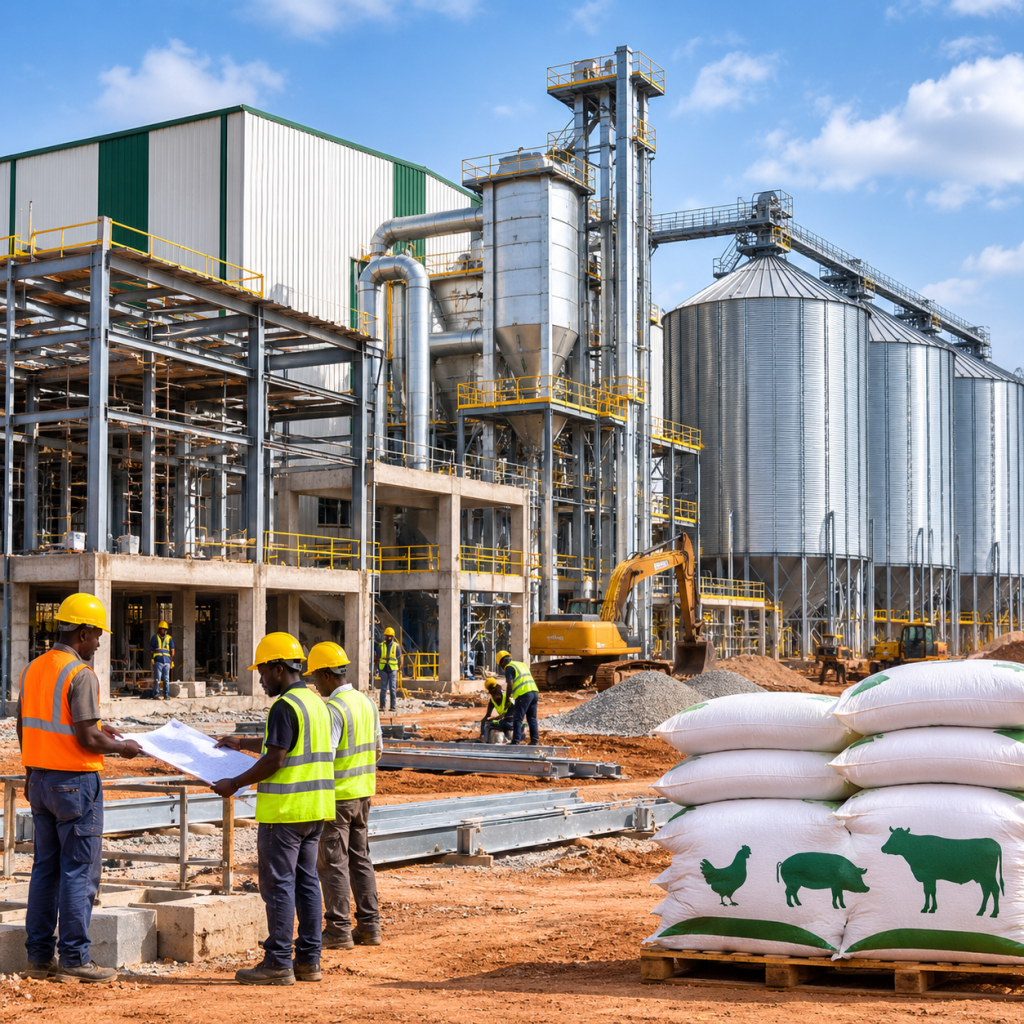
The project, announced through company communications published on 5 November 2026, follows the acquisition of approximately 99.99 hectares of land for the development. Construction has commenced, with the facility expected to become operational in 2027.
Two production lines targeting poultry and aquaculture
The integrated facility will combine two specialised manufacturing operations:
- Poultry feed: Production capacity of 1,500 tonnes per day.
- Aquaculture feed: Production capacity of 300 tonnes per day.
- Storage infrastructure: Capacity for 125,000 tonnes through silo bag storage.
Combined, the two manufacturing lines will provide 1,800 tonnes of daily feed production capacity.
The investment is strategically positioned to bring manufacturing closer to poultry farmers, fish producers and livestock operators in Nigeria’s South-South and South-East regions.
By establishing production capacity closer to these agricultural markets, Olam Agri intends to reduce dependence on feed transported from the South-West, improve product availability and strengthen distribution efficiency.
Strengthening the domestic livestock value chain
The investment builds on Olam Agri’s existing Nigerian agricultural operations, which include animal feed manufacturing facilities, poultry breeding farms, a hatchery producing day-old chicks and soybean crushing infrastructure.
The new development expands that integrated operating model by adding dedicated aquaculture feed manufacturing alongside poultry feed production.
This is commercially significant because feed availability and distribution are important components of livestock production economics. Bringing manufacturing closer to agricultural production centres can improve access to inputs, reduce transportation requirements and support more predictable supply for farmers.
For Nigeria’s aquaculture industry, the additional 300-tonne daily production capacity also strengthens the industrial infrastructure supporting domestic fish farming.
Private capital supports agricultural industrialisation
The investment reflects a broader strategy by Olam Agri to expand its manufacturing footprint across African food and agricultural value chains.
The company is positioning its operations around local production, processing infrastructure and distribution networks rather than relying exclusively on the movement of agricultural commodities between markets.
The Ogwashi-Uku development also aligns with Nigeria’s ambitions to strengthen domestic food production, improve access to animal protein and attract private investment into agricultural manufacturing.
Delta State Governor Sheriff Oborevwori welcomed the project, highlighting its potential to stimulate economic activity, create employment opportunities and strengthen the state’s agricultural value chains.
The development therefore represents both an industrial investment and an expansion of the infrastructure required to support agricultural businesses operating across the region.
What the investment signals for African food systems
Olam Agri’s investment demonstrates the growing commercial importance of agricultural inputs manufacturing in Africa.
Poultry and aquaculture production require dependable access to quality feed, storage and distribution. Expanding these capabilities locally can strengthen the relationship between agricultural manufacturers, commodity suppliers and primary producers.
For investors, the development highlights opportunities across the agricultural value chain beyond primary farming, particularly in feed manufacturing, grain processing, storage infrastructure and integrated livestock production.
The project’s next significant milestone will be its expected operational launch in 2027. Its ability to achieve planned production capacity and serve regional agricultural markets will determine the full commercial and economic impact of the investment.
The strategic significance is clear: Africa’s food production capacity increasingly depends on investment in the industrial infrastructure connecting farmers to manufacturers, processors and consumers.