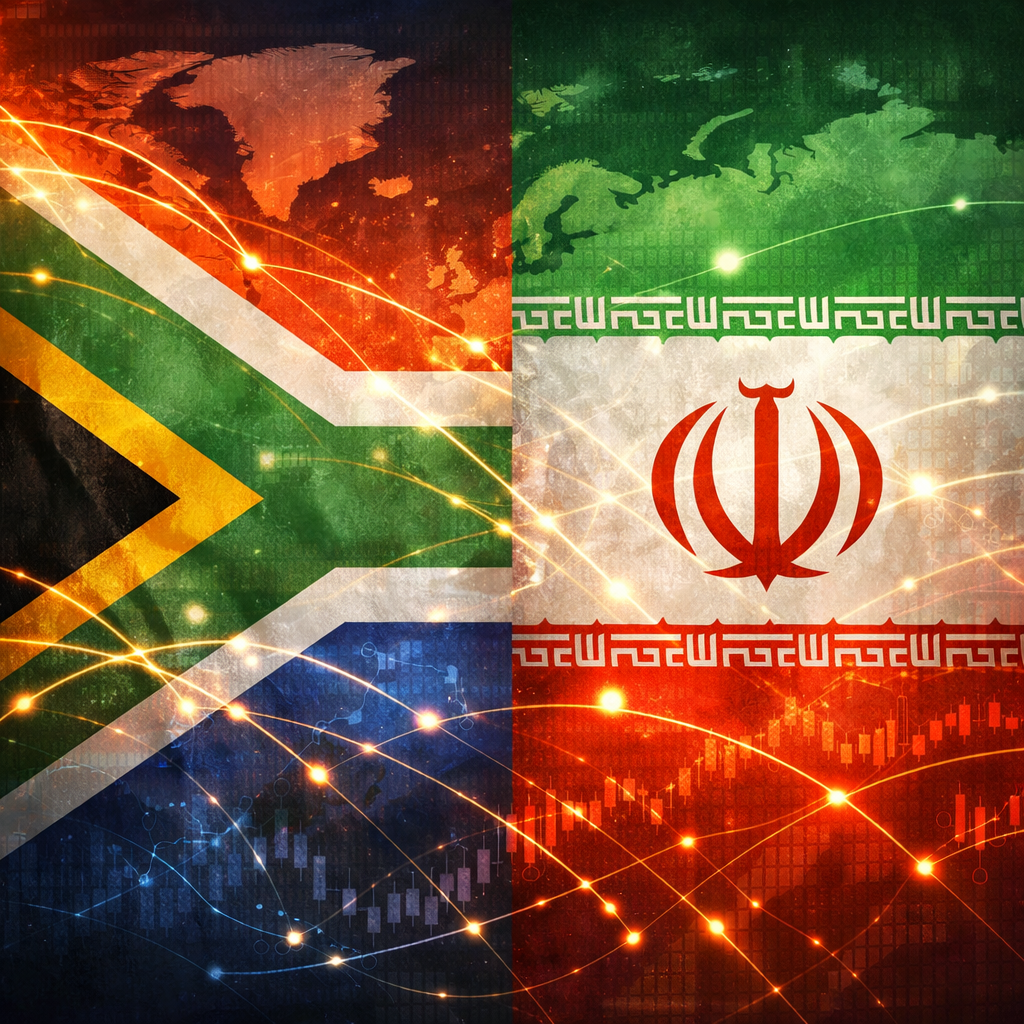

Renewed public attention this week on South Africa’s relationship with Iran—amplified by widely circulated reports and commentary—has brought Pretoria’s foreign policy stance back into sharp global focus. At the centre is a familiar but increasingly consequential position: South Africa’s refusal to align its diplomatic relationships with external geopolitical pressure, particularly from the United States.
While no single new policy announcement has been formally issued in recent days, the resurfacing of this issue reflects a real and ongoing strategic posture by South Africa—one that is shaping its global economic and political positioning in 2026.
The Event Behind the Moment: Renewed Pressure, Consistent Position
South Africa has, over time, maintained that its foreign policy is independent, historically grounded, and guided by national interest. This includes sustained diplomatic and economic ties with Iran despite Western sanctions frameworks and geopolitical tensions.
Recent circulation of statements and narratives highlighting this position signals something important:
Global pressure is not new—but its intensity is rising again.
This comes at a time when geopolitical blocs are hardening, and countries are increasingly expected to “choose sides.”
South Africa is choosing something else entirely.
Non-Alignment Is Becoming an Economic Strategy
What appears on the surface as a diplomatic stance is, in reality, an economic positioning strategy.
By maintaining relationships across geopolitical divides—including with Iran, China, the United States, and BRICS partners—South Africa is:
- Preserving trade flexibility
- Expanding energy sourcing options
- Positioning itself within alternative financial systems
- Reducing dependency on any single geopolitical bloc
This is not neutrality for its own sake. It is strategic diversification.
In a fragmented global economy, countries that can operate across systems will hold disproportionate leverage.
The BRICS Factor: A Parallel Power Structure
South Africa’s posture cannot be separated from its role in BRICS.
With BRICS expanding and deepening cooperation—particularly around alternative payment systems, development financing, and energy trade—South Africa’s willingness to maintain ties with countries like Iran signals alignment with a broader shift:
The gradual emergence of a multi-polar economic order.
Iran itself has strengthened ties within this ecosystem, further reinforcing South Africa’s incentive to maintain engagement rather than isolate.
The Real Risk: Financial System Exposure
However, this strategy is not without consequences.
The United States retains significant influence over:
- The global dollar system
- International banking channels
- Sanctions enforcement mechanisms
For South Africa, the key risk is not diplomatic—it is financial system exposure.
If geopolitical tensions escalate, pressure could manifest through:
- Banking compliance restrictions
- Trade financing limitations
- Increased scrutiny on cross-border transactions
This creates a delicate balancing act:
Maintain strategic independence without triggering financial isolation.
A Defining Test of Policy Execution
South Africa’s stance is clear. The real question is execution.
To successfully sustain this position, the country must:
- Strengthen domestic financial resilience
- Expand intra-BRICS trade mechanisms
- Build alternative settlement infrastructure
- Ensure regulatory clarity to avoid investor uncertainty
Non-alignment without execution risks instability.
Non-alignment with execution creates leverage.
What This Signals for Global Capital
For investors and institutions, this moment is not about politics—it is about predictability and access.
South Africa is effectively positioning itself as:
- A gateway economy between geopolitical blocs
- A diversified trade partner
- A participant in emerging financial architectures
If managed correctly, this could attract a specific class of capital:
investors seeking exposure to multi-aligned markets with strategic optionality.
Conclusion: Independence Is Now a Competitive Asset
The renewed spotlight on South Africa’s relationship with Iran is not an isolated story—it is part of a larger global transition.
As geopolitical lines harden, policy independence is becoming an economic asset.
South Africa is not avoiding alignment.
It is redefining it.
And in a world where capital follows stability, access, and flexibility, that decision may prove to be one of the most consequential strategic choices of the decade.