
When NASA’s Orion spacecraft carried four astronauts on humanity’s first crewed lunar flyby in more than half a century, a team of South African engineers in Gauteng was quietly ensuring the mission never lost its lifeline.
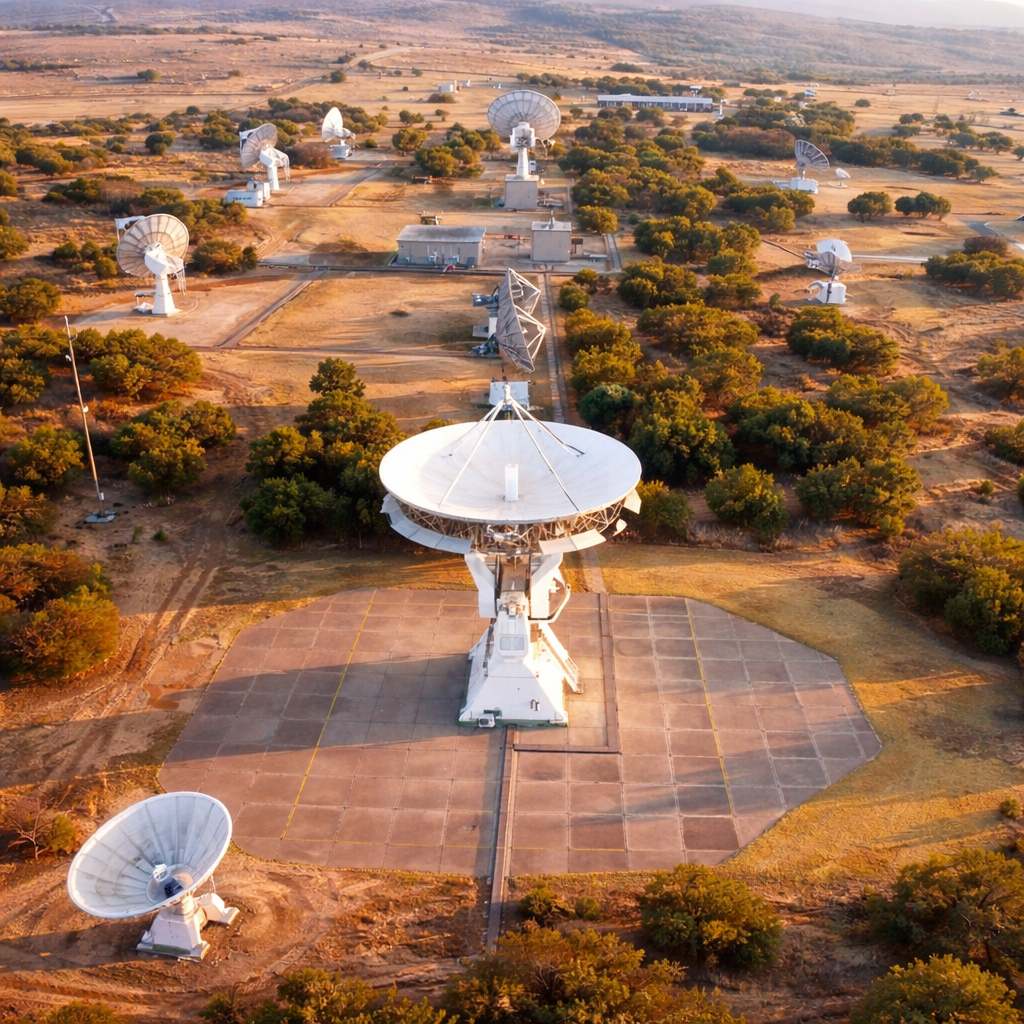
The South African National Space Agency (SANSA), an entity of the Department of Science and Innovation, provided tracking, telemetry, and data support to NASA throughout the Artemis II mission. The operation was executed from SANSA’s Hartebeesthoek Ground Station, and it confirmed South Africa’s enduring position as a strategically indispensable node in the global deep-space network.
A Mission of Historic Proportions
The Artemis II mission wrapped up a historic seven-hour lunar flyby, marking humanity’s first return to the Moon since Apollo 17 in 1972. During a planned 40-minute loss of signal as Orion passed behind the Moon, the spacecraft and crew reached their closest approach at approximately 6,545km above the lunar surface. Two minutes later, the crew set a new record, travelling 406,771km from Earth, the furthest any human has ever been from home.
The crew comprised NASA astronauts Reid Wiseman, Victor Glover, and Christina Koch, alongside Canadian Space Agency astronaut Jeremy Hansen. The mission launched on April 1, 2026, from Kennedy Space Center. The Orion capsule successfully concluded the mission with a splashdown in the Pacific Ocean off San Diego on April 10.
South Africa’s Strategic Role
From its Hartebeesthoek Ground Station in Gauteng, one of the largest in the Southern Hemisphere, SANSA engineers delivered essential spacecraft tracking, telemetry, and data relay during key phases of the mission, particularly when the spacecraft was visible from the southern hemisphere due to Earth’s rotation.
For this mission, SANSA used two antennas, one dating from 1963 and one from 1988, with one serving as a backup. The team tracked the Orion capsule from the moment of its launch, with engineers monitoring the spacecraft’s health throughout the journey.
SANSA’s advanced tracking systems are integrated into an international network, relaying real-time data to NASA during mission-critical moments. SANSA did not communicate directly with NASA but transmitted data through a contracted third party, feeding it into NASA’s systems in real time. As SANSA Space Operations Executive Director Raoul Hodges noted, no single country can maintain uninterrupted contact with a spacecraft throughout its journey, instead, agencies rely on a coordinated chain of ground stations, each assuming tracking responsibilities as the spacecraft moves in and out of range.
A Partnership Built Over Six Decades
Hartebeesthoek was originally built by NASA in 1963 and handed over to South Africa in 1976. The facility, now operated by SANSA, is the largest ground station in the Southern Hemisphere. The station supported NASA missions during the Apollo era, including Apollo 11, before moving through various South African government institutions before consolidating into SANSA, established in 2011.
The Artemis II engagement is therefore not incidental. It is the continuation of a structured, long-standing partnership between South Africa and NASA, one that has grown in technical sophistication with each successive mission.
Geography as Strategic Capital
What makes Hartebeesthoek irreplaceable is not merely its history but its coordinates. SANSA Space Operations Executive Director Raoul Hodges explained that as plans develop toward inhabiting the Moon by 2030 and beyond, continuous communications coverage will require ground stations positioned in both the Northern and Southern Hemispheres. South Africa’s location in the Southern Hemisphere makes it critical, the same reason it supported earlier Moon missions between 1963 and 1976.
This geographic advantage is not passive. It is increasingly active capital in a sector commanding substantial sovereign and private investment globally. As the new space race intensifies, countries that control ground-based infrastructure along key orbital and deep-space corridors will hold leverage that extends well beyond scientific cooperation.
Expanding South Africa’s Space Infrastructure
SANSA is expanding its infrastructure, including a new ground station in Matjiesfontein, aiming to strengthen South Africa’s role in the global deep-space network. The agency is also investing in training the next generation of South African space professionals, positioning the country for continued participation in Artemis III, IV, and the broader international lunar programme.
Chief Engineer Eugene Avant confirmed that ahead of the mission, the agency focused on ensuring all antenna subsystems were fully operational and working to specification. The execution, from launch tracking through lunar flyby to re-entry, validated that investment.
For a country often evaluated through the narrow lens of its near-term economic challenges, SANSA’s Artemis II role signals something structurally different: a capable, internationally contracted, technically precise institution operating at the frontier of global science and strategic infrastructure. That is not a footnote. It is a foundation.