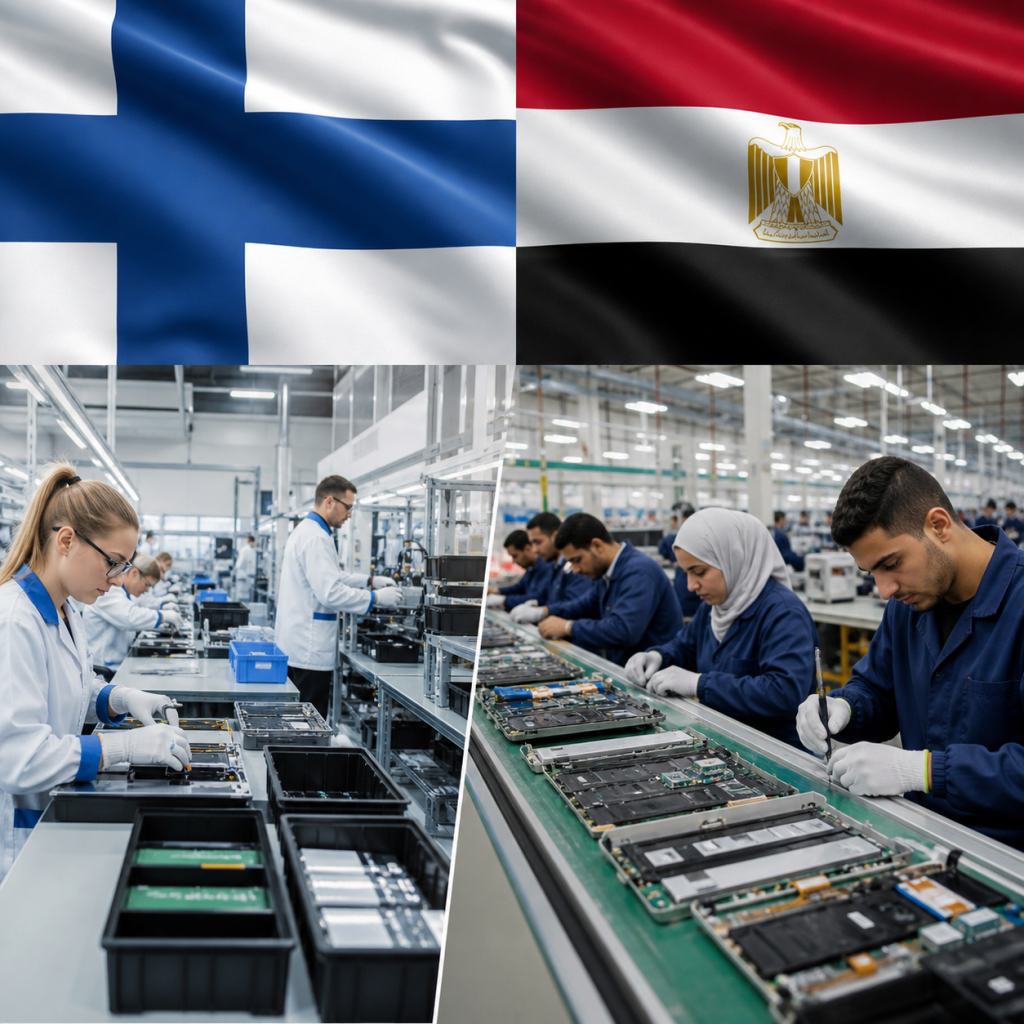

Egypt is emerging as a pivotal manufacturing and distribution node for mobile technology in Africa, following high-level talks between HMD Global, the licensee of the Nokia phone brand, and Egyptian government officials held on the sidelines of the Finnish President’s state visit to Cairo.
Egypt’s Minister of Communications and Information Technology, Raafat Hendy, met with HMD Global Co-Founder, Chairman, and CEO Jean-François Baril to discuss the company’s expansion of local mobile phone manufacturing and its plans to begin exporting to North African and broader African markets in the near term.
Manufacturing Already Operational
HMD officials outlined the progress of local manufacturing operations, which began in 2023, in collaboration with the E-SICO manufacturing facility at the New Assiut Technology Park. The company is currently producing around 12 product models locally, with production expected to reach approximately two million mobile phones, including feature phones and smartphones, by 2026.
The scale of that target signals a transition from pilot-phase assembly to industrial-volume output, positioning Egypt as the company’s primary production base for the region.
A Strategic Shift Toward Africa
Baril outlined HMD’s expansion plans for 2026–2027, which include a gradual transition toward the production of 4G mobile phones and an increased share of smartphones, emphasising that Egypt represents a strategic hub for the company’s regional operations, given its strategic location and skilled talent pool.
The discussions also covered ways to accelerate access to regional markets in Africa and Europe, and explored strengthening cooperation to increase local value added by developing feeder industries and attracting suppliers to the Egyptian market, thereby reinforcing local value chains.
This is not a memorandum of intent. Manufacturing is live. The question now is velocity, how quickly HMD converts its Egyptian base into a continent-wide supply operation.
Nokia’s Infrastructure Ambitions Run in Parallel
The HMD manufacturing discussions took place alongside a separate bilateral engagement. Nokia’s President of Middle East and Africa, Mikko Lavanti, also met with Minister Hendy during the Finland visit, with discussions centred on Nokia’s plans to establish an end-to-end regional hub in Egypt for technical support and managed services, as well as its broader expansion strategy.
Nokia outlined plans to launch a fully integrated regional centre in Egypt to enhance service delivery efficiency and expand its reach across Middle East and African markets, aligning with the company’s shift toward advanced operating models amid growing demand for network management services and digital solutions driven by 5G expansion and increasing reliance on cloud computing.
This dual-track engagement, devices through HMD, network infrastructure through Nokia, places Finland’s technology ecosystem in a structurally significant position across Africa’s digital build-out.
What This Means for Africa’s Device Market
Africa remains chronically underserved in locally manufactured mobile devices. Most handsets consumed across the continent are imported from Asia, with limited local assembly adding minimal value to domestic economies. HMD’s Egyptian manufacturing operation, if it scales to the two-million-unit target, represents one of the more concrete attempts by a recognised global brand to shift that dynamic.
The convergence of device manufacturing, 4G transition planning, export route development, and network infrastructure investment, all consolidated within a single bilateral diplomatic moment, suggests coordinated execution rather than isolated announcements.
For African markets, particularly in North and East Africa, the implications are direct: more affordable 4G-capable devices, regionally manufactured, with supply chains progressively embedded on the continent.