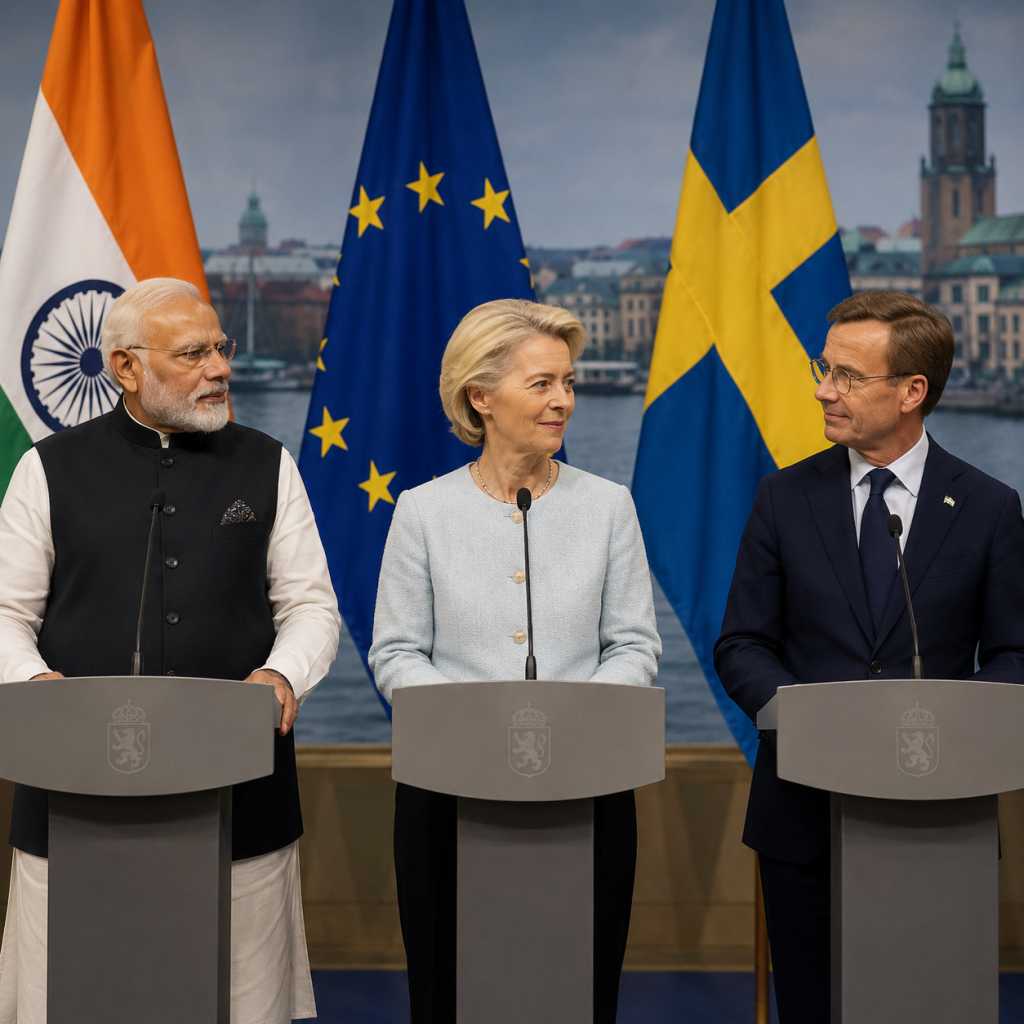

In Gothenburg, Sweden, on 17 and 18 May 2026, Indian Prime Minister Narendra Modi met with European Commission President Ursula von der Leyen and Swedish Prime Minister Ulf Kristersson at the European Round Table for Industry, hosted by the Volvo Group. The trilateral engagement produced concrete timelines, bilateral commitments, and a direct signal to global capital that the India-EU economic architecture is being built in real time.
The centrepiece of the Gothenburg meetings was the India-EU Free Trade Agreement, finalised in January 2026 after nearly two decades of stalled negotiations. Von der Leyen vowed to make the deal fully operational by the end of this year, describing the process as moving at record speed. Speaking at the roundtable, she highlighted the scale of the arrangement, noting that it spans a shared market of over 2 billion people, representing close to one quarter of global GDP, with tariff cuts exceeding 9 percent.
The investment dimension was the sharpest new signal to emerge from Gothenburg. Von der Leyen stated that the EU’s next step must be the delivery of an investment agreement, calling it the missing piece of the puzzle in reinforced economic cooperation, particularly as global supply chains are being reshaped and economic security pressures intensify. She said deepening investment ties would help both sides de-risk and diversify.
Beyond the EU-India framework, Sweden and India announced a strategic partnership aimed at doubling their bilateral trade and investment within five years. Annual trade between the two countries currently stands at $7.75 billion. Swedish Prime Minister Kristersson expressed confidence the target could be reached ahead of schedule. Modi and Kristersson confirmed the launch of a strategic partnership and joint action plan focused on innovation, emerging technologies, artificial intelligence, space, geospatial technology, and the green transition. A joint innovation partnership 2.0 was agreed upon, along with the establishment of a joint centre for science and technology to connect academic institutions in both countries.
The Gothenburg meetings form part of a broader six-nation European and West Asian tour by Modi, underscoring India’s systematic effort to deepen institutional ties across multiple capital markets simultaneously. Modi had signed a strategic partnership with the Netherlands the previous day, following a meeting with Dutch Prime Minister Rob Jetten covering trade, technology, and energy. His tour continues to Oslo for the third India-Nordic Summit, where he is scheduled to meet the leaders of Norway, Denmark, Finland, and Iceland, before concluding in Rome with Italian Prime Minister Giorgia Meloni.
The commercial dimension at Gothenburg was equally significant. Addressing the European Round Table for Industry, Modi described the India-EU FTA as a transformative economic partnership that would create new opportunities across trade, technology, manufacturing, services, and resilient supply chains. He invited European industry leaders to make investment pledges in India over the next five years, citing the FTA as the enabling framework.
For investors, the Gothenburg summit clarifies several things at once. The FTA operational timeline is no longer aspirational but has been given a public year-end commitment by the EU’s top executive. A bilateral investment protection agreement is now formally on the agenda, with von der Leyen framing it as the essential complement to the trade deal. Sweden’s specific ambitions, backed by the presence of 300 Swedish companies already operating in India, signal that Nordic capital is being mobilised to participate in India’s manufacturing and technology build-out.
The architecture being assembled between India and the European Union is not a peripheral arrangement. It connects a continent with $19 trillion in GDP to an economy growing at over 6 percent annually, in a period when multinationals are actively restructuring their China exposure and seeking alternative manufacturing and sourcing environments. The 2026 operational deadline for the FTA, combined with the investment agreement timeline now in motion, means that the window for early positioning is measurably narrow.
For African and emerging market businesses watching this alignment, the strategic implication is direct. As European supply chains reorient toward India and as Indian companies expand their outbound investment footprint, the intermediary roles across logistics, raw material supply, and infrastructure connectivity become commercially viable propositions for African economies positioned within both corridors.