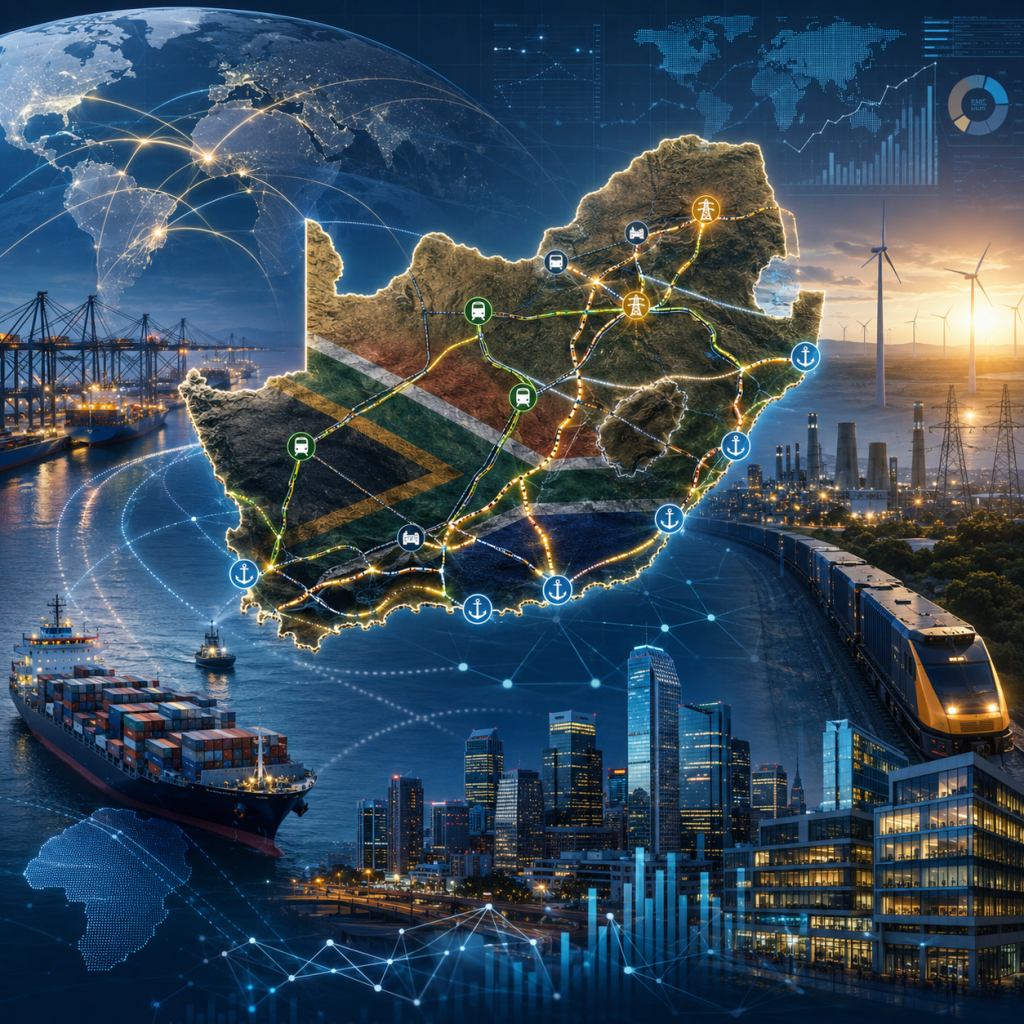

South Africa’s economic debate is entering a decisive new phase.
Within the past 32 hours, the Institute of International Finance warned that rising geopolitical tensions and higher energy costs linked to the Middle East conflict are clouding South Africa’s growth outlook for 2026, despite improving domestic fundamentals.
The immediate headline is about downgraded growth expectations. The more important story is what this reveals about the structural future of emerging economies.
South Africa is no longer competing primarily on commodity exports, low-cost labour, or macroeconomic credibility alone. It is now competing on infrastructure resilience.
That distinction matters because the next decade of global capital allocation will increasingly reward countries capable of maintaining operational continuity during periods of geopolitical instability, energy volatility, and fragmented supply chains.
For South Africa, this is both a warning and an opportunity.
The Real Economic Shift Happening Behind the Forecast
Traditional economic analysis often treats infrastructure as a domestic governance issue. That framework is becoming outdated.
Infrastructure has now become a strategic macroeconomic asset class.
Electricity reliability, logistics efficiency, water security, freight rail performance, and port turnaround times are increasingly determining sovereign competitiveness in the same way interest rates and fiscal policy once dominated investor decision-making.
This explains why institutions such as the IMF continue to focus heavily on South Africa’s infrastructure reforms when assessing long-term growth potential.
The message from international financial institutions is becoming clearer:
Countries that solve infrastructure bottlenecks will attract disproportionate investment flows during the next global economic cycle.
Countries that fail to modernise operational systems will face structurally lower growth regardless of natural resource wealth.
South Africa’s recent progress in stabilising electricity supply demonstrates that reform execution can materially improve investor confidence. Eskom’s improving operational performance and extended periods without load shedding have already altered international perceptions of South Africa’s economic trajectory.
However, the latest IMF-linked concerns show that isolated reform wins are no longer sufficient in a highly volatile geopolitical environment.
Why Global Conflict Is Reshaping Emerging Market Strategy
The Middle East conflict is exposing a broader vulnerability across emerging markets.
For years, many economies relied on relatively stable global energy systems, predictable shipping corridors, and low-cost financing conditions. That environment is disappearing.
The new global economy is being shaped by:
- Persistent geopolitical fragmentation
- Energy security competition
- Strategic industrial policy
- Supply chain regionalisation
- Rising infrastructure nationalism
For African economies, this changes the development equation completely.
The countries likely to outperform over the next decade may not necessarily be those with the largest populations or resource reserves. Instead, they may be the countries capable of delivering reliable systems under pressure.
This is where South Africa still holds a strategic advantage.
Despite its challenges, the country maintains deep capital markets, institutional banking strength, advanced financial infrastructure, sophisticated industrial capacity, and continental logistics relevance.
The critical question is whether South Africa can convert these structural advantages into execution speed.
The Infrastructure Economy Is Becoming the Real Investment Story
A major strategic misunderstanding persists in many policy discussions.
Infrastructure spending is still often treated as a fiscal burden rather than an economic multiplier.
Globally, that perception is changing rapidly.
Infrastructure modernisation is increasingly viewed as a mechanism for attracting private capital, reducing sovereign risk, enabling industrial expansion, and improving geopolitical resilience.
This shift explains why international lenders and development institutions are increasingly linking financing directly to infrastructure reform programmes.
South Africa’s recent $150 million development policy loan from the OPEC Fund specifically tied funding support to reforms aimed at easing infrastructure bottlenecks reflects this broader trend.
This model is likely to expand significantly.
Future global investment competition may increasingly revolve around which countries can build the most investable operating environments rather than simply offering the lowest labour costs or largest consumer markets.
What Decision-Makers Should Understand Now
The long-term implication is profound.
South Africa’s growth ceiling is no longer determined primarily by macroeconomic policy. It is increasingly determined by implementation capability.
If infrastructure reforms accelerate consistently across electricity, logistics, ports, rail, digital systems, and water management, South Africa could reposition itself as Africa’s primary industrial and capital coordination hub during a period of global fragmentation.
If reforms slow or become inconsistent, the country risks remaining trapped in low-growth equilibrium while faster-moving emerging markets capture redirected capital flows.
The encouraging reality is that reform momentum has already demonstrated measurable results.
The challenge now is scale, speed, and institutional consistency.
The next phase of South Africa’s economic story will not be decided by rhetoric about potential.
It will be decided by operational delivery.
And in the emerging geopolitical economy, operational delivery is rapidly becoming the most valuable national asset of all.