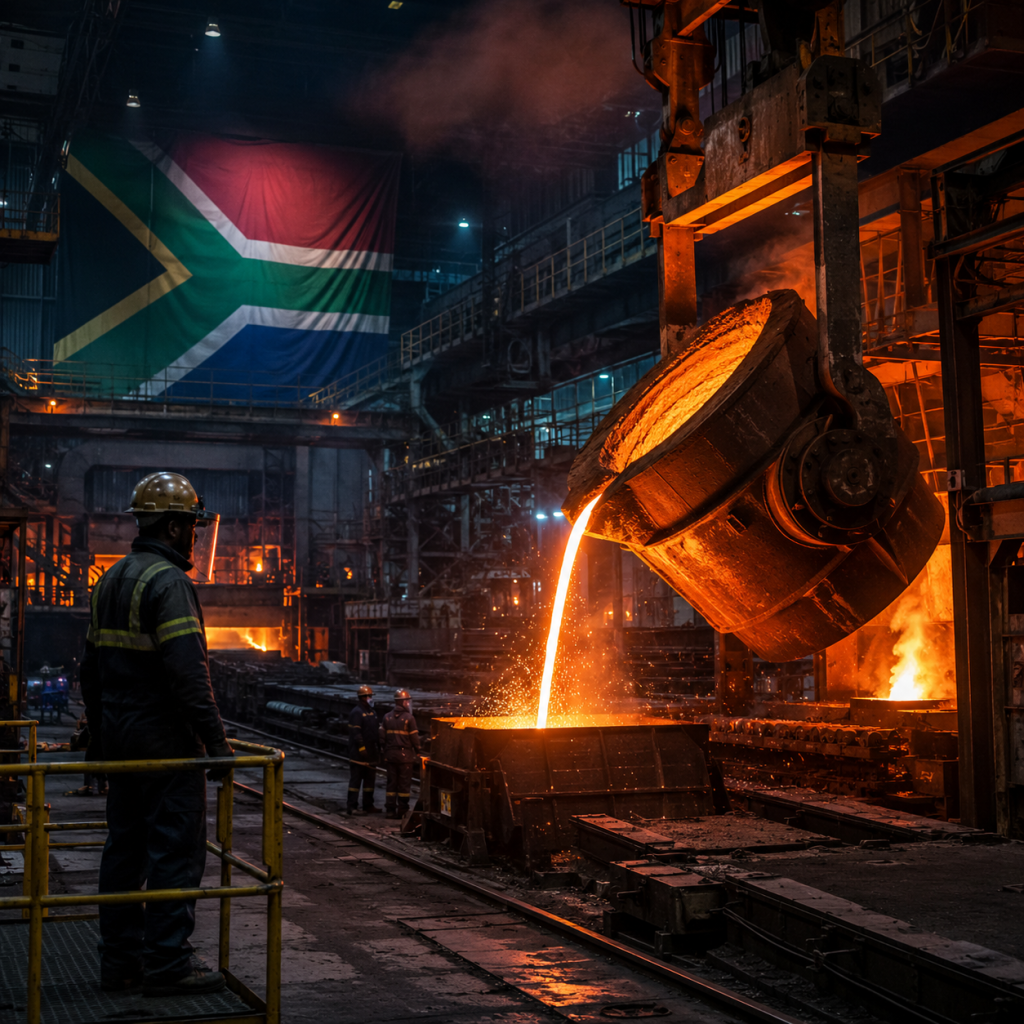

The South African government has officially raised import duties on a range of steel products to between 10% and 30%, marking one of the country’s strongest industrial protection interventions in recent years.
The decision, disclosed through a government notice and confirmed by the International Trade Administration Commission (ITAC), is aimed at stabilising South Africa’s struggling steel sector after mounting pressure from rising imports, particularly from China.
The tariffs apply to products including flat-rolled iron, non-alloy steel, bars, rods, tubes, and pipes. Previous tariff levels ranged from 0% to 15%.
The move comes at a critical moment for South Africa’s industrial economy, with major producers including ArcelorMittal South Africa having already shut portions of their operations amid weak domestic demand and increasing import pressure.
Why the Decision Was Made
Government officials and industry regulators have framed the tariff increase as an emergency industrial support measure designed to preserve productive capacity, jobs, and future investment potential inside South Africa’s manufacturing base.
According to ITAC Chief Commissioner Ayabonga Cawe, the objective is to create enough operational space for local producers to reinvest and modernise their facilities instead of continuing with shutdowns and retrenchments.
The intervention also reflects growing concern within government about South Africa’s exposure to heavily imported industrial inputs.
Imports currently account for roughly 36% of South Africa’s steel consumption, with China representing approximately 73% of those imports, according to the South African Iron and Steel Institute.
The latest tariff decision follows anti-dumping measures imposed earlier against structural steel imports from China and Thailand.
Who Is Impacted
The decision carries major implications across manufacturing, mining, infrastructure, engineering, logistics, and construction sectors.
Local steel producers stand to benefit directly through reduced import competition and improved pricing support.
At the same time, downstream manufacturers that rely heavily on imported steel inputs may face higher procurement costs in the short term, particularly in sectors such as electronics manufacturing and industrial fabrication.
Government has attempted to soften that impact through adjustments to tariff rebate mechanisms for processors using structural and flat steel products.
For organised labour, the decision is likely to be viewed positively as policymakers attempt to slow industrial decline and preserve manufacturing employment.
What the Decision Signals
The tariff increase signals a more interventionist industrial policy posture from Pretoria as the government intensifies efforts to rebuild domestic productive capacity.
It also highlights a broader strategic shift toward economic resilience, localisation, and industrial retention at a time when global trade competition is intensifying.
For investors, the move sends a dual message.
On one side, it demonstrates that government is willing to act decisively to protect strategically important industries. On the other, it raises questions about input costs and competitiveness for businesses dependent on imported industrial materials.
The decision further positions South Africa within a wider global trend where governments are increasingly deploying tariffs, subsidies, and industrial policy tools to defend domestic manufacturing sectors against oversupply from major exporting economies.
For South Africa’s industrial economy, the success of the intervention will ultimately depend on whether local producers use the protection window to modernise operations, improve competitiveness, and attract long-term investment rather than relying on permanent tariff protection.