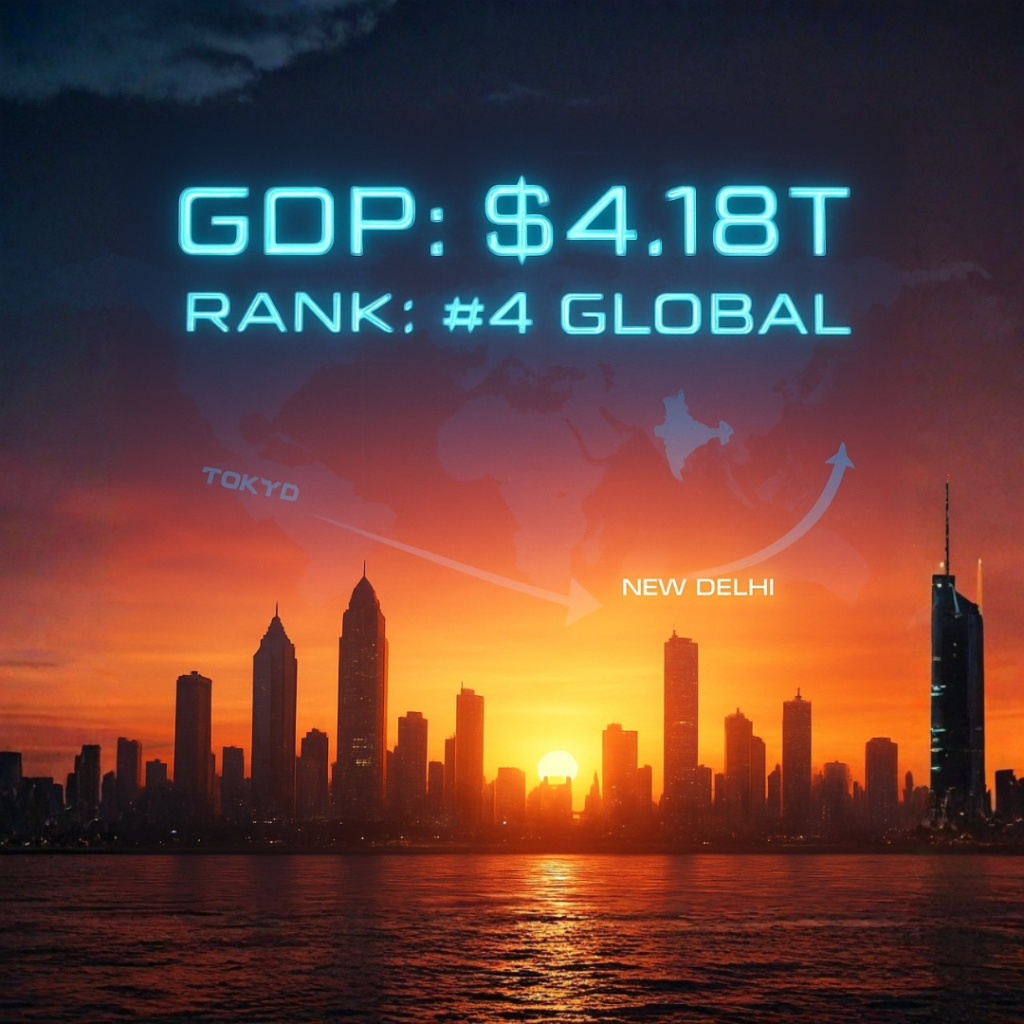

The global economic hierarchy has been fundamentally reordered as 2026 begins. According to official data released at the close of 2025 and confirmed by the latest International Monetary Fund (IMF) projections, India has officially surpassed Japan to become the world’s fourth-largest economy. With a nominal GDP reaching $4.18 trillion, India now trails only the United States, China, and Germany in terms of economic size.
This milestone is not merely a statistical achievement; it represents the most significant shift in the global balance of power since China’s rise to the second spot in 2010. While Japan grapples with demographic contraction and a weakened Yen, India’s “Goldilocks” phase—characterized by high growth and low inflation—has created a multi-trillion-dollar vacuum that global capital is rushing to fill.
The Engine Room: Why India Surpassed Japan
The divergence in these two economies is a masterclass in demographic destiny. Japan, a mature and technologically advanced nation, has faced nearly three decades of growth averaging less than 1%, burdened by an aging population and structural deflation.
In contrast, India enters 2026 as the world’s fastest-growing major economy, with a real GDP expansion of 8.2% in the second quarter of fiscal year 2025-26.
Key Growth Drivers:
- The Demographic Dividend: With a median age of 28, India’s youthful workforce continues to drive domestic consumption and industrial productivity, while Japan’s shrinking labor pool struggles to sustain its social welfare and manufacturing outputs.
- Digital and Service Dominance: India has transitioned from being the world’s “back office” to its premier services export hub. Digitization and structural reforms like the Goods and Services Tax (GST) rationalization have streamlined domestic trade, while the “Silicon Workforce” continues to dominate global software and fintech markets.
- Infrastructure Momentum: The “front-loading” of government capital expenditure (CAPEX) into mega-highways, smart cities, and semi-conductor corridors has created a secondary sector boom that is now pulling millions into the formal economy.
Currency Volatility: The Weak Yen Effect
While India’s growth is organic, the timing of the flip was accelerated by currency dynamics. The Japanese Yen has faced significant selling pressure throughout 2025, largely due to expansionary fiscal plans and a persistent gap in interest rates between Tokyo and the rest of the world. Because nominal GDP is measured in US dollars, the Yen’s depreciation effectively “shrank” the dollar value of Japan’s output, allowing India to move ahead earlier than many analysts had predicted.
Market Implications for 2026
For global investors, India’s ascension to the fourth spot changes the risk-reward calculus of the “East vs. West” trade.
- Credit Ratings: Following India’s upgrade to a stronger investment-grade status in late 2025, foreign direct investment (FDI) has surged to a record $51.8 billion in the first half of the current fiscal year.
- The Stock Market Rally: The Indian equity markets enter 2026 on a bullish footing, as institutional investors shift capital from stagnant East Asian markets toward the NSE and BSE, viewing India as the only reliable “growth engine” capable of offsetting slowing momentum in China and Europe.
Next Milestone: The Race for Number Three
The Indian government has already set its sights on the next target: Germany. With India projected to reach a GDP of $7.3 trillion by 2030, current estimates suggest that India could displace Germany from the third rank within the next 2.5 to 3 years. Unlike the relatively stagnant German economy—which is battling high energy costs and a manufacturing slowdown—India is expected to maintain a real growth rate of 6.5% to 7.6% through 2027.
The Challenges Ahead
Despite the aggregate glory, India’s per capita income remains a stark reminder of the work ahead. At approximately $2,934, India’s per capita GDP is nearly 12 times smaller than Japan’s ($33,955) and 20 times smaller than Germany’s ($55,911). To sustain this rise and reach “high middle-income” status by 2047, India must solve its youth unemployment crisis and navigate the “US tariff tantrums” that threaten its energy and oil supply chains.