
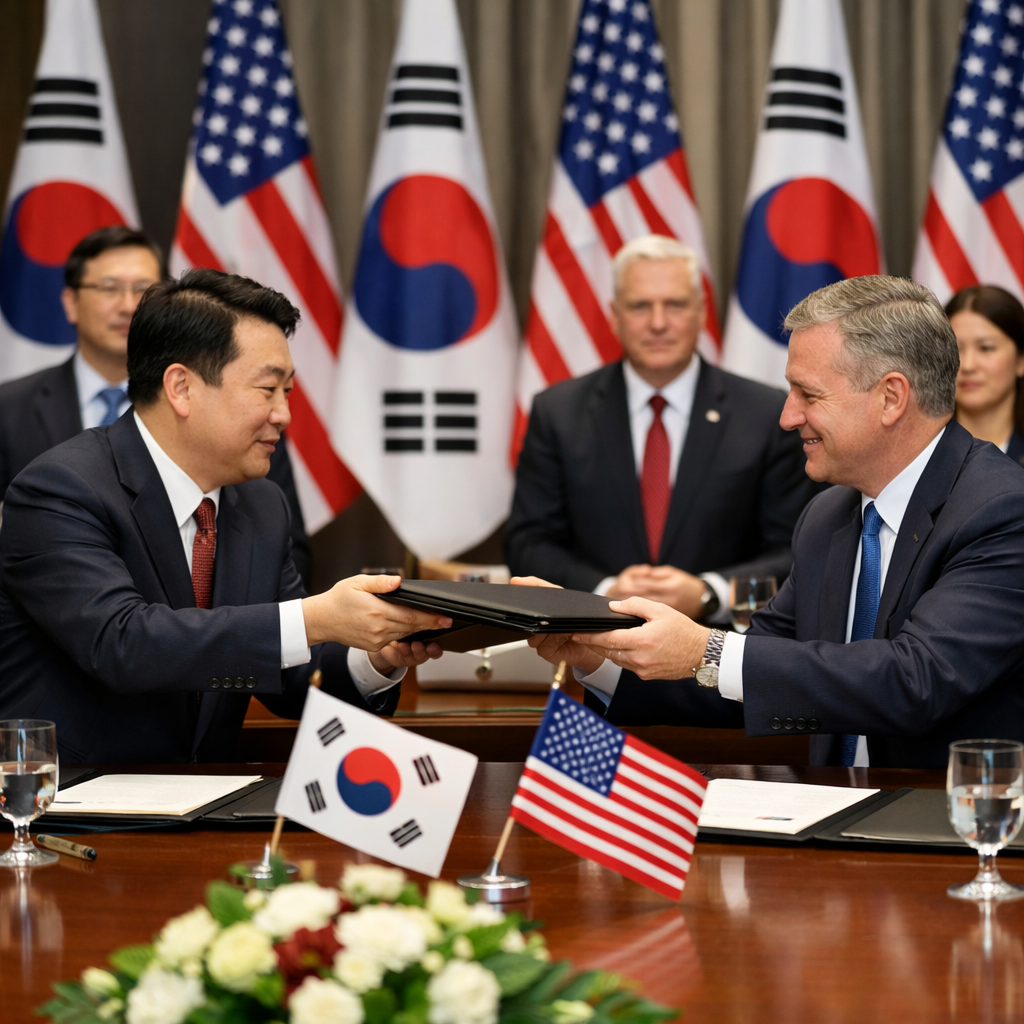

A New Industrial Alliance Between Washington and Seoul
On 12 March 2026, South Korea’s National Assembly passed a bipartisan bill enabling a $350 billion investment commitment in strategic industries in the United States, including semiconductors, shipbuilding, pharmaceuticals, critical minerals, energy, artificial intelligence, and quantum computing.
The legislation establishes a state-backed investment structure and formalizes a major industrial partnership tied to earlier trade negotiations between the two countries. The program includes $200 billion for strategic industry investments and $150 billion focused on shipbuilding cooperation, with oversight from both Korean and U.S. authorities.
At first glance, the announcement appears to be a conventional trade and investment arrangement. In reality, it represents something more significant: the consolidation of supply-chain geopolitics as the central organizing principle of global industrial policy.
Industrial Policy Has Become the New Trade Policy
For decades, trade agreements primarily focused on tariffs and market access. The South Korea–U.S. investment framework reflects a structural shift in how major economies are managing economic relationships.
The modern version of trade policy is now built around three pillars:
- Strategic industry placement
- Supply-chain security
- Technology sovereignty
Under the newly approved framework, investment decisions will be assessed not only for commercial viability but also for national security and supply-chain resilience considerations.
This signals a broader global trend: capital flows between major economies are increasingly guided by strategic alignment rather than pure market logic.
The South Korea decision effectively institutionalizes this reality.
Why Semiconductors, Shipbuilding, and AI Matter
The sectors prioritized under the agreement are not accidental.
Each reflects a critical node in the global industrial system:
- Semiconductors underpin digital infrastructure and defense systems
- Shipbuilding supports maritime logistics and naval capacity
- Critical minerals enable battery manufacturing and advanced electronics
- Artificial intelligence and quantum computing define next-generation technological competitiveness
By embedding Korean capital into U.S. industrial expansion in these areas, both countries are reinforcing a shared technological ecosystem.
For Washington, the strategy diversifies supply chains away from geopolitical rivals.
For Seoul, it ensures continued access to the world’s largest technology market.
The Strategic Logic: Risk Diversification Through Alliances
The bill also arrives at a moment of rising trade tension and tariff threats. Earlier warnings of potential U.S. tariffs on allies underscored how fragile supply chains can become in periods of geopolitical friction.
South Korea’s response illustrates a pragmatic adaptation:
invest directly inside the partner economy rather than relying solely on exports.
This model accomplishes several goals simultaneously:
- Reduces tariff exposure
- Anchors political alliances through capital
- Secures long-term market access
- Aligns industrial policy across allied economies
In effect, investment becomes the new currency of diplomatic stability.
A Template for Future Economic Blocs
The deeper implication of the South Korea–U.S. arrangement is that it may become a template for future economic alliances.
Rather than traditional free-trade agreements, the next generation of partnerships will likely revolve around:
- Joint industrial funds
- Strategic technology investment pools
- Coordinated supply-chain planning
These structures create economic interdependence that is harder to unwind than tariff agreements alone.
The European Union, Japan, and several Indo-Pacific economies are already moving in similar directions through critical-minerals partnerships and technology investment alliances.
What This Means for Emerging Markets
For emerging economies, the shift carries both opportunity and risk.
On one hand, countries that possess critical resources, manufacturing capacity, or logistics advantages can position themselves as partners in these industrial networks.
On the other, the rise of tightly integrated economic blocs could concentrate high-value technology ecosystems within strategic alliances, leaving others outside.
The policy challenge for emerging markets is therefore clear:
they must align with global supply chains not merely as exporters, but as industrial participants in strategic sectors.
The Future of Global Trade Is Being Written Through Capital
The South Korean investment bill marks a defining moment in how global economic relationships are evolving.
Trade is no longer only about moving goods across borders.
It is increasingly about where factories are built, where research is conducted, and where strategic technologies are financed.
In that sense, the $350 billion commitment from Seoul is not simply an investment program.
It is a signal that the next era of globalization will be shaped less by tariffs and more by industrial alliances built through capital deployment.



online tadalafil
online tadalafil
dutasteride for hair loss male
dutasteride for hair loss male
30 mg prevacid over the counter
30 mg prevacid over the counter
lasix medicine price
lasix medicine price
fluconazole for yeast infection over the counter
fluconazole for yeast infection over the counter
lasix water pill over the counter
lasix water pill over the counter
tadalafil health benefits
tadalafil health benefits
sémaglutide oral prix
sémaglutide oral prix
does finpecia work
does finpecia work
doxycycline side effects burning eyes
doxycycline side effects burning eyes
does metronidazole work on rosacea
does metronidazole work on rosacea
acyclovir 800 mg picture
acyclovir 800 mg picture
xenical doses
xenical doses
terbinafine reference page
terbinafine reference page
ivermectin scabies benefits
ivermectin scabies benefits
ivermectin mechanism breakdown
ivermectin mechanism breakdown
minoxidil action timeline
minoxidil action timeline
vardenafil 10 mg tablet summary
vardenafil 10 mg tablet summary
avanafil risk‑based contraindications
avanafil risk‑based contraindications
vardenafil 5 mg analysis
vardenafil 5 mg analysis
vardenafil duration profile
vardenafil duration profile
vardenafil vs sildenafil PK
vardenafil vs sildenafil PK
online safety verification
online safety verification
otitis media key information
otitis media key information
Educational PK Resource
Educational PK Resource
Drug Timing Reference
Drug Timing Reference
which lasts longer sildenafil or tadalafil
which lasts longer sildenafil or tadalafil
Sildenafil vs Cialis Onset Differences Explained
Sildenafil vs Cialis Onset Differences Explained
a guide to the drug sildenafil
a guide to the drug sildenafil