
South Africa has bought itself a fiscal cushion. On 28 April 2026, the National Treasury and the Department of Mineral and Petroleum Resources jointly confirmed that the temporary fuel levy relief, initially introduced on 1 April in response to the Middle East conflict, will be extended through June 2026. The decision carries a total price tag of R17.2 billion in foregone tax revenue. It is a politically necessary, economically rational, and strategically precarious move, all at once.
The announcement confirms what many economists had already anticipated: global oil prices, pushed above $100 a barrel by supply disruptions from the US-Israel-Iran conflict, are not retreating fast enough for government to exit its relief position on schedule. With the rand under pressure and diesel prices having reached record highs in April, the social and inflationary consequences of an abrupt withdrawal were deemed untenable.
A Phased Exit, Not an Open Commitment
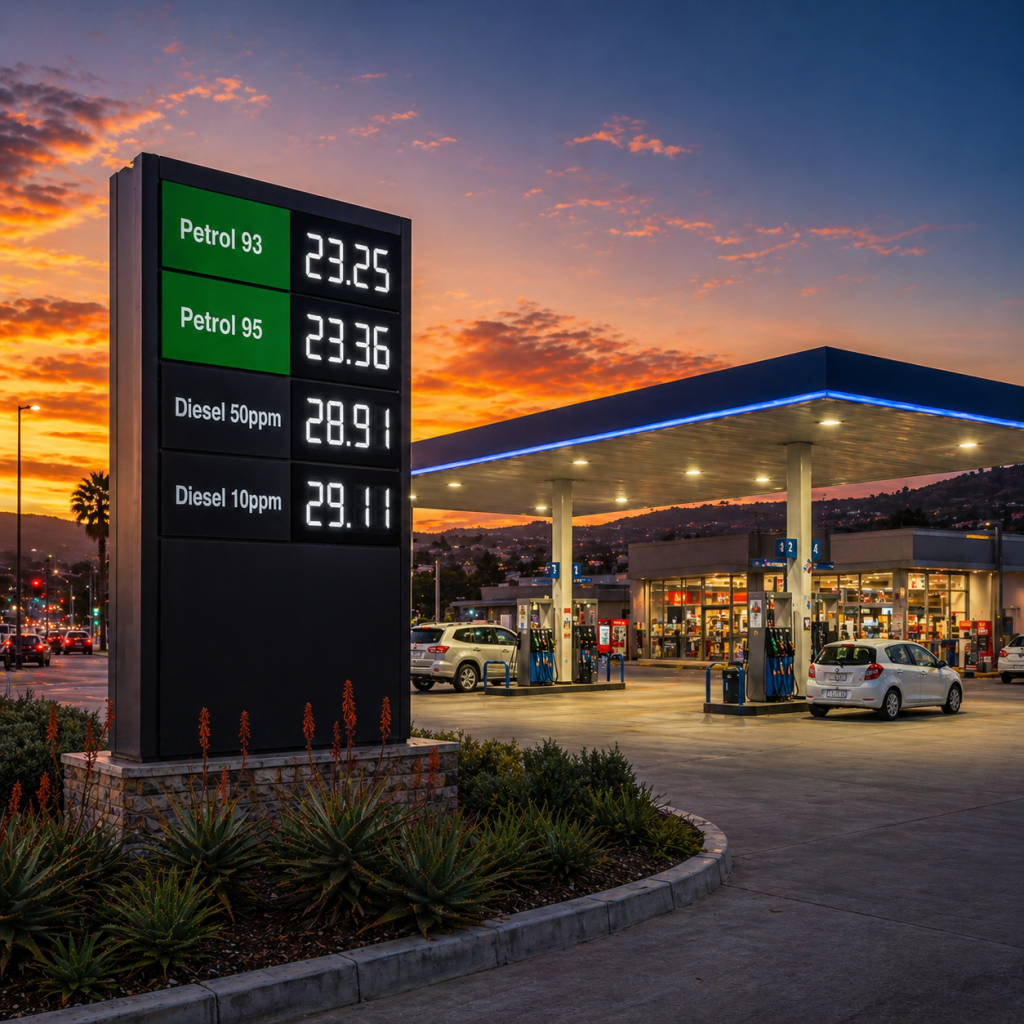
What distinguishes this extension from a blanket fuel subsidy is its architecture. The R3 per litre relief on petrol will be maintained through to 2 June, after which the relief is halved to phase out the measure before July. From 1 July, the general fuel levy for petrol returns to R4.10 per litre and diesel to R3.93 per litre. This phased structure signals that government is not abandoning fiscal discipline, it is managing a landing, not an indefinite hover.
That distinction matters enormously for sovereign credibility. Treasury has explicitly stated that the package is “designed to be revenue neutral” and will be funded through “a combination of higher-than-expected tax revenue and underspending,” adding that it “will not have an impact on the fiscal framework adopted by Parliament following the 2026 Budget.” If that commitment holds, it is a sophisticated piece of fiscal engineering, absorbing an external shock without structurally widening the deficit.
What This Means for Inflation and the SARB
The South African Reserve Bank entered 2026 on a cautious trajectory, having held the repo rate at 6.75% in January after a 150-basis-point cutting cycle from late 2024. Its mandate is increasingly anchored at a 3% inflation target. February’s CPI reading came in precisely at that figure. April threatened to undo that discipline entirely.
KPMG South Africa’s Lead Economist Frank Blackmore noted that without the intervention, the inflationary impact of the April fuel shock would have added approximately one percentage point to the Consumer Price Index. With the levy reduction, the expected contribution was closer to 0.6%. The extension into May and June, with a partial phaseout, keeps that buffer in place through the first half of the year, preserving the SARB’s optionality.
This is the critical insight: the fuel levy extension is not just a consumer relief measure. It is a monetary policy co-ordination instrument. By compressing inflationary pressure in Q2, Treasury is reducing the probability that the SARB is forced into a reactive rate hike cycle in a period of global uncertainty. That co-ordination, if it holds, benefits every borrower, every mortgage holder, and every business carrying variable-rate debt across South Africa.
The Fiscal Arithmetic and Its Limits
The R17.2 billion figure requires sober assessment. South Africa’s 2026 budget projected a primary surplus and a debt-stabilisation path that required tight expenditure management. The fuel levy relief was not budgeted. Treasury’s argument that it will be absorbed by revenue overruns and underspending is credible, but only if both conditions persist simultaneously through the quarter.
Finance Minister Enoch Godongwana characterised the 2026 budget as a turning point in South Africa’s public finances, heralding improved confidence, increased growth, and rising infrastructure investment. That narrative now carries an asterisk. Absorbing R17.2 billion in emergency fiscal accommodation while maintaining the primary surplus target is achievable, but it narrows the margin for any further external shock between now and July.
Rating agencies will be watching. The question they will ask is not whether this specific intervention is justified, most analysts accept that it is, but whether South Africa’s fiscal buffers are deep enough to absorb a second or third disruption of this scale. The answer, at present, is uncertain.
The Structural Question No One Is Asking Loudly Enough
Behind the headline relief measure is a more durable problem. South Africa’s fuel pricing mechanism remains fully exposed to the intersection of dollar-denominated oil benchmarks and rand volatility. South Africa’s fuel prices are directly linked to global benchmarks quoted in US dollars at refined petroleum export-oriented centres in the Mediterranean, the Arab Gulf, and Singapore. Every geopolitical disruption that moves oil and weakens the rand simultaneously becomes a domestic inflation event with no structural defence.
The fuel levy extension, as designed, ends on 1 July 2026. At that point, the general fuel levy for petrol returns to R4.10 per litre and diesel to R3.93 per litre. If oil prices remain above $100 a barrel and the rand has not materially recovered, South African motorists and logistics operators will face a price shock in Q3 that has been deferred, not absorbed. The political and inflationary consequences of that scenario will be more complex to manage, particularly given that local government elections are expected in the latter part of 2026.
The Path Forward
Government has signalled that a broader package of medium-term fuel pricing reforms is under consideration. That signal must be converted into policy, and quickly. The structural reform agenda should focus on three areas.
First, a review of the fuel pricing formula to introduce greater smoothing mechanisms that reduce the immediacy of global price pass-throughs to domestic consumers, without eliminating market discipline. Second, a targeted support architecture for logistics and agriculture, the two sectors most exposed to diesel price volatility and most consequential for food inflation. Third, a credible and pre-committed exit strategy for any future emergency levy relief, so that markets and rating agencies can price temporary interventions without treating them as signals of fiscal weakness.
The R17.2 billion decision is defensible. The extension is rational. But the July cliff, when the full levy returns in an environment that may still be defined by elevated global oil prices, rand pressure, and geopolitical uncertainty, represents a test that temporary fiscal relief cannot pass alone. The structural work must begin now.