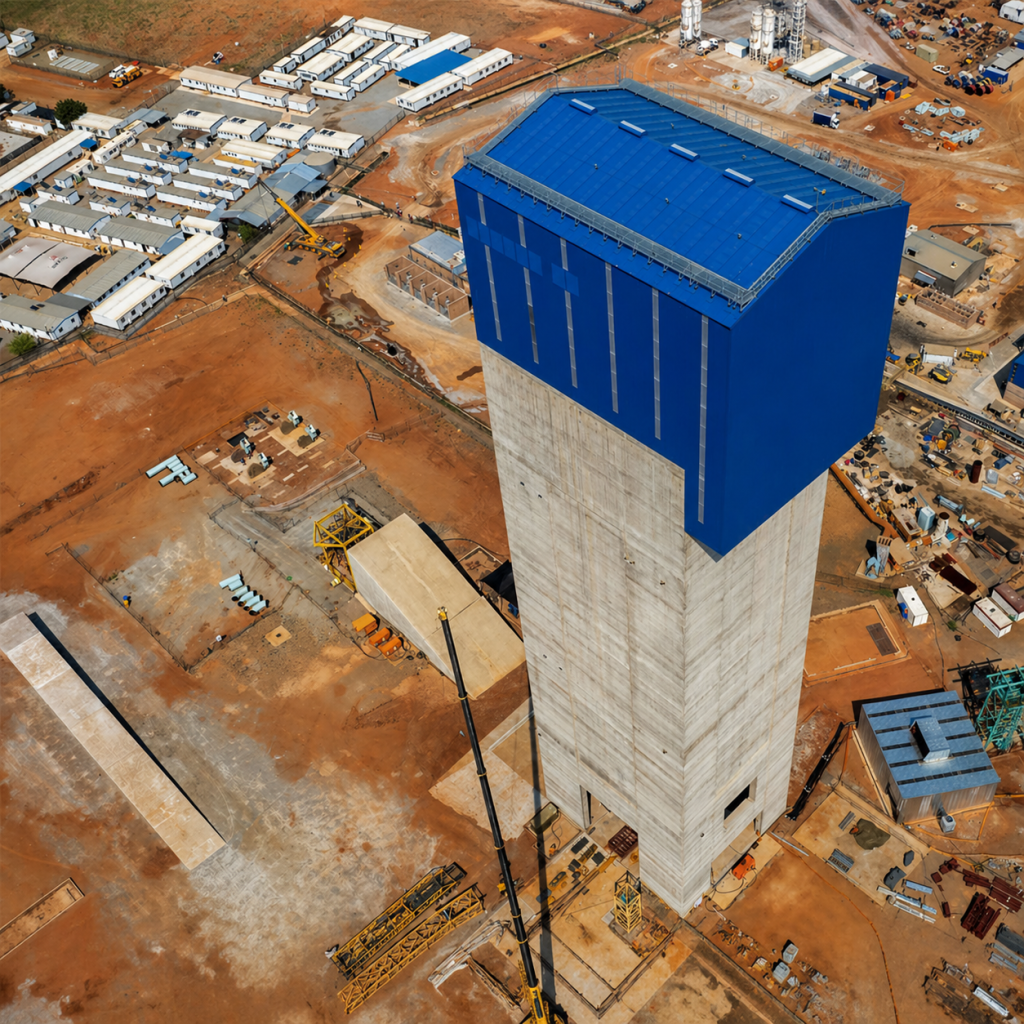

Ivanhoe Mines marked a significant operational advance at its Platreef Mine in Limpopo Province on April 23, 2026, when the company held a formal on-site ceremony to confirm the simultaneous completion of three major construction milestones, a convergence of delivery that positions the project for a near five-fold increase in precious metals production within 18 months.
The milestones announced include the completion of construction of the 4-million-tonne-per-annum Shaft #3, the breaking of ground for the Phase 2 concentrator site, and the commencement of widening works on Shaft #2. Each milestone advances a distinct and interdependent strand of the Phase 2 expansion, and together they signal that Platreef’s build-out is executing on schedule across all three fronts simultaneously.
Shaft #3: Five-Fold Hoisting Capacity Now Live
The completion of Shaft #3 is the most immediately consequential of the three milestones. Its installation increases the total available hoisting capacity at Platreef five-fold to approximately 5 million tonnes per annum, while also enabling greater flexibility in hoisting both ore and waste rock to the surface, a critical operational requirement as the mine accelerates its Phase 1 ramp-up. The shaft provides the infrastructure foundation upon which Phase 2 production targets are built.
Phase 2 Concentrator: Ground Broken, Delivery Targeted for Q4 2027
The Ivanplats project team broke ground on the Phase 2 concentrator site on April 9, 2026. DRA Global is serving as the engineering, procurement, and construction management contractor for both the Phase 2 underground infrastructure and the 3.3-million-tonne-per-annum Phase 2 concentrator. DRA Global previously delivered Platreef’s Phase 1 concentrator on schedule in June 2024, establishing a track record of delivery on this project.
The Phase 2 concentrator is targeted for completion by the end of next year, with procurement of long-lead mechanical and electrical equipment already underway.
Shaft #2: Africa’s Largest Hoisting Shaft Under Construction
The third milestone involves the widening of Shaft #2, a multi-year construction programme that carries substantial long-term significance. The shaft was initially raised-bored to a diameter of 3.1 metres. The contract to widen it to a final diameter of 10 metres was awarded to United Mining Services of Johannesburg, with the first slipe blast completed on April 1, 2026.
Once operational, Shaft #2 is set to become the largest hoisting shaft on the African continent. It is expected to hoist labour and materials by end of 2028 and ore by end of 2029, supporting both Phase 2 steady-state operations and the eventual Phase 3 expansion.
The Production and Cost Case
The Phase 2 expansion is expected to increase annualized production almost five-fold to over 460,000 ounces of platinum, palladium, rhodium, and gold, plus approximately 9,000 tonnes of nickel and 6,000 tonnes of copper.
The project’s cost structure is a central part of its global competitiveness argument. The Phase 2 life-of-mine total cash cost is estimated at $599 per ounce of platinum, palladium, rhodium, and gold, net of nickel and copper by-product credits. Life-of-mine total cash costs are projected to fall further to $511 per ounce following the Phase 3 expansion, comparing favourably with a basket spot price of approximately $2,000 per ounce as at April 22, 2026.
That margin structure, a cost base less than a third of prevailing spot prices, makes Platreef one of the most compelling large-scale mining investment cases currently under active construction anywhere in the world.
Stakeholder Composition and Strategic Significance
In attendance at the ceremony were Ivanhoe’s management team led by CEO Marna Cloete, and other key stakeholders including representatives from the broad-based black equity empowerment group and the JOGMEC-ITOCHU consortium, which own 26% and 10% of the mine, respectively.
The Japanese industrial and government capital represented by JOGMEC and ITOCHU reflects the degree to which Platreef has been recognised as a strategic critical minerals asset by foreign sovereign and corporate investors, not merely a South African mining project. Platinum, palladium, rhodium, nickel, and copper are all on critical minerals lists across multiple jurisdictions, and Platreef sits atop a resource capable of supplying all five at scale.
According to a preliminary economic assessment, completion of all expansion phases would take Platreef’s annual precious metals production to over 1 million ounces, plus approximately 22,000 tonnes of nickel and 13,000 tonnes of copper.
What It Means
Three simultaneous construction milestones at a single site, all on schedule, represent an execution standard that is uncommon in large-scale underground mining. For South Africa’s mining sector, Platreef is becoming a proof point for what mechanised, deep-resource, capital-backed industrial extraction can deliver. For Limpopo Province, the economic footprint of a fully operational Platreef will extend well beyond the mine gate: into logistics, services, employment, and local supply chains.
The Phase 2 concentrator is targeted for Q4 2027. The construction clock is running.