
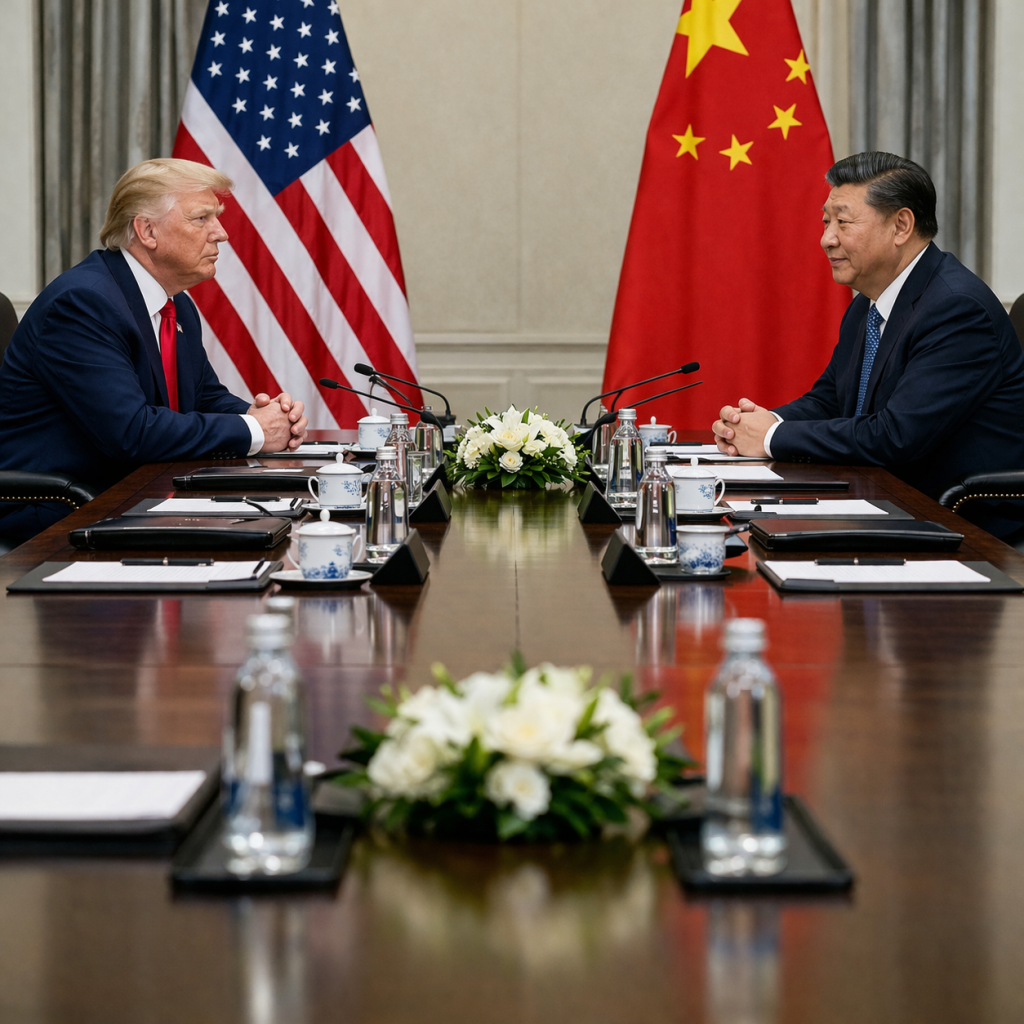

The White House confirmed on 25 March 2026 that U.S. President Donald Trump will travel to Beijing on May 14 and 15 for a leaders’ summit with Chinese President Xi Jinping, rescheduling a meeting that had originally been planned for late March before being postponed due to U.S. military operations tied to the conflict with Iran.
White House Press Secretary Karoline Leavitt announced the new dates and confirmed that Xi would visit Washington at a later date to be announced this year. The summit will be the first direct engagement between the two leaders since the U.S. Supreme Court struck down Trump’s sweeping reciprocal tariff regime in February, a ruling that materially altered the balance of leverage heading into Beijing.
A Relationship Built on Fragile Ground
The diplomatic backdrop is one of managed tension. The two countries reached a partial trade truce at the APEC summit in Busan, South Korea in October 2025, where both sides agreed to take specific steps to de-escalate trade tensions that had recently escalated through mutual imposition of new export control measures. That agreement suspended a range of escalatory measures on both sides and set the stage for the now-rescheduled Beijing meeting.
But the intervening months have not been straightforward. The U.S. Supreme Court’s decision to strike down Trump’s sweeping tariffs has strengthened China’s hand, with one former U.S. trade representative saying Trump has “effectively had his wings clipped on his signature economic policy.” Beijing’s commerce ministry confirmed it was assessing the ruling’s impact, a signal that China intends to factor the changed legal landscape into its negotiating posture.
Adding further friction, the U.S. launched sweeping trade investigations under Section 301 of the Trade Act of 1974 in the weeks before the originally planned summit, aimed at identifying unfair trade practices and structural excess capacity in Chinese manufacturing sectors. The timing was characterised by analysts as deliberate leverage-building ahead of a high-stakes meeting.
What Is on the Table
The agenda heading into May is substantial on both sides. Officials from both countries, including U.S. Trade Representative Jamieson Greer and Treasury Secretary Scott Bessent, met in Paris in March and expressed willingness to stabilise relations, with discussions underway on a possible trade enforcement panel — a mechanism Greer has called “a U.S.-China Board of Trade.”
Washington is expected to push for expanded Chinese purchases of U.S. agricultural products, including soybeans and corn, as well as Boeing aircraft and energy exports. Multiple agricultural sectors are pressing for outcomes, with Trump having floated additional Chinese purchases of 8 million metric tons of soybeans as a key pressure valve for U.S. producers.
For Beijing, the priorities run in a different direction. China aims to address technology export controls, the U.S. Department of Commerce’s entity list, and restrictions on Chinese direct investment in the United States, nudging Washington to loosen semiconductor and AI-related controls and remove sanctions against Chinese firms.
The Taiwan question looms over the entire agenda. Xi told Trump during a February 4 phone call that Taiwan is “the most important issue in China-U.S. relations,” and Beijing is widely expected to press Washington to constrain future arms sales to Taipei. An $11.1 billion U.S. arms package to Taiwan announced in late 2025 has already inflamed relations and set a charged diplomatic context for the May meeting.
The Rare Earths Variable
Critical minerals remain one of the most consequential pressure points in the relationship. Under the Busan framework, Beijing agreed to issue general licenses for the export of rare earth minerals to the United States, including gallium, germanium, antimony, and graphite, effectively removing controls imposed in 2022 and 2025, in exchange for U.S. tariff rollbacks. Those suspensions are time-bound, and their renewal or expansion will be central to May’s discussions.
China controls approximately 70% of global rare earth mining and 90% of processing capacity, giving Beijing effective leverage over defence, semiconductor, and automotive supply chains in the United States and allied economies. The Busan truce demonstrated that China is willing to use that leverage actively, and that Washington has limited short-term alternatives.
The Broader Signal
The rescheduling of the summit, while ostensibly driven by the Iran conflict, has reinforced a broader pattern: Beijing has structured 2026 as a year of sequenced, pre-planned leader-level engagements designed to introduce a degree of predictability, or at minimum, plannability, into a relationship defined by U.S. unpredictability. Xi’s expected reciprocal visit to Washington later this year, tied to the G20, extends that architecture further.
For global markets, the May summit is a material event. The trajectory of tariffs on Chinese goods, the durability of rare earth export licences, the fate of technology transfer restrictions, and the structure of any new bilateral trade enforcement mechanism will shape industrial supply chains, commodity flows, and capital allocation across multiple sectors and geographies for years ahead.
Whether the meeting delivers a durable framework or another time-limited truce, the direction of travel between the world’s two largest economies is being set now.


