
Rhodium, the rarest and most strategically concentrated of the platinum group metals, is commanding renewed global attention as supply constraints intensify and industrial demand accelerates. With South Africa accounting for over 80% of global rhodium output, the country’s Bushveld Complex operations are once again at the centre of one of the world’s most structurally constrained commodity markets.
Global rhodium prices reached $307,099 per kilogram in December 2025, with an upward pricing movement of 9.9% registered between September and December of that year. The metal rebounded sharply in 2025, rising 94.72%, a move that underscored just how sensitive rhodium pricing is to shifts in industrial demand and tight global supply.
A Metal Defined by Scarcity
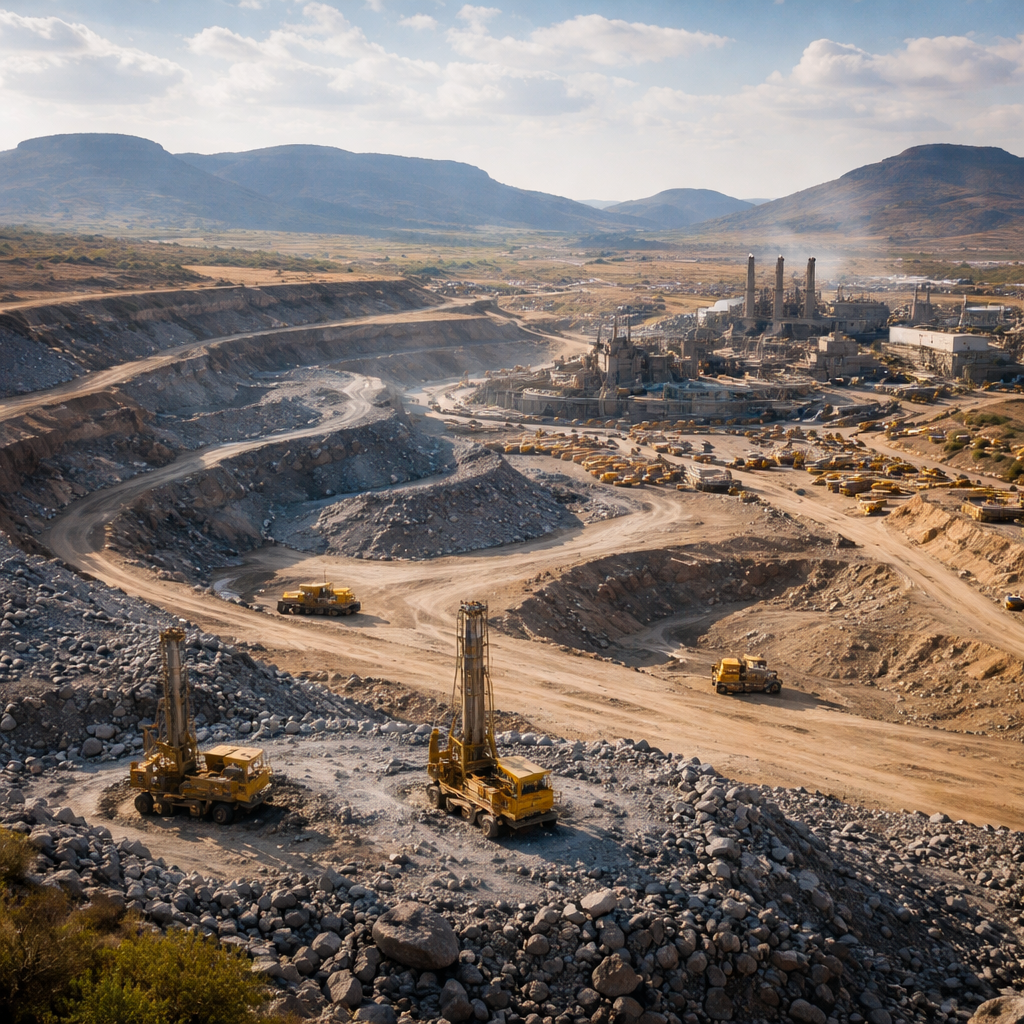
Rhodium is not mined independently. It appears as a byproduct of platinum and palladium extraction, with South Africa providing the majority of overall output. Any mining slowdown, power instability, labour restriction, or geopolitical disruption can sharply impact availability.
Annually, approximately 25 tonnes of rhodium are mined globally, with 85% coming from South Africa, where all the major producers are located. Russia, Zimbabwe, and Canada account for the remaining 14%. Recycling also plays a role, returning approximately 10 tonnes per year to the market.
The three dominant South African producers, Impala Platinum, Sibanye-Stillwater, and Anglo American Platinum (Amplats), collectively underpin global supply. Sibanye-Stillwater’s South African PGM prill split in 2024 was approximately 59% platinum, 30% palladium, 9% rhodium, and 2% gold.
Supply Disruptions Drive Price Action
The first quarter of 2025 delivered a significant market signal. Flooding in parts of South Africa in late February prompted Amplats to temporarily halt operations at its Tumela mine, which accounts for 10% of the group’s output. The disruption coincided with active market buying by Amplats itself. Johannesburg-based Amplats, the world’s third-largest rhodium producer after Impala Platinum and Sibanye-Stillwater, had sought to buy or borrow the metal on the spot market, a move that unnerved consumers who had anticipated prices would fall.
Metals Focus noted that rhodium’s 2025 deficit would reduce above-ground stocks by 23% to 349,000 troy ounces, their lowest level in at least 40 years and equal to just four months of demand. The consultancy flagged that with a portion of those inventories locked in work-in-progress, the market remains susceptible to physical squeezes.
Automotive Demand Remains the Structural Anchor
The automotive sector is the dominant demand driver, with over 80% of rhodium consumed in catalytic converters as countries worldwide enforce stricter emissions standards to reduce nitrogen oxide output, prompting manufacturers to increase rhodium loading per vehicle.
In Q4 2025, rhodium prices in Europe surged 18.61% quarter-on-quarter as automotive manufacturers increased rhodium loadings to comply with stringent Euro 7 emission standards. Global supply constraints persisted, as production remained concentrated in South Africa and secondary supply from recycling was unable to meet rising demand.
The regulatory environment is adding further structural pressure. Tougher emission rules now fully enforced in China, India, and Europe are compelling automakers to rely on high-load rhodium catalysts, despite the accelerating EV transition. As long as internal combustion engines remain on the road, rhodium retention is non-negotiable.
New Capacity Entering the Pipeline
South Africa’s mining sector is responding to the structural deficit with new investment. Ivanhoe Mines confirmed it is in advanced talks to raise $700 million to fund Phase 2 of its Platreef mine, with Phase 1 expected to begin production targeting an annual output of 100,000 ounces of platinum, palladium, rhodium, and gold. Tharisa also unveiled a $547 million underground expansion plan to extend production beyond 2035.
These investments signal measured confidence in the medium-term PGM thesis, even as the industry continues to absorb the impact of prior cost-cutting cycles and structural job reductions across major producers.
The Long-Term Structural Question
The EV transition remains the principal demand risk. If hybrid and internal combustion vehicle production stays steady, rhodium could remain in the $8,000 to $9,500 per ounce range through 2026. If emission restrictions tighten further and mining regions face material disruption, pricing could reach or exceed $10,000 to $12,000 per ounce.
Supply elasticity remains extremely low. New rhodium production does not simply ramp up in response to higher prices — it is locked into PGM mining cycles that take many years to adjust. That structural reality means South Africa’s dominance over global rhodium supply is not just a statistical fact, it is a permanent feature of global industrial risk.
The global rhodium market is expected to be valued at $2.67 billion in 2026. South Africa will produce the overwhelming majority of it.