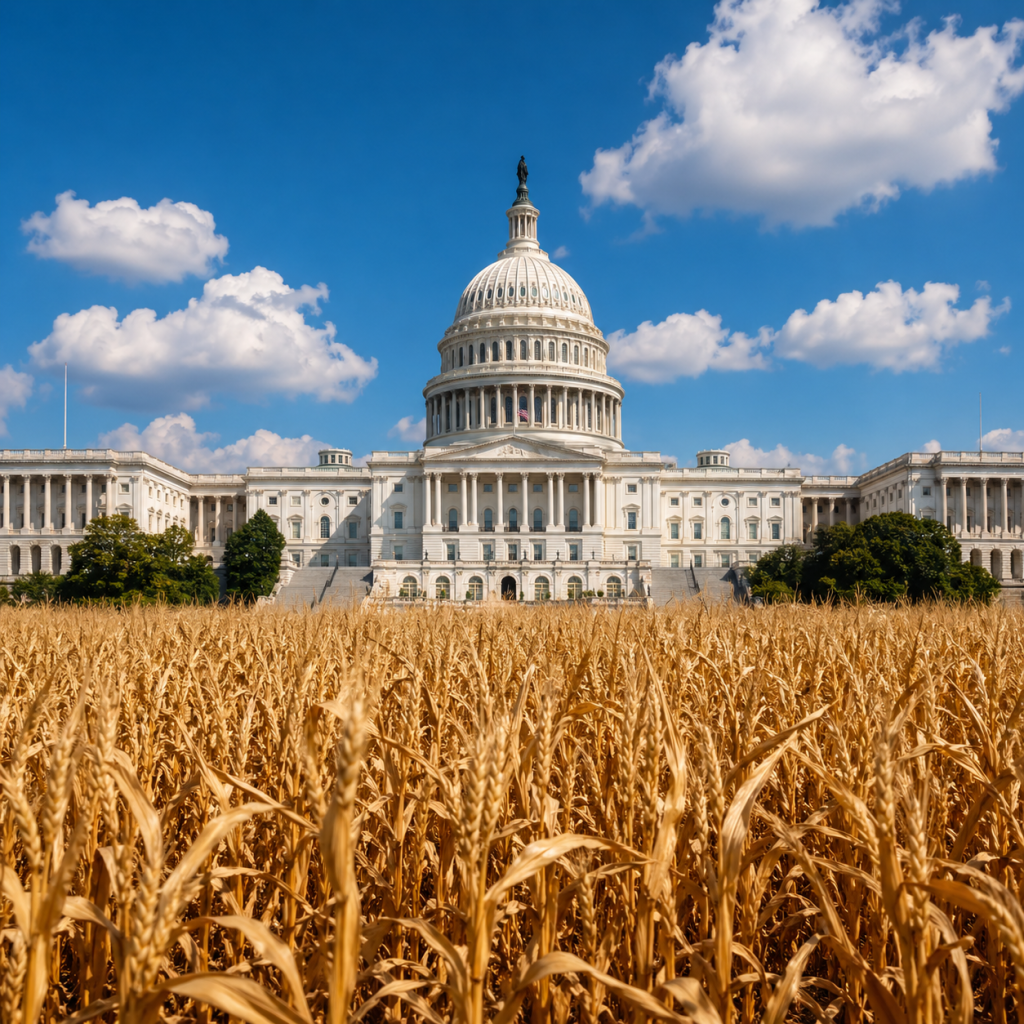

The United States House of Representatives took a decisive step today toward reshaping American agricultural and food policy, as the House Rules Committee convened at 1:00 PM ET on April 27, 2026, to advance H.R. 7567, the Farm, Food, and National Security Act of 2026, to the full House floor for a vote this week.
The development marks the most significant movement on U.S. food and farm legislation since 2018, and carries wide-ranging implications for global food markets, commodity flows, nutrition programmes, rural infrastructure, and agribusiness investment.
Eight Years in the Making
The House Agriculture Committee approved the Farm, Food, and National Security Act of 2026 after more than 20 hours of debate by a margin of 34 to 17, with all Republican committee members and seven Democrats voting in favour. The bill then entered the Rules Committee process before being cleared for full House consideration.
House Rules Committee Chair Virginia Foxx announced the committee would meet the week of April 27 to provide for floor consideration of H.R. 7567. The Rules Committee controls the time for debate, whether the bill can be amended, and which amendments can be considered before the full House votes.
House Agriculture Committee Chairman Glenn “GT” Thompson confirmed the timeline directly. “We have sent the text last week to the Rules Committee. Members have this week in order to submit amendments. And then the week of April 27th, the farm bill will be on the floor,” Thompson said, adding that “this bill is long overdue” and that the 2018 farm bill “doesn’t really provide what our farm and ranch families need here in 2026.”
What the Bill Covers
The Farm, Food, and National Security Act of 2026 spans all 12 titles of the traditional farm bill. Among its focus areas are expanded rural community investments, restored regulatory certainty in the interstate marketplace, improved risk management tools for specialty crop producers, lower energy costs in rural America, expanded producer access to credit, promotion of precision agriculture, and enhanced conservation programmes for working lands.
The legislation also incorporates significant nutrition and food assistance provisions. A coalition of 330 farm groups wrote to House Speaker Mike Johnson and House Minority Leader Hakeem Jeffries urging passage, noting that farmers and agribusinesses have been operating under farm bill policies written in 2018 and that “agriculture and rural America cannot continue to manage the challenges of 2026 with the solutions from 2018.”
Pressure from Rising Input Costs
The urgency behind the legislation is driven in part by deteriorating farm economics. Among the economic headwinds cited by agricultural organisations are high input costs including fuel and fertiliser, which have risen sharply due to ongoing global conflicts, supply chain disruptions, and uncertainty in both domestic and foreign demand.
These dynamics have direct consequences for global food markets. The United States is among the world’s largest exporters of maize, soybeans, wheat, and processed food commodities. Any shift in domestic farm support structures, credit availability, or conservation spending carries downstream consequences for international buyers, including African markets that rely on U.S. agricultural exports and pricing benchmarks.
A Tight Vote Ahead
House Republican leaders are working to secure votes, but given tight margins and some opposition within their own party, they will need Democratic support to pass the bill. Currently, there are 217 Republicans, 214 Democrats, one Independent, and three vacancies in the House.
House Agriculture Democrats have described the farm bill as an opportunity to mark a contrast on affordability, an issue that has come to dominate political messaging across both parties. Negotiations over food assistance programme cuts and ethanol policy remain the principal fault lines.
Global Stakes
For decision-makers outside the United States, the implications are concrete. The bill’s conservation and regenerative agriculture funding, which includes $400 million through the Environmental Quality Incentives Programme and $300 million through the Conservation Stewardship Programme dedicated to regenerative agriculture projects in fiscal year 2026, signals a structural shift in how American farmland is managed and capitalised.
For African importers and processors, U.S. food policy determines commodity price floors, export availability, and the terms under which American agricultural products enter global supply chains. A modern, fully enacted U.S. farm bill would restore regulatory clarity to those supply chains, clarity that has been absent for the better part of a decade.
The House floor vote is expected this week.