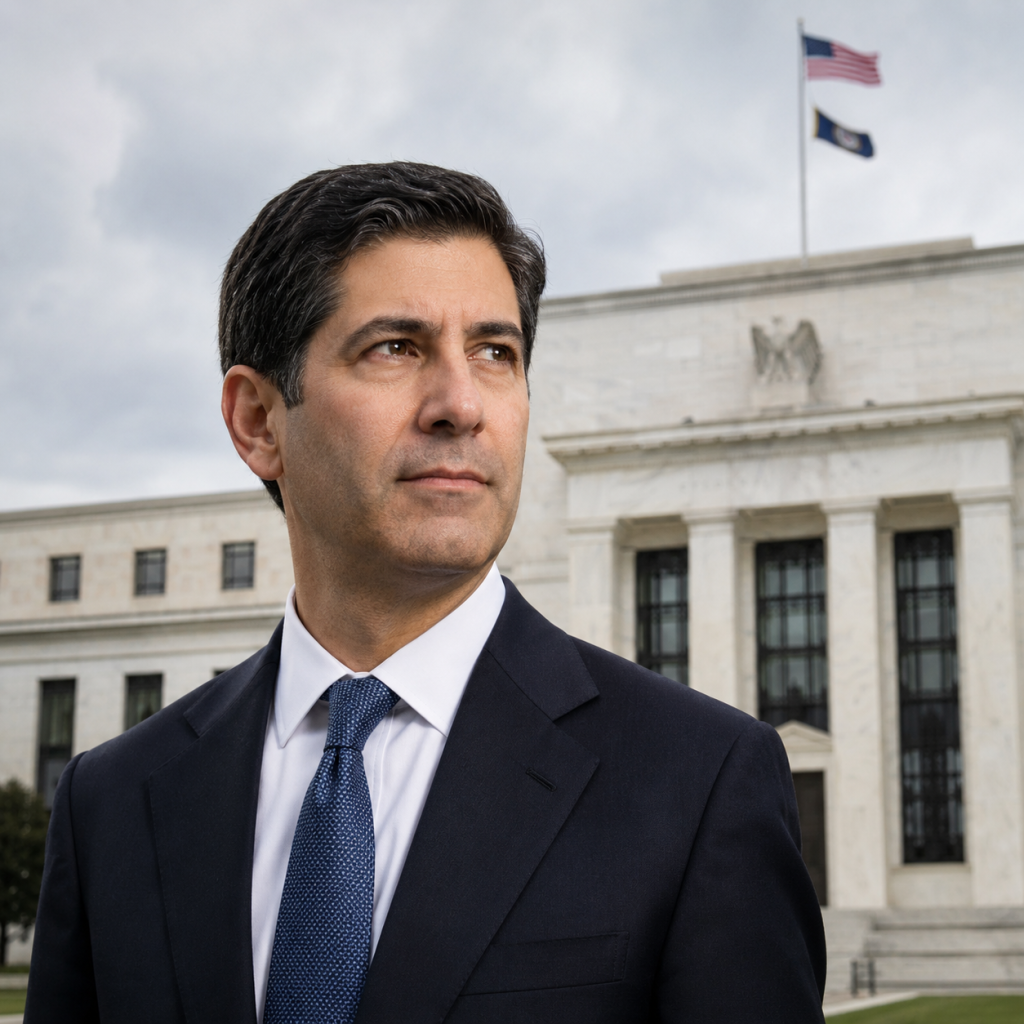

On May 13, 2026, the United States Senate confirmed Kevin Warsh as the 17th Chair of the Federal Reserve in a 54-45 vote, the most partisan confirmation of a Fed chair in modern history. Jerome Powell, who has led the Fed since 2018, formally departs the chairmanship today, Friday May 15, though he remains on the Fed’s governing board as a rank-and-file governor. The transition is not procedural. It is structural. And for South Africa and the broader emerging market world, it opens a period of heightened financial sensitivity that demands immediate strategic attention.
The confirmation does not arrive in a vacuum. Warsh takes over at a time when inflation has remained above the Fed’s 2% target for over five years and is being further pressured by tariffs and a surge in oil prices linked to the conflict in the Middle East. An index of producer prices jumped 6% in April from a year earlier, the fastest pace since December 2022. This is not a benign handover. It is a transfer of authority at precisely the moment when the central bank’s decisions carry the highest global consequence.
The central question for emerging markets is straightforward: will Warsh cut, hold, or hike? The answer, at this stage, is genuinely uncertain, and that uncertainty is itself the first risk.
Warsh has spent years positioning himself as a critic of the monetary consensus. Since leaving the Fed, he has been a consistent critic of monetary policy and in a CNBC interview last year, called for “regime change” at the central bank. During his confirmation hearings, he signalled openness to rate reductions, framing artificial intelligence as a disinflationary force with the capacity to justify easier policy even when headline inflation remains elevated. Yet the inflation data he inherits makes that case difficult to sustain in the near term. Traders largely expect the Fed to hold rates steady for the rest of 2026, though the odds for a rate hike have risen to 20% for October and are pegged at 30% for December.
For South Africa, this environment lands on already fragile ground.
The South African Reserve Bank held its key repo rate at 6.75% on March 26, 2026, marking a second consecutive pause, citing upside risks to the inflation outlook due to the ongoing Middle East conflict. Policymakers revised their policy outlook, now projecting only one rate cut instead of two previously. That single projected cut already reflected caution. A Warsh-led Fed that remains restrictive, or signals a hawkish recalibration, could eliminate even that limited room.
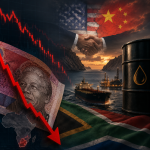
The mechanism is well understood by anyone operating in South African capital markets. When the Federal Reserve keeps rates elevated or signals tighter policy ahead, global capital gravitates toward dollar-denominated assets. When the Fed is hawkish or keeps rates higher for longer, global money tends to flow back to the US, putting pressure on emerging markets like South Africa through a weaker rand, higher bond yields, and tighter financial conditions. South Africa is not merely exposed to this dynamic, it is among the most exposed. South Africa has deep, liquid financial markets and is widely used by global investors as a proxy for emerging markets, meaning money moves in and out quickly when global sentiment changes.
The rand’s vulnerability to this repricing is not theoretical. It is current. And a stronger dollar, driven by a Fed that refuses to capitulate to rate cut pressure, compresses the SARB’s room to act even when domestic inflation conditions might otherwise permit easing. A more restrictive stance from the Fed could directly influence South Africa’s own interest rate outlook in 2026, limiting the South African Reserve Bank’s ability to cut rates aggressively, even if local inflation is under control, because protecting the rand and capital flows remains critical.
This is the trap South Africa must navigate: domestic conditions may be improving, but the external anchor remains unfavourable.
There is, however, a more complex reading of Warsh that policymakers in Pretoria and Johannesburg would be wise to consider. In his congressional testimony, Warsh emphasized the importance of Fed independence and appeared open to a more nuanced interpretation of inflation. His testimony was broadly read as dovish and pragmatic. He has also proposed ending the Fed’s practice of telegraphing interest rate decisions through forward guidance, which could reduce the kind of speculative capital volatility that punishes currencies like the rand in anticipation of Fed moves. If markets can no longer front-run the Fed, emerging market currencies may experience less pre-emptive pressure, even if the underlying rate environment remains challenging.
Furthermore, Warsh’s first FOMC meeting as chair is scheduled for June 16-17. That gives markets approximately five weeks to price in expectations. The lead-up to that meeting will be the first real test of how Warsh intends to communicate, what signals he sends to the committee, and whether his stated commitment to institutional independence holds against the considerable political pressure he faces from a White House that has been explicit about its desire for lower rates. If he cannot convince the rest of the committee to cut rates, Warsh could also take heat from Trump, who favoured Warsh precisely for his views on lower rates.
The systemic implication for Africa extends beyond South Africa’s immediate monetary position. A prolonged period of dollar strength, driven by a Fed that holds or tightens, accelerates debt service costs across the continent for sovereigns with dollar-denominated obligations. It constrains the capacity of development finance institutions to deploy concessional capital competitively. It pressures African central banks from Lagos to Nairobi to prioritise exchange rate defence over growth-enabling monetary easing. The ripple is not abstract. It reaches infrastructure budgets, investment timelines, and the cost of capital for businesses operating across the continent.
What South Africa and Africa’s institutional actors can do in this environment is not nothing. The SARB has demonstrated disciplined credibility over recent cycles, and that credibility functions as a buffer. A strong domestic inflation performance, currently tracking toward the 3% target, gives the SARB a degree of policy narrative that can be communicated coherently to international investors even when the external environment tightens. Fiscal consolidation, where it proceeds, similarly signals that South Africa is not merely a passive recipient of global shocks but an economy with its own institutional anchors.
The Warsh era at the Federal Reserve begins today. It begins with inflation running above target, a war influencing energy markets, and a political environment that will test the boundaries of central bank independence in ways not seen in a generation. As the world moves into the second half of 2026, the interplay between Warsh’s policy discipline and the global economy’s need for growth will be the defining story of international finance.
For South Africa, the strategic imperative is clarity. Clarity about what the SARB can and cannot control. Clarity about the conditions under which the rand can be defended without sacrificing growth. And clarity about where domestic policy choices, rather than Federal Reserve decisions, remain the determining variable.
The chair has changed. The pressures have not. The response now belongs to Pretoria.