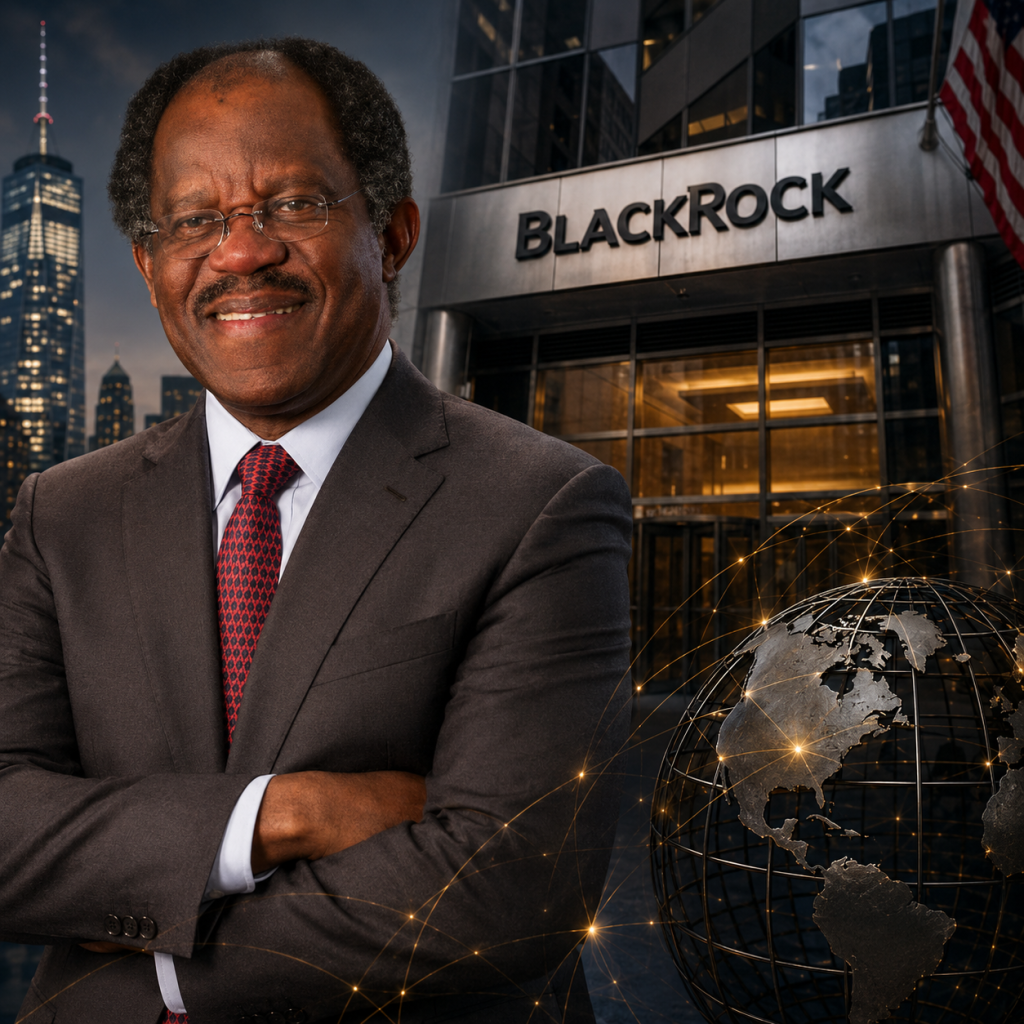

Adebayo Ogunlesi, the Nigerian-born billionaire who chairs Global Infrastructure Partners and sits on BlackRock’s Global Executive Committee, used a high-level summit in Cape Town on 13 May 2026 to disclose that the world’s largest asset manager currently controls approximately R500 billion in South African assets and intends to double that exposure over the next five years.
The declaration came at the BlackRock South Africa Infrastructure Investment Summit, convened jointly by GIP and BlackRock and attended by President Cyril Ramaphosa, cabinet ministers, and a concentrated group of global institutional investors. The setting was deliberate. It was not a press conference or a filing. It was a structured capital signal delivered in front of the decision-makers with authority to either accelerate or obstruct deployment.
Ogunlesi, 71, built GIP into the world’s largest independent infrastructure manager before BlackRock acquired it in October 2024 for approximately $12.5 billion. His net worth stands at approximately $2.4 billion. That acquisition gave BlackRock a direct operational line into some of the world’s most consequential infrastructure assets, and Ogunlesi now serves as a senior managing director within the firm’s leadership structure. His presence in Cape Town was not ceremonial.
Ogunlesi pointed to electricity transmission, renewable energy, rail, ports, airports and digital infrastructure as the critical sectors capable of unlocking South Africa’s economic potential and reinforcing its competitiveness. The framing was precise. These are not aspirational categories. They are the infrastructure verticals where BlackRock’s GIP division has existing operational experience globally, meaning deployment in South Africa would draw on established GIP execution capacity rather than a greenfield learning curve.
He identified artificial intelligence as a major future driver of infrastructure demand, particularly for power systems and data centres, noting that reliable and affordable energy is a foundation requirement for growth. That observation carries direct capital implications. As AI data centre demand accelerates globally, the electricity and digital infrastructure requirements attached to those assets are becoming a standalone investment thesis, one that South Africa’s renewable energy pipeline is positioned to serve if transmission constraints are addressed.
President Ramaphosa used the summit to position South Africa as a premier destination for global infrastructure capital, referencing a R1 trillion government infrastructure spending plan over three years, a record R890 billion in pledges secured at the recent 6th South Africa Investment Conference, and ambitious new targets to attract R3 trillion in total investment over the next five years. Ramaphosa’s response to Ogunlesi’s doubling target was characteristically direct: doubling was insufficient, and BlackRock should quadruple it instead.
Ramaphosa also confirmed a $500 million commitment BlackRock made to the African Infrastructure Fund III ahead of the summit, targeting energy systems, logistics corridors and transport infrastructure across the continent. That commitment is a separately structured vehicle from BlackRock’s existing R500 billion South Africa asset base, meaning the capital pipeline into South Africa and the broader continent is now operating on multiple concurrent tracks.
Ogunlesi was measured but direct about what private capital requires in return. He noted that the traditional model of relying solely on governments to finance infrastructure was no longer sustainable, and that countries were increasingly competing for the same pools of private capital. Policy certainty, transparent procurement systems, stable regulation, and the rule of law, he said, were the conditions that determined where long-term institutional capital ultimately landed.
The competitive framing matters. Ogunlesi stated plainly that South Africa is competing with the United States, Germany, GCC countries, and Asian and Latin American countries for the same institutional capital pools. That is not a diplomatic softening. It is an operational reality that any government seeking to close its infrastructure funding gap through private capital must price into every regulatory and procurement decision it makes.
South Africa’s drop from 7th to 12th in the 2026 Kearney FDI Confidence Index, which surveys senior executives from multinational firms, signals that global sentiment has cooled amid ongoing concerns about infrastructure bottlenecks, political uncertainty, and rising costs. The Ogunlesi summit lands directly into that context, and its timing appears intentional. A public commitment of this scale from a manager of BlackRock’s standing, delivered alongside a sitting head of state, functions as a counter-signal to the FDI index slide.
For family offices and institutional investors tracking African infrastructure positioning, the weight of this event is structural rather than transactional. BlackRock is not announcing a single deal. It is communicating a multi-year directional commitment to a specific country with a specific set of sector priorities. That kind of signal, from the world’s largest asset manager, reshapes how other institutional capital prices South African risk and in which direction the next layer of infrastructure capital is likely to flow.