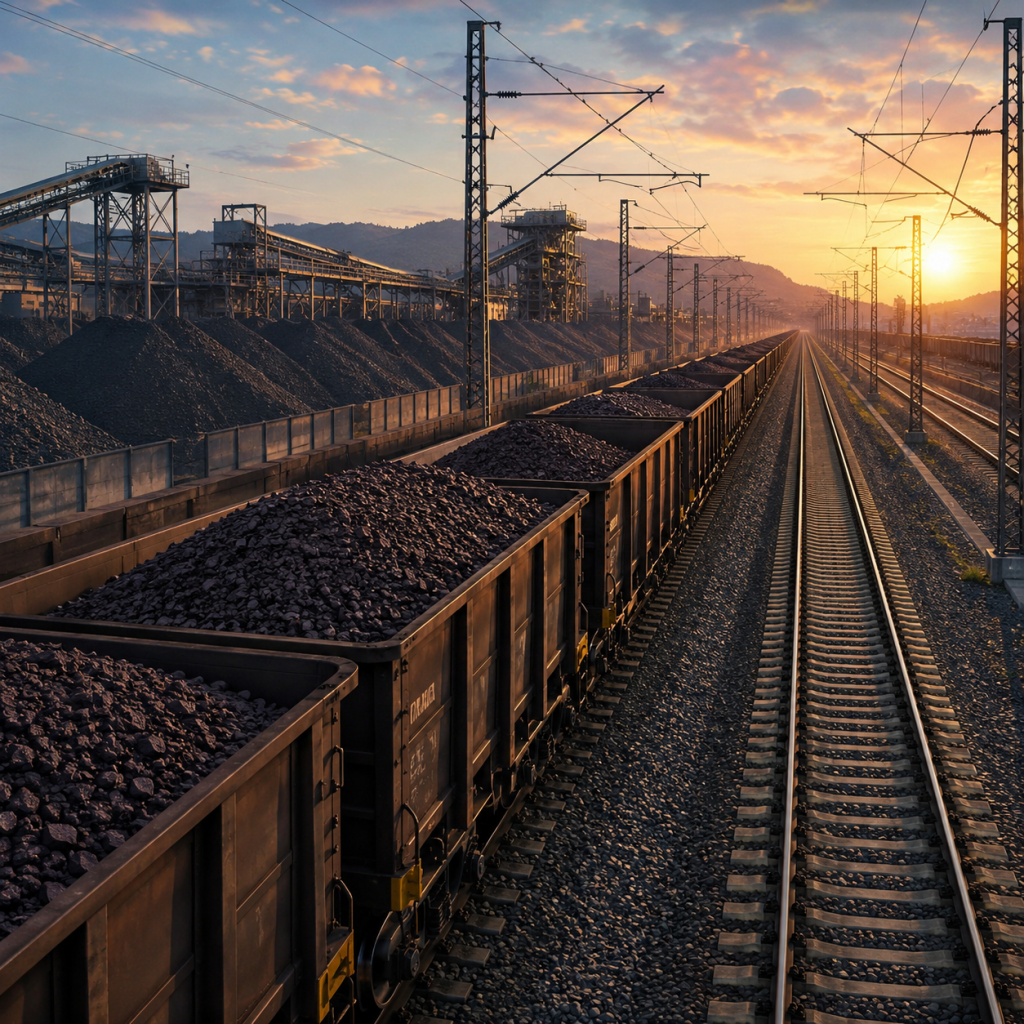

South Africa’s drive to strengthen industrial logistics received a significant boost this week as mining group South32 confirmed a R3.9 billion investment in rail infrastructure upgrades across the Northern Cape and KwaZulu-Natal.
The investment was highlighted during discussions surrounding South Africa’s investment and infrastructure development agenda and represents one of the most significant private sector commitments aimed at improving freight movement for the country’s mining industry.
Rail Capacity Moves Back to the Centre of Industrial Growth
Rail performance has become one of the most important factors influencing South Africa’s mining sector competitiveness.
While global demand for critical minerals continues to expand, producers have increasingly focused on improving the movement of commodities from mines to ports. The ability to export efficiently remains a major determinant of production growth, investment decisions and future project development.
South32’s R3.9 billion commitment targets strategic freight corridors that connect mineral-producing regions with export facilities. The investment is expected to support greater throughput capacity while reducing bottlenecks that have constrained exports in recent years.
Mining, Logistics and Infrastructure Converge
The investment reflects a broader trend across South Africa’s industrial economy where mining companies are increasingly participating in logistics solutions rather than relying solely on existing transport networks.
The country’s mineral sector remains one of the largest contributors to exports and industrial output. Improved freight rail performance directly affects the movement of manganese, chrome, iron ore, coal and other bulk commodities destined for international markets.
Industry stakeholders have repeatedly identified logistics infrastructure as one of the most important requirements for unlocking additional mining investment and production growth.
What It Signals for the Economy
The significance of the rail upgrade extends beyond mining.
Improved freight corridors support port activity, industrial processing, manufacturing supply chains and export earnings. Increased rail efficiency can lower transport costs, improve competitiveness and create conditions for future industrial investment along major logistics routes.
The project also aligns with broader government and private sector efforts to modernise infrastructure and attract capital into productive sectors of the economy. South Africa recently reported that more than 160 investment projects are either completed or under construction as part of its wider investment drive.
A Vote of Confidence in Industrial Execution
At a time when investors are placing greater emphasis on execution rather than announcements, South32’s rail commitment represents tangible capital deployment into productive infrastructure.
For South Africa’s mining industry, the message is clear: future growth will depend not only on mineral resources beneath the ground but also on the efficiency of the infrastructure connecting those resources to global markets.
As global competition for mineral investment intensifies, logistics upgrades such as these are increasingly becoming strategic industrial assets capable of determining export growth, production expansion and long-term economic competitiveness.