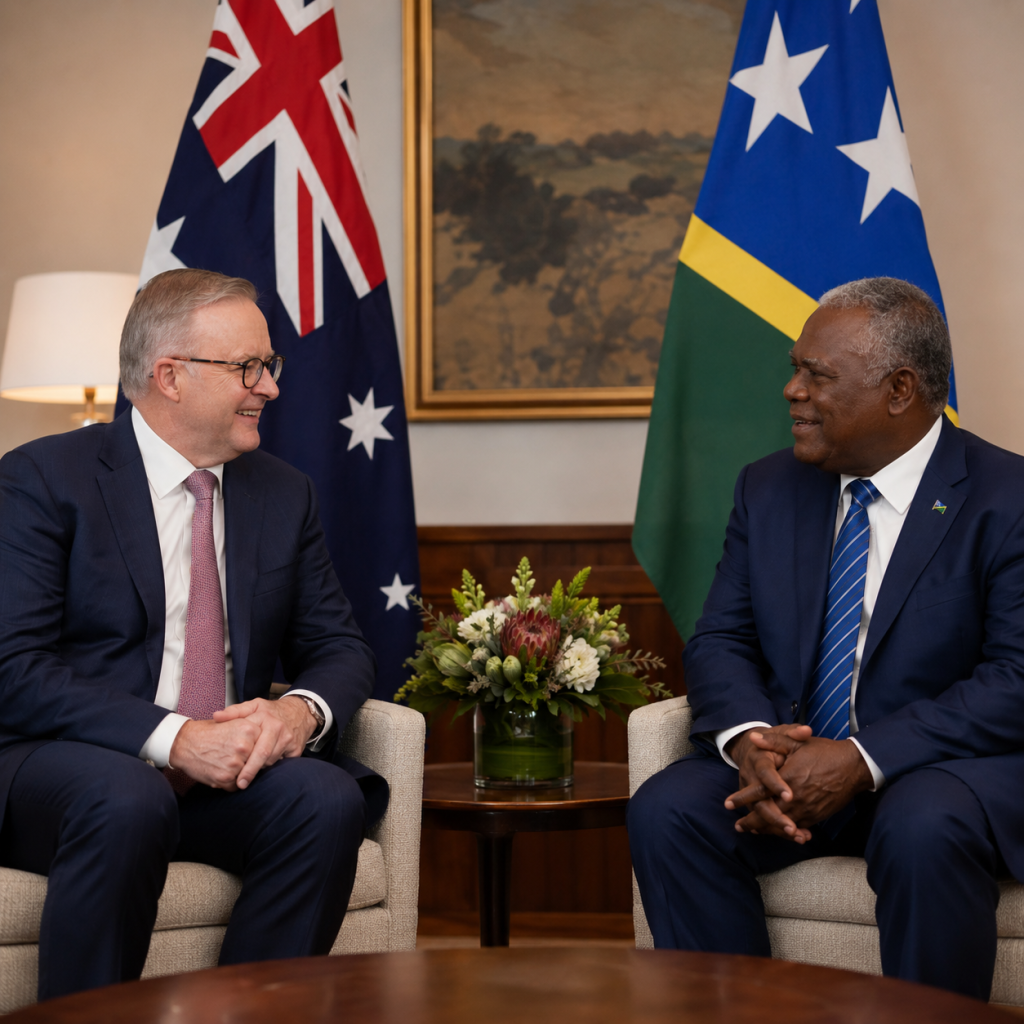

The governments of Australia and the Solomon Islands have agreed to begin negotiations on a comprehensive strategic treaty, marking a significant shift in Pacific regional diplomacy and one of the most consequential government-to-government developments in the region this week.
The announcement was made during the first official visit to Canberra by newly elected Solomon Islands Prime Minister Matthew Wale, less than three weeks after taking office. Alongside the treaty discussions, Wale confirmed that his government is reviewing the controversial security agreement signed between the Solomon Islands and China in 2022.
A New Direction in Pacific Relations
The proposed Australia-Solomon Islands treaty is expected to deepen cooperation across security, economic development, infrastructure, governance, and regional stability.
Speaking alongside Australian Prime Minister Anthony Albanese, Wale emphasized the importance of rebuilding trust and strengthening relations with Australia, describing the Solomon Islands as a long-standing partner of Canberra. Australia, in turn, reiterated its ambition to remain the Pacific region’s preferred security partner.
The development comes after several years of heightened geopolitical competition in the Pacific, particularly following the Solomon Islands’ security agreement with China, which raised concerns among Australia, New Zealand, the United States, and other regional partners.
Why the Treaty Matters
The Solomon Islands occupies a strategically important position in the South Pacific, located along key maritime routes between Australia, Asia, and the United States.
A comprehensive treaty would provide Australia with a stronger institutional framework for cooperation while potentially reducing uncertainty surrounding future security arrangements in the Pacific.
For the Solomon Islands, deeper engagement with Australia could unlock additional investment, infrastructure funding, disaster recovery assistance, energy projects, education programs, and institutional support. Australia has already committed substantial resources to policing and development initiatives across the country.
Implications for Regional Geopolitics
The announcement signals that the Pacific remains a critical arena for strategic competition between major powers.
While Prime Minister Wale has not indicated any immediate termination of the China security agreement, the decision to formally review the pact suggests a reassessment of the country’s external partnerships and security priorities.
For regional governments and investors, the treaty discussions indicate a renewed effort by Australia to strengthen its diplomatic and economic influence across the Pacific through long-term institutional partnerships rather than short-term initiatives.
The outcome of the negotiations could influence future infrastructure investment, security cooperation, development financing, and diplomatic alignments across other Pacific island nations.
What Happens Next
Officials from both governments are expected to begin detailed negotiations on the scope and structure of the comprehensive strategic treaty in the coming months.
If concluded, the agreement would represent one of the most significant diplomatic realignments in the Pacific since the Solomon Islands signed its security pact with China four years ago, potentially reshaping regional power dynamics and economic cooperation across the South Pacific.