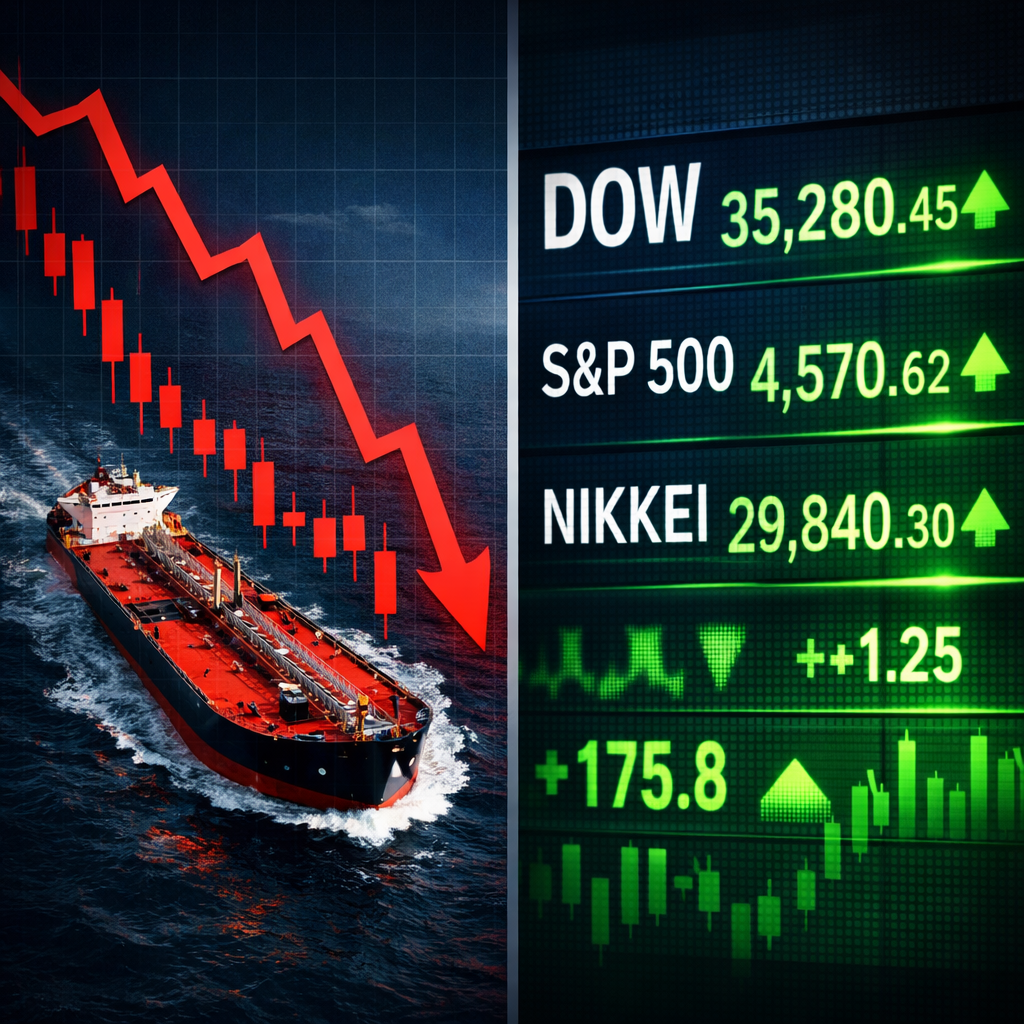

A fragile but consequential ceasefire between the United States and Iran detonated one of the most dramatic single-session market reversals of 2026, sending oil prices into freefall and igniting a global equities rally on Wednesday, April 8, as investors priced in the partial reopening of the Strait of Hormuz for the first time in over five weeks.
The announcement, made by U.S. President Donald Trump on social media late Tuesday, barely an hour before a self-imposed deadline to launch wide-scale military strikes on Iran, caught markets mid-cycle in an energy-driven inflation spiral that had been rattling central banks, supply chains, and consumer budgets across the world.
What Moved
WTI crude, the U.S. benchmark, tumbled 16.41% to settle at $94.41 per barrel, its largest single-day decline since April 2020, while Brent crude dropped 13.29% to settle at $94.75 per barrel. Both benchmarks, while sharply lower, remain well above pre-war levels. WTI settled at $67 per barrel on February 27, the day before the conflict began.
On Wall Street, the S&P 500 climbed 2.51% to close at 6,782.81, the Nasdaq Composite advanced 2.80% to 22,634.99, and the Dow Jones Industrial Average jumped 2.85% to 47,909.92. The Dow posted its best single-day performance in a year.
The relief rally was not confined to the United States. South Korea’s Kospi led gains in Asia, closing 6.87% higher. Japan’s Nikkei gained 5.39%, its best day since April 2025. Hong Kong’s Hang Seng rose 3.09%. In Europe, Germany’s DAX soared 5.06% and France’s CAC 40 jumped 4.49%, each recording their strongest session since March 2022. Wall Street’s fear gauge, the VIX, dropped 22%.
What Triggered It
Global markets had been rattled since the U.S. and Israel attacked Iran at the end of February, prompting Tehran to effectively close the Strait of Hormuz, a key waterway through which roughly one-fifth of the world’s oil and gas normally transits. The closure triggered the largest oil supply shock on record, choking off an estimated 12 million to 15 million barrels of crude per day.
The ceasefire came following accelerated diplomatic efforts led by Pakistan and was secured just hours before Trump’s threatened bombardment deadline. Trump framed the deal as contingent on Iran’s immediate and complete reopening of the strait, while Iran stated it would cease defensive operations if attacks against it were halted, and that commercial transit through the Strait of Hormuz would be possible for two weeks under coordination with the Iranian Armed Forces.
What It Signals, And What It Does Not
Seasoned strategists were quick to temper the market’s initial euphoria. Pratibha Thaker, regional director for Africa and the Middle East at the Economist Intelligence Unit, described the arrangement as a pause rather than any form of lasting resolution, warning that a significant trust deficit on both sides, particularly over Iran’s nuclear programme and U.S. intentions, would complicate any subsequent negotiations.
Matt Gertken, chief geopolitical strategist at BCA Research, warned that the coordination requirement embedded in both sides’ statements remains a risky ambiguity, and that renewed conflict is possible later this year, particularly after U.S. midterm elections ease political pressure on the Trump administration to keep energy prices contained.
Safe-haven demand did not evaporate with the ceasefire announcement. Gold rose and Treasury yields fell on the day, signalling that institutional investors are hedging rather than fully unwinding war-risk positioning.
The Broader Market Picture
Morningstar’s chief U.S. market strategist Dave Sekera noted that the May 2026 WTI futures contract was still trading around $96, approximately 47% above pre-conflict levels, and that significant production and shipping disruptions will continue to work through the global economy for months ahead. Agricultural commodity prices remain elevated, with fertilizer costs rising in tandem with natural gas disruptions.
For emerging market economies and African energy importers, the ceasefire offers a measure of relief from an oil shock that has exacerbated import bills and currency pressures across the continent. However, with Brent still trading roughly $22 per barrel above its pre-war level, the structural inflation impact on oil-dependent economies has not been reversed, it has merely been paused.
Jamie Cox, managing partner at Harris Financial Group, captured the sentiment cleanly: “Markets have been predicting that Trump was looking for an off-ramp in Iran. Today, he got one and took it.” Whether that off-ramp leads somewhere durable or loops back to the same junction in a fortnight is the question now shaping every major capital allocation decision on the planet.