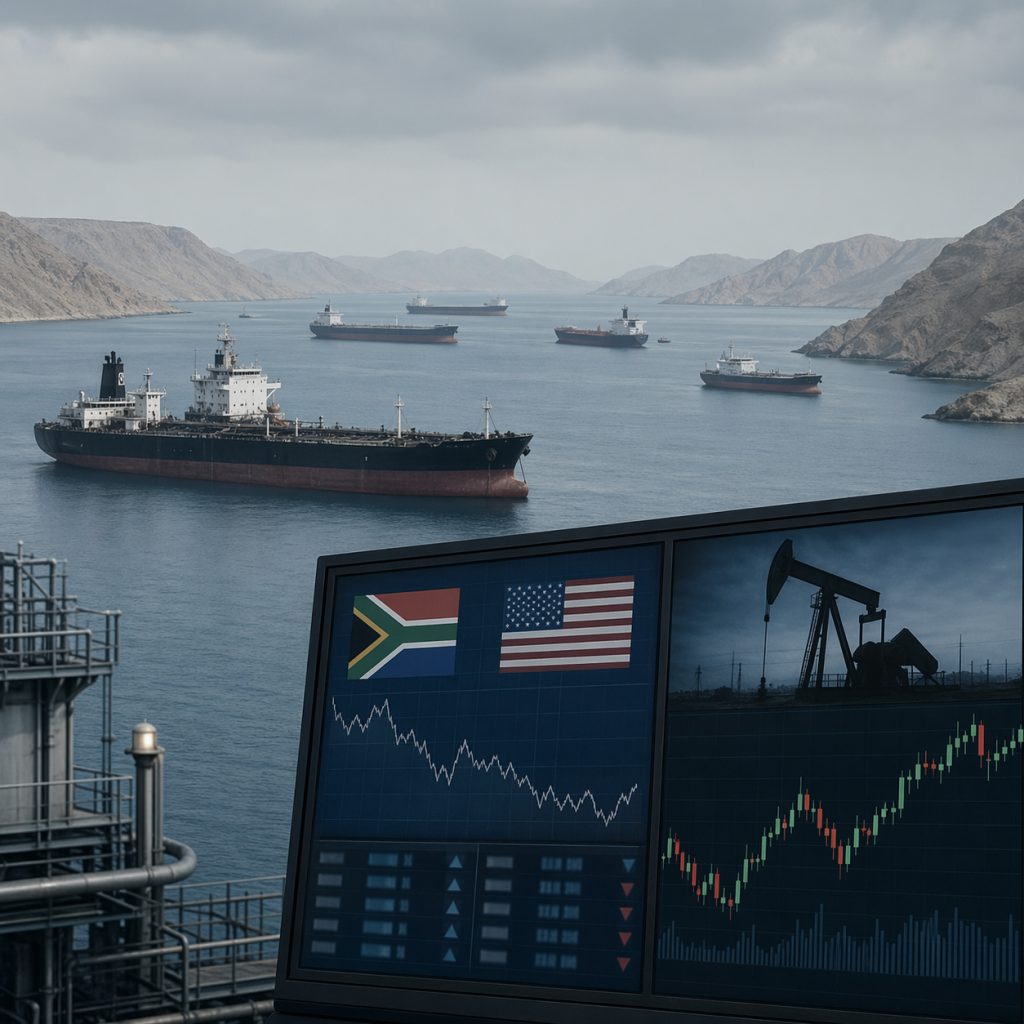

The South African rand strengthened and global oil prices pulled back on Friday after confirmation that direct U.S.-Iran peace negotiations would resume in Pakistan, the clearest diplomatic signal in weeks that the Strait of Hormuz standoff may be approaching a resolution.
Brent crude futures fell to $104.83 per barrel while West Texas Intermediate retreated approximately 2% to $93.90 as markets repriced the risk of continued supply disruption following the breakthrough. The move reversed days of mounting pressure driven by Iranian seizures of vessels in the strait and the absence of a confirmed negotiating framework.
White House press secretary Karoline Leavitt confirmed Friday that U.S. special envoy Steve Witkoff and Jared Kushner would travel to Pakistan on Saturday morning for direct talks with Iranian counterparts. Iran’s foreign minister, Abbas Araghchi, signalled his own travel to Islamabad, a convergence that gave markets the diplomatic confirmation they had been seeking since a prior round of talks collapsed.
The Rand’s Read
The rand had been trading at 16.53 against the dollar in early sessions on Wednesday, with South Africa’s benchmark 2035 government bond weakening and its yield rising 6 basis points to 8.615%, a clear reflection of the risk-off positioning that had gripped emerging market assets as oil climbed and peace talks stalled.
Friday’s diplomatic development reversed that trajectory. The rand’s recovery is directly tied to the oil price equation: South Africa imports the majority of its crude, meaning every dollar off Brent translates into tangible relief on fuel costs, transport inflation, and the Reserve Bank’s inflation calculus.
When the initial ceasefire was announced earlier this month, the JSE All Share Index surged more than 5% and the rand strengthened more than 2.3% against the dollar, a precedent that illustrates just how sensitive South African financial markets are to movements in the Hormuz corridor.
The Oil Shock in Context
Iran’s effective closure of the Strait of Hormuz, which typically carries approximately one-fifth of global oil and natural gas supplies, has driven a sustained surge in fuel prices worldwide, forcing governments to tap emergency reserves and introduce energy-saving measures.
Exports from Middle East Gulf producers collapsed during the conflict, triggering what analysts described as the largest oil supply disruption in history. Tanker traffic through the strait remained restricted even during the ceasefire period, as shippers faced an unresolved security environment.
The Friday oil retreat signals that markets are now assigning meaningful probability to a negotiated outcome — but traders are pricing in caution, not certainty. Trump prolonged the ceasefire after plans for a second negotiating round in Pakistan fell apart, citing what he described as fractured Iranian leadership. The confirmation Friday that both delegations are now en route represents a material change in posture.
Equity Markets: A Split Picture
The S&P 500 advanced 0.7% on Friday and the Nasdaq Composite gained 1.5%, buoyed by the diplomatic development and a sharp post-earnings rally in Intel shares, which surged 19% after beating first-quarter expectations. The Dow Jones Industrial Average declined modestly, reflecting ongoing uncertainty rather than outright pessimism.
Nvidia crossed the $5 trillion market capitalisation threshold again, rising 5% in midday trading on renewed confidence in the artificial intelligence investment cycle, a signal that risk appetite was returning selectively, concentrated in sectors insulated from the geopolitical premium embedded in energy prices.
Sentiment Holding, Not Recovering
Despite the oil pullback, consumer sentiment data released Friday offered a sobering counterweight. The University of Michigan’s Survey of Consumers showed the sentiment gauge at 49.8 in April, a record low, down 6.6% from a month earlier and 4.6% below the same period last year.
Long-term inflation expectations rose to 3.4% in the preliminary reading, a development that the Federal Reserve is watching closely as policymakers work to keep inflation expectations anchored ahead of its rate decision scheduled for April 29.
For South Africa and broader emerging markets, the direction of travel on Friday was constructive, but contingent. A productive Islamabad session that produces a framework for Hormuz reopening would accelerate rand recovery, ease the Reserve Bank’s inflation burden, and restore momentum to JSE-listed equities. A breakdown would send oil back above $110 and reprice risk assets accordingly.
The market’s message on Friday was clear: the path to stability runs through Pakistan.