
On 22 April 2026, South African President Cyril Ramaphosa and Lesotho’s King Letsie III jointly opened the Senqu Bridge in the highland district of Mokhotlong, a R2.4 billion structure that marks the most visible milestone yet in Phase II of the Lesotho Highlands Water Project (LHWP), a binational infrastructure initiative now entering its fourth decade.
The ceremony was more than a ribbon-cutting. It was a reaffirmation of one of southern Africa’s most consequential bilateral frameworks, a treaty-based partnership between two sovereign states whose resource interdependence has grown into one of the continent’s most strategically significant transboundary arrangements.
What Was Inaugurated
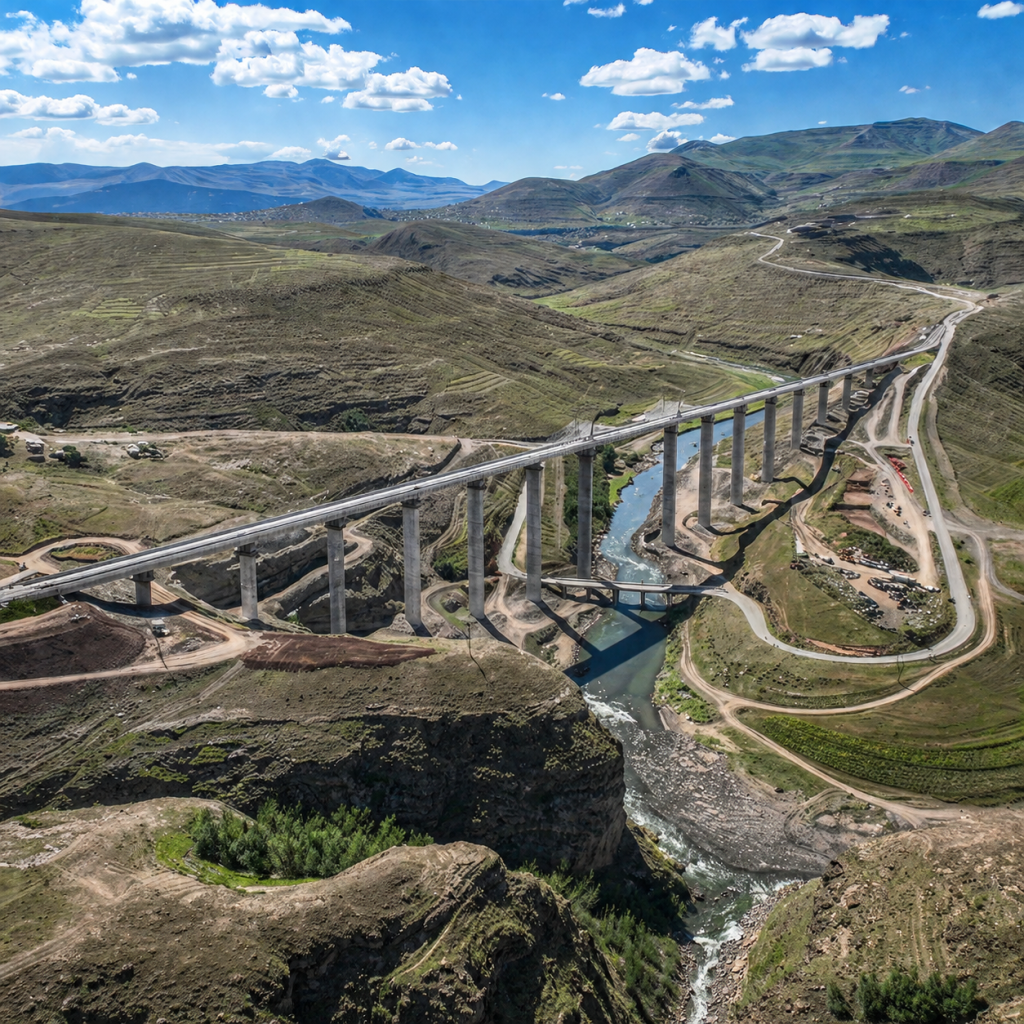
The Senqu Bridge, the first extradosed bridge ever built in Lesotho, stretches 825 metres across a valley that will eventually become part of the Polihali Reservoir. It stands as the largest of three major crossings being developed under Phase II of the LHWP, constructed at an estimated cost of 2.4 billion maloti, equivalent to approximately $145 million.
The bridge was built by the Webuild Group as lead partner of an international joint venture on behalf of the Lesotho Highlands Development Authority. The structure replaces an existing crossing that will be submerged once the Polihali Dam is impounded. Without it, communities in Mokhotlong and surrounding highlands would have been cut off from the national road network, and from Maseru.
The project created approximately 250,000 person-days of employment, with a peak workforce of around 1,200 workers, the majority of whom were Basotho. Procurement was structured to direct significant expenditure toward local enterprises in both countries, including South African black-owned firms.
The Strategic Architecture Behind the Bridge
The Senqu Bridge is not a standalone structure. It is a node in a much larger system. Phase II of the LHWP includes the Polihali Dam, a concrete-faced rockfill structure approximately 165 metres high, as well as a 38-kilometre transfer tunnel connecting the Polihali and Katse reservoirs.
Once completed, Phase II will increase water supply capacity from 780 million cubic metres per annum to 1,270 million cubic metres per annum, significantly strengthening long-term water security for South Africa. That water flows into the Integrated Vaal River System, which underpins the economic hub of Gauteng, South Africa’s industrial and financial engine, home to roughly a quarter of the country’s population.
For Lesotho, the return is hydropower, infrastructure development, and long-term fiscal revenues, a structural exchange that defines the economic logic of the bilateral partnership.
What Ramaphosa Announced
Speaking at the launch, President Ramaphosa announced that South Africa will provide R30 million in humanitarian assistance to Lesotho through the African Renaissance Fund, directed toward the country’s response to HIV and tuberculosis amid declining international support.
He also pointed to the expanding scope of bilateral cooperation through the Bi-National Commission. The two countries have signed six bilateral agreements covering water and energy, capacity building and skills development, defence and social development, with commitments to deepen economic cooperation in energy, infrastructure, agriculture, telecommunications, and the finance and services sectors.
The next session of the Bi-National Commission is expected to formalise further progress across these pillars.
Why This Matters Beyond the Border
The Senqu Bridge inauguration arrives at a moment when South Africa is navigating a complex and contested global trade environment. With AGOA’s future uncertain, US tariffs of 30% on South African goods still in play, and Pretoria actively pursuing a bilateral trade framework with Washington, the domestic pressure to demonstrate economic momentum is acute.
Projects of this scale serve a dual purpose. They advance real infrastructure, water supply, energy generation, road connectivity, while simultaneously projecting the kind of institutional credibility and execution capacity that matters to sovereign credit ratings, multilateral lenders, and foreign investors assessing southern Africa as a destination.
The LHWP is a multi-phased, binational infrastructure initiative established under the 1986 Treaty between South Africa and Lesotho, and is widely regarded as a flagship example of bilateral cooperation contributing significantly to regional water security and economic development. The 2026 inauguration marks the 40th anniversary of that treaty, a point both leaders acknowledged on the day.
Lesotho’s King Letsie III said the bridge represented more than an infrastructure achievement, noting it would help connect communities, strengthen cooperation and support economic growth in both countries.
The Broader Signal
The LHWP is frequently cited in discussions of African-led infrastructure diplomacy, a model where two states with unequal resources forge a durable, treaty-based arrangement that delivers measurable value to both parties over generations. Its continuation into Phase II, despite shifting geopolitical conditions and the withdrawal of certain traditional donor support structures, signals that regional integration within SADC can hold.
For South Africa, completing a project of this scale, on time, within a defined institutional framework, with meaningful local economic participation, strengthens the case it is making to international partners and investors: that execution is possible and that the southern African development corridor is open for business.