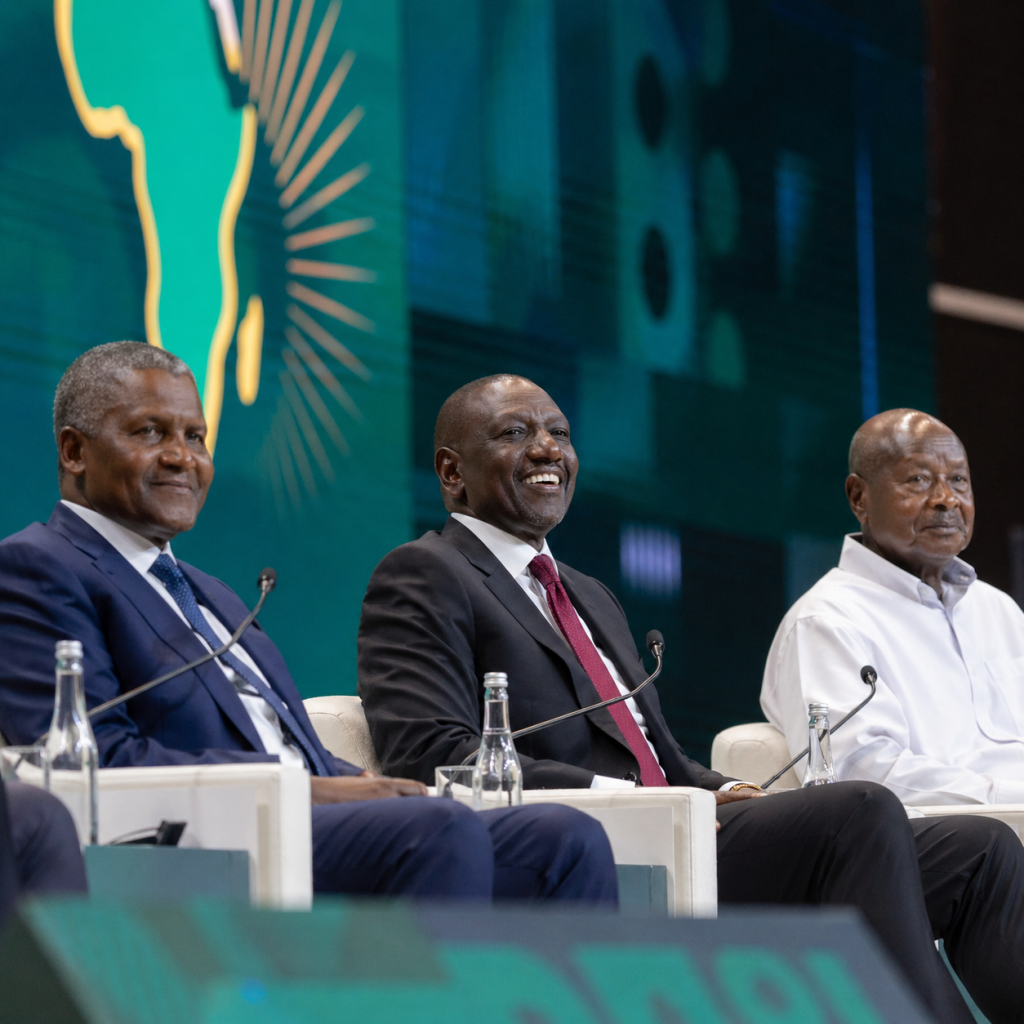

At the Africa We Build Summit in Nairobi on 23 April 2026, something significant was said out loud, and this time, with heads of state in the room.
Aliko Dangote, Africa’s richest man, pledged to help East African nations build a new oil refinery in Tanzania, directly citing the continent’s over-reliance on fuel imports from the Middle East. The facility would be located in Tanga, on Tanzania’s northeastern coast, and the project would include a pipeline linking it to the Kenyan port city of Mombasa, utilising the Kenya Pipeline Corporation’s existing network for onward distribution.
The scale of the ambition is not in question. Dangote indicated his group is ready to construct a 650,000-barrel-per-day refinery in partnership with regional governments, provided there is policy alignment and sustained support. That is not a feasibility study. That is a commitment from a man who has already executed one of the most complex private infrastructure projects in African history.
But the real story here is not the refinery. It is what this moment reveals about where African industrial capital is heading, and what must happen for the region to capture it.
The Structural Problem Being Addressed
Industry data shows that about 75 per cent of refined petroleum products consumed in East and Southern Africa are imported, largely from the Middle East, exposing the region to supply disruptions and price spikes, particularly during geopolitical tensions. This is not a logistics problem. It is a structural failure of decades-long policy that permitted resource extraction without anchoring downstream value on the continent.
East Africa currently imports all of its refined petroleum products, leaving the region vulnerable to supply disruptions and price spikes, as seen in the fallout of the Iran conflict. That conflict has made the cost of this dependency suddenly and painfully visible. Governments that have long deferred action on refining capacity are now confronting the consequences in real time, at the pump and on the balance sheet.
Dangote articulated the logic with characteristic directness. “By exporting raw materials and importing finished products, we are impoverishing our population,” he said, framing the refinery not as an energy project but as an industrial sovereignty argument.
He is correct. And that reframing matters enormously for how governments, development finance institutions, and private capital should respond.
The Feedstock Equation Changes Everything
What distinguishes this proposal from prior regional refinery ambitions is the feedstock architecture. The proposed refinery is expected to process crude from across the region, including supplies from the Democratic Republic of Congo and South Sudan, with Kenya and Uganda also feeding into the facility. This is a multi-origin, multi-government supply model, which transforms the project from a single-country asset into a regional infrastructure play.
Kenya’s President William Ruto confirmed that the project would be supported by a pipeline linking Mombasa to Tanga, ensuring a steady supply of crude to the facility. The East African Crude Oil Pipeline, EACOP, which terminates in Tanga, further reinforces the site’s logic as a convergence point for regional crude.
Kenya, Uganda, and Tanzania are in talks to construct a multi-billion-dollar joint refinery in Tanga, at the terminus of EACOP itself, with Dangote committed as anchor investor. If structured correctly, this facility would sit at the intersection of every meaningful upstream crude development in the region over the next decade. That is an extraordinary position for any industrial asset to occupy.
The Governance Test
The history of African mega-project proposals is littered with commitments that dissolved on contact with bureaucratic delay, inter-governmental disagreement, and shifting political cycles. Dangote acknowledged this plainly. He made clear that he needs serious support from both Presidents Ruto and Museveni for the project to work.
That condition is neither unreasonable nor unusual. No $20 billion refinery anywhere in the world is built without long-term offtake agreements, stable regulatory frameworks, tax treatment certainty, and cross-border coordination mechanisms. The Nigerian refinery took seven years to construct and required sustained political insulation from disruption.
East Africa’s governments have a defined window to demonstrate that this time is different. The Iran-driven supply shock has created genuine political urgency. The Africa Finance Corporation’s convening role signals institutional backing. And Dangote’s own IPO timeline, with Dangote Petroleum Refinery planning a landmark pan-African initial public offering targeting the Johannesburg, Nairobi, Ghana, and Ethiopian exchanges between May and July 2026, means that capital formation is already in motion.
This is not the moment for further studies. It is the moment for term sheets, inter-governmental frameworks, and land allocation.
What This Signals for the Continent
Beyond East Africa, this announcement carries a message about the direction of African private capital. Dangote has already demonstrated that continent-scale industrial infrastructure can be financed, built, and operated without multilateral dependence as the primary mechanism. His group has outlined a $40 billion investment plan across multiple sectors between now and 2030, covering petrochemicals, fertilisers, and industrial raw materials.
The model being proposed for East Africa is replicable. West Africa has the Lagos refinery. Southern Africa has the deepwater ports and mineral processing corridors. If East Africa secures this refinery, the continent begins to form a connected industrial spine, not a map of extraction points, but a network of value-capture nodes.
Expansion of the Lagos refinery from 650,000 to 1.4 million barrels per day is already underway, which means the supply surplus from Nigeria could eventually support regional markets while the East African facility comes online. The logic of an integrated African energy system is no longer theoretical.
The Forward Position
The Tanga refinery will not be built by declarations. It will be built when governments align on revenue-sharing, when environmental and community frameworks are established, when development finance institutions provide the blended capital structures that de-risk early-stage construction, and when a single implementation authority with binding mandate is created.
The 23 April summit was the public crystallisation of something that has been building for years: African states and African private capital converging on the same strategic objective. That alignment is rare. It should not be allowed to dissipate into procedural delay.
The analysis here is straightforward. If three or four governments move decisively in the next six months, this refinery gets built. If they do not, the geopolitical window narrows, investor attention migrates, and East Africa continues importing fuel it has the crude to refine itself.
The choice is that clean. The cost of inaction is now priced into every litre of imported fuel on the continent.