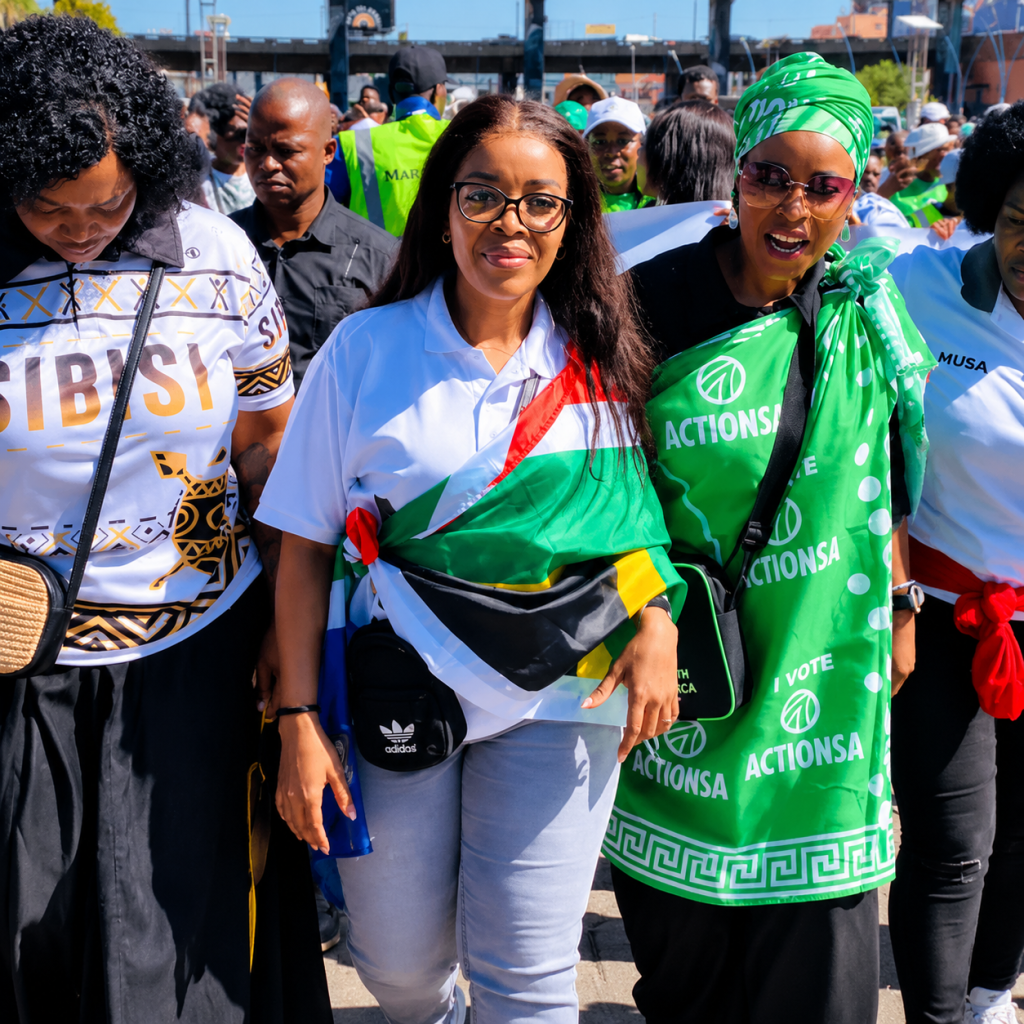

Jacinta Zinhle Ngobese Zuma has urged supporters of the March and March movement to remain focused on what she describes as the mission of “reclaiming South Africa,” arguing that the organisation should never become centred around one individual. Her remarks come at a pivotal moment for one of the country’s fastest-growing civic movements, following internal debate over its engagement with political leaders and parties.
The movement has attracted national attention through campaigns advocating stricter immigration enforcement and greater government accountability. As its influence has expanded, so too has scrutiny over its leadership, strategy and long-term direction.
A message bigger than one leader
Ngobese Zuma said supporters should avoid personality-driven politics that could distract from the movement’s objectives. According to her, she previously rejected proposals to place her image on March and March T-shirts and posters because she believes the campaign should never revolve around a single figure.
She also reiterated a position she has expressed publicly before, that the movement should continue with or without her leadership, reinforcing her view that its success depends on shared civic participation rather than individual prominence.
Responding to questions about political engagement
Her comments follow public disagreements involving civic activist Nkosikhona “Phakel’umthakathi” Ndabandaba after engagements with President Cyril Ramaphosa generated debate among supporters over whether the movement was becoming politically aligned.
Ngobese Zuma rejected suggestions that engaging with the MK Party or other political organisations transforms March and March into a political party. She maintained that the movement has engaged with multiple political parties since its formation and argued that dialogue with elected representatives is consistent with its objective of influencing public policy while remaining an independent civic organisation.
Why this stands out
Many civic movements gain momentum through charismatic leadership, yet sustaining public credibility often depends on demonstrating that their purpose extends beyond any individual.
By publicly discouraging the promotion of her own image and emphasising institutional continuity, Ngobese Zuma is attempting to position March and March as a movement defined by its mission rather than by its founder. Whether that approach succeeds could shape both the organisation’s longevity and its influence on South Africa’s public policy debate.
The broader strategic significance
South Africa has a long history of civic organisations influencing national policy through advocacy, public mobilisation and engagement with government institutions.
The challenge for modern civic movements is balancing constructive engagement with political leaders while maintaining sufficient independence to retain public trust. Organisations perceived as becoming extensions of political parties often struggle to preserve broad-based legitimacy, while those that refuse institutional engagement may limit their ability to influence policy outcomes.
March and March now finds itself navigating that same balance as its national profile continues to grow.
What it signals
Ngobese Zuma’s latest remarks highlight a defining leadership moment, not only for March and March but for civic activism in South Africa more broadly.
The emphasis on institutional purpose over individual leadership reflects an effort to strengthen organisational resilience as public attention intensifies. It also illustrates an evolving model of civic engagement in which movements seek to influence government through dialogue while asserting that they remain independent of party politics.
How successfully March and March maintains that balance is likely to determine its credibility and influence in the months ahead.