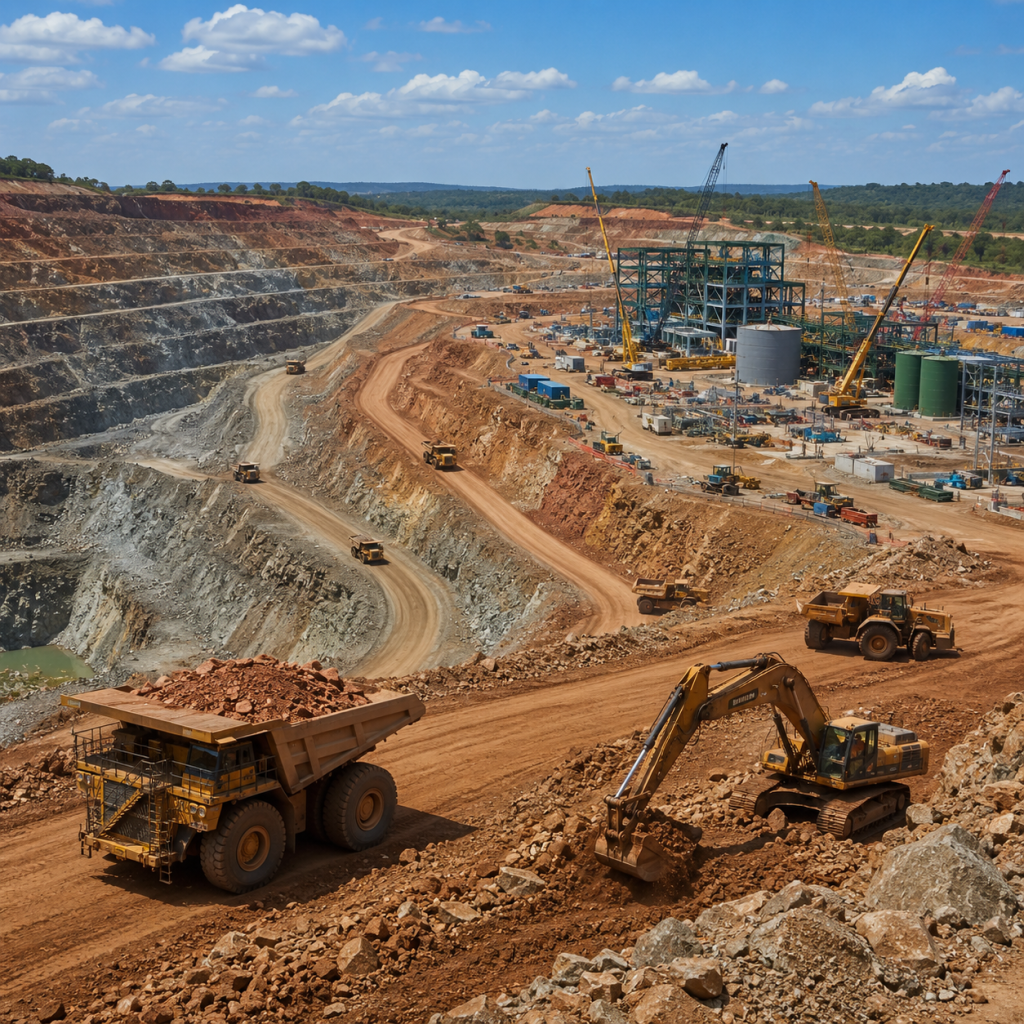

Barrick Mining Corporation has confirmed that construction at the Lumwana Super Pit copper expansion in Zambia’s North-Western Province advanced on time and on budget through the first quarter of 2026, with several structural milestones completed and first copper production still firmly targeted for the end of the first quarter of 2028.
The initial lift of the mill building wall was completed during the first quarter, with mill shells delivered to site and the first loads of structural steel expected in the three months ending 30 June. The progress, reported by Barrick on 11 May, marks the project’s continued transition from earthworks and civil preparation into above-ground structural construction, a phase that typically determines whether a major mining project holds its schedule or begins to slip.
A $2 Billion Build With Tier One Ambitions
The Lumwana Super Pit expansion is one of Africa’s most significant active copper infrastructure programmes. The expansion will extend the mine’s operational life by 17 years to 2057, double the processing plant capacity from 27 million tonnes per annum to a peak design of 54 million tonnes per annum, and achieve an average copper output of 240,000 tonnes annually over the life of the mine.
Capital expenditure for 2026 is expected to come in at the lower end of the $750-million to $850-million guidance range, with total project capital anticipated at $2-billion. For a project of this scale operating deep in a landlocked African country, the combination of on-schedule construction and cost discipline is a meaningful signal to the broader mining investment community.
Overall, first-quarter copper production of an 11%-higher 49,000 tonnes was in line with plan, while copper cost of sales of $3.41 per pound was up 17%, with all-in sustaining costs of $3.67 per pound. The operating mine continues to produce throughout the expansion programme, a logistical and operational complexity that Barrick has managed without production shortfall.
Zambia’s Industrial Supply Chain Absorbs the Work
Beyond the headline construction numbers, the project’s procurement footprint within Zambia continues to deepen the country’s industrial base. Since 2019, the mine has contributed over $4 billion to the Zambian economy through taxes, royalties, procurement, and wages, with more than $3.4 billion spent with Zambian suppliers, representing 79% of total procurement.
South African fabrication capacity is also directly embedded in the build. Mpumalanga-based structural steel fabricator B&T Steel Construction has delivered 17 structures to the Lumwana non-processing infrastructure programme, supplying precision-engineered steel into one of the continent’s most demanding remote construction environments.
Infrastructure upgrades, including a new power transmission framework developed in partnership with ZESCO, are progressing to support both the mine and the wider region, alongside development of the Manyama township and industrial supplier park, and a TEVETA-accredited training centre to expand Zambia’s mining skills base.
Context: Copper’s Strategic Weight in 2026
Lumwana’s expansion is not being built into a neutral market. Copper prices remain elevated amid sustained demand from energy transition infrastructure, data centre construction, and electrification programmes across Asia and Europe. Zambia, as Africa’s second-largest copper producer, sits at the centre of a global competition for reliable supply that is reshaping how mining majors and governments position long-term extraction assets.
Barrick President and CEO Mark Hill said copper “performed well and is an important part of the growth pipeline,” framing Lumwana as central to the company’s strategy at a time when sovereign and institutional capital is actively seeking stable, large-scale copper exposure in Africa.
For Zambia, the expansion is also an industrial policy anchor. A mine of this scale, supported by domestic suppliers, local workforce development, and power infrastructure shared with the national grid, creates a platform that outlasts the extraction cycle. Whether Lumwana ultimately achieves its Tier One classification will depend as much on execution quality over the next two years as it does on the feasibility economics that justified the investment.
The next test of that execution comes at the end of the second quarter, when the first loads of structural steel are expected on site.