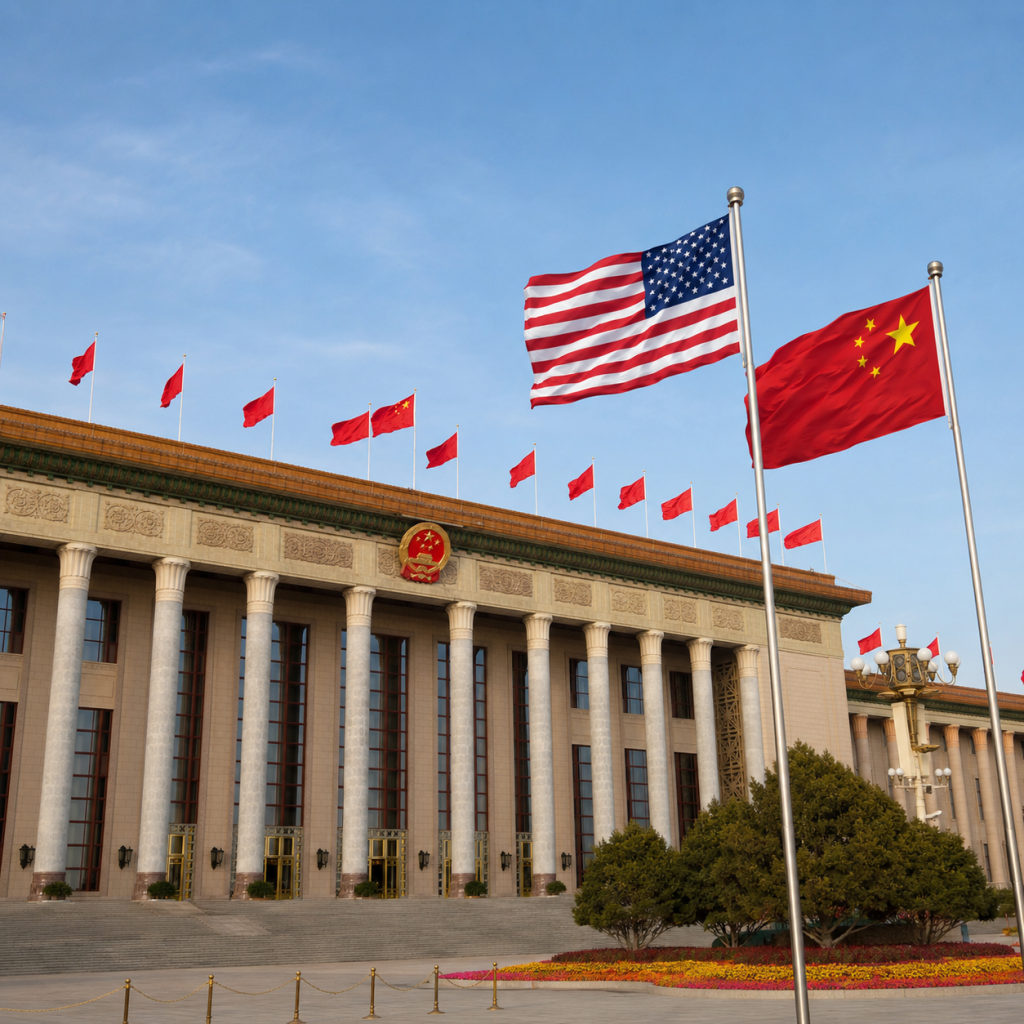

The most consequential bilateral meeting in nearly a decade opened at Beijing’s Great Hall of the People on Thursday, as United States President Donald Trump and Chinese President Xi Jinping launched a two-day summit that carries significant implications for global trade, capital markets, energy supply chains, and the broader architecture of great-power competition.
Trump arrived in Beijing accompanied by a delegation that included some of America’s most influential business leaders, among them Elon Musk, Tim Cook, and Larry Fink, a deliberate signal from Washington that commercial outcomes, not just diplomatic optics, are central to the visit’s agenda.
A Framework for the Next Three Years
Xi and Trump agreed to develop what Beijing’s official readout described as a “constructive China-U.S. relationship of strategic stability,” a framework Xi indicated would guide the bilateral relationship for the next three years and beyond. The framing is significant. It suggests both governments are seeking to institutionalise a managed equilibrium rather than pursue the kind of structural resolution that markets have long anticipated but which neither side appears willing, or able, to deliver.
Ahead of the summit, trade envoys from both countries reported “overall balanced and positive outcomes” at a preparatory session in South Korea. That delegation was led by U.S. Treasury Secretary Scott Bessent and Chinese Vice Premier He Lifeng. Xi used the results of that preparatory work to call on both sides to “preserve this hard-won positive momentum,” signalling that Beijing views continuity of dialogue as a strategic asset in itself.
Trade, Agriculture, and the Board of Trade
The Trump administration is expected to announce the creation of a “Board of Trade” comprising senior officials from both countries to oversee implementation of purchase commitments, a direct response to China’s failure to deliver on its Phase One trade deal commitments made in 2020. The mechanism is designed to give the agreement institutional teeth, though its enforcement power remains to be tested.
Analysts at the Council on Foreign Relations had identified agriculture, aerospace, and investment as the most likely areas for concrete deliverables, with Boeing aircraft purchases and American soybean procurement widely expected to form part of any announcement. For commodity-exporting nations in Africa and South America, any large-scale agricultural reorientation between the world’s two largest economies carries direct implications for global pricing and demand patterns.
Taiwan: A Line Drawn Clearly
The summit’s most pointed moment came when Xi issued a direct warning on Taiwan. Xi told Trump that the Taiwan question is “the most important issue in China-U.S. relations” and that if it is mishandled, the two countries “will have clashes and even conflicts.” The warning, delivered in private bilateral talks and later confirmed in Chinese state media, was the clearest statement Beijing has made to the Trump administration on the matter.
Secretary of State Marco Rubio, who travelled with Trump to Beijing despite being under Chinese sanctions, confirmed after the bilateral session that U.S. Taiwan policies remain unchanged. Markets interpreted that clarification as the stabilising signal they needed, at least for the near term.
The Iran Variable
Trump and Xi also discussed the ongoing war in Iran and the blockade of the Strait of Hormuz. Rubio confirmed that China stated it is not in favour of militarising the Strait, a position that aligns with Washington’s own stance. The alignment on Hormuz is notable. China’s economy is deeply exposed to Middle East energy flows, and any extension or intensification of the blockade would accelerate inflationary pressure across Asian manufacturing hubs and commodity-dependent economies in Africa.
What This Means for Africa and Emerging Markets
For Africa, the Beijing summit is not a peripheral event. China remains the continent’s largest bilateral creditor and trading partner. Any recalibration of Beijing’s trade posture toward the United States, including large-scale commodity purchase commitments that redirect Chinese buying power, creates ripple effects across African export markets for minerals, agricultural goods, and energy.
In the first two months of 2026, China’s exports grew by 21.8% year-on-year, reflecting a deliberate reorientation toward non-U.S. markets, a trend that has deepened China’s commercial engagement across Africa, Southeast Asia, and the Gulf. A stabilised U.S.-China trade relationship, if the Beijing summit delivers meaningful commitments, could slow that diversification push. Alternatively, if the summit produces largely symbolic outcomes, Beijing’s strategic courtship of African and emerging market partners is likely to intensify further.
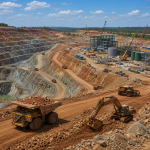
South Africa, as a major rare earth and mineral producer and a BRICS member with deep institutional ties to both Washington and Beijing, sits at an unusually complex intersection of these dynamics. Any agreement on rare earth access, a central issue in the lead-up to this summit, would directly affect the competitive positioning of South African mining assets and the country’s leverage in ongoing investment negotiations.
The Broader Signal
Xi posed a pointed question in his opening remarks: “Can China and the United States overcome the so-called Thucydides Trap and create a new model of relations between major countries?” The answer will not arrive in a single communique. But the willingness of both governments to engage at this level, with business delegations, bilateral frameworks, and an explicit commitment to strategic stability, is itself a form of market communication.
For decision-makers tracking capital flows, supply chain exposure, and geopolitical risk across Africa and beyond, the Beijing summit has opened a new chapter in U.S.-China relations, one defined less by confrontation and more by managed competition with agreed parameters. Whether those parameters hold will be the defining question of the next three years.