
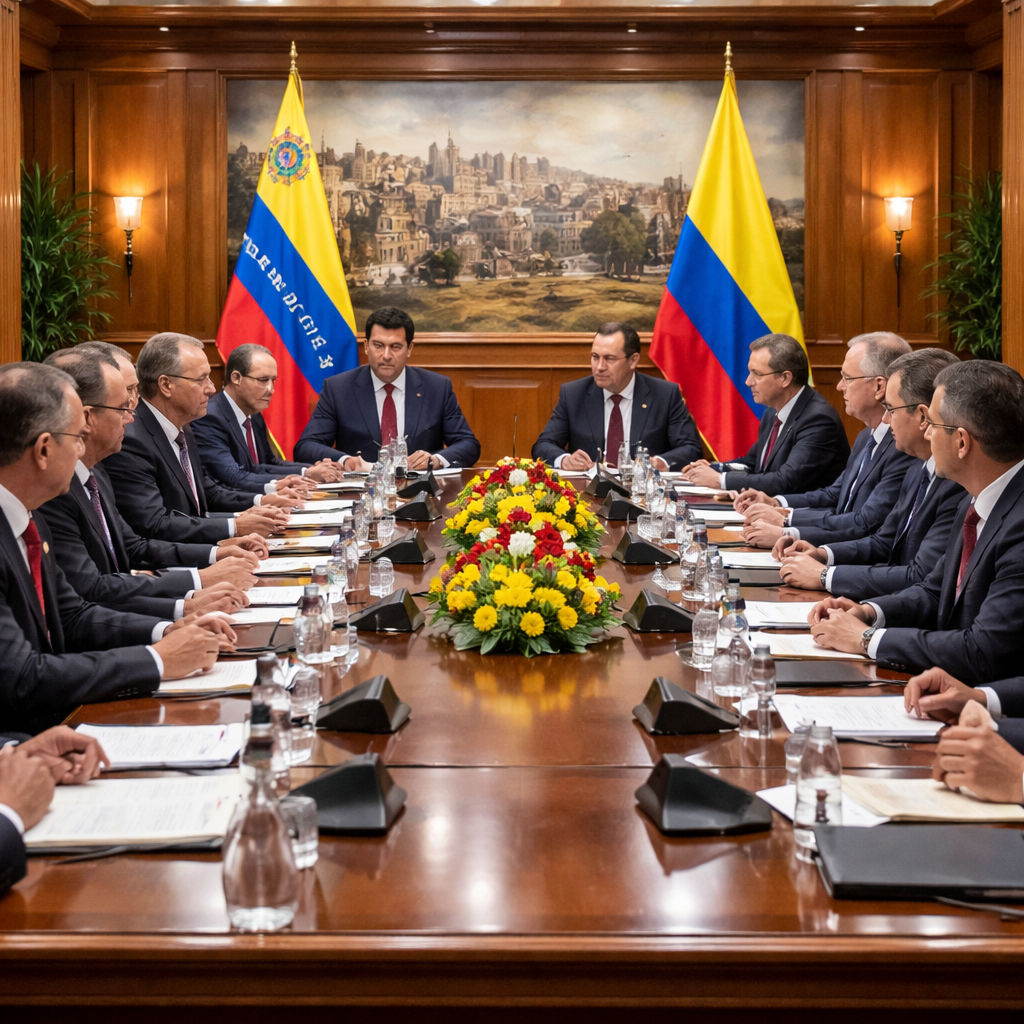

Senior officials from the governments of Venezuela and Colombia met in Caracas this week for their first high-level bilateral talks since the political transition in Venezuela, signaling an effort by both countries to normalize economic relations and restart cross-border cooperation.
The meeting brought together Colombian ministers responsible for foreign affairs and defense with Venezuelan counterparts representing the administration of acting president Delcy Rodríguez. Discussions focused on restoring trade flows, stabilizing the shared border, and rebuilding energy cooperation between the two neighboring economies.
Energy Infrastructure at the Center of Talks
One of the most significant outcomes of the discussions was renewed attention on the Antonio Ricaurte gas pipeline, a cross-border energy link connecting Venezuela’s gas reserves with Colombian demand. Venezuelan state oil company PDVSA and Colombia’s Ecopetrol are exploring the restoration of the pipeline to enable Venezuelan natural gas exports to Colombia.
If revived, the pipeline could reshape regional energy trade. Venezuela holds some of the world’s largest natural gas reserves, while Colombia faces increasing domestic demand for energy supply stability.
Reactivating the infrastructure would therefore allow both governments to integrate energy markets more closely while generating export revenue for Venezuela and supply diversification for Colombia.
Rebuilding Cross-Border Trade
The two countries share a 2,200-kilometre border, historically one of South America’s most active trade corridors. In recent years, however, political tensions and economic disruption sharply reduced commerce and disrupted logistics networks.
Colombia continues to maintain a trade surplus with Venezuela, exporting manufactured goods, agricultural products, and consumer supplies while importing raw materials and energy inputs.
Officials at the meeting emphasized rebuilding border coordination mechanisms to enable businesses, freight operators, and regional traders to resume predictable cross-border activity.
Investment Signals and Regional Stability
The talks also carry broader implications for investment. Venezuela’s interim leadership is seeking to reopen the country’s economy to foreign capital, particularly in the oil and mining sectors, while improving diplomatic relations with regional partners and major global economies.
For Colombia, stabilizing relations with its eastern neighbor reduces migration pressure, improves energy cooperation, and restores commercial access to Venezuelan markets.
Although a planned presidential-level meeting between the two leaders was postponed due to scheduling issues, both governments described the ministerial dialogue as constructive and indicative of a renewed bilateral relationship.
What It Means for Business
For regional businesses, the renewed diplomatic engagement signals potential reopening of one of Latin America’s historically important trade routes.
Energy companies, logistics firms, and commodity traders stand to benefit most if the pipeline restoration and border coordination initiatives translate into operational agreements in the coming months.
For investors watching South America’s geopolitical landscape, the Caracas meeting represents an early but notable step toward economic normalization between two neighboring states whose relationship has long shaped regional trade flows.


hello world
hello world
levitra pills
levitra pills
metoprolol 50 mg tablet
metoprolol 50 mg tablet
lasix diuretic pill
lasix diuretic pill
buy vibramycin
buy vibramycin
orlistat manufacturer coupon
orlistat manufacturer coupon
sildenafil vs tadalafil which is better
sildenafil vs tadalafil which is better
substitute for tadalafil
substitute for tadalafil
finasteride female reddit
finasteride female reddit
semaglutid piller
semaglutid piller
doxycycline mono for kidney infection
doxycycline mono for kidney infection
toradol speed of action
toradol speed of action
sinusitis treatment basics
sinusitis treatment basics
Compare Sildenafil and Cialis Duration
Compare Sildenafil and Cialis Duration
tadalafil brands explained
tadalafil brands explained