
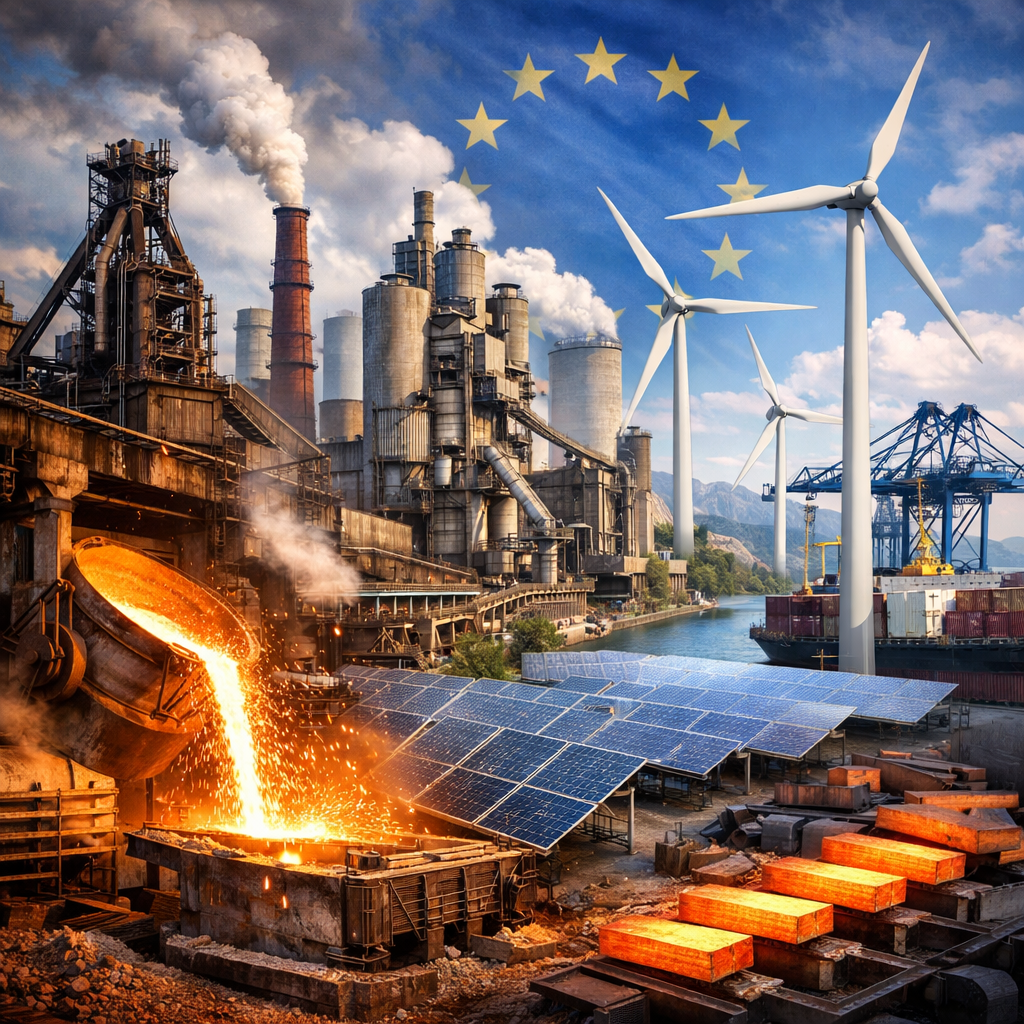

The European Union’s Carbon Border Adjustment Mechanism (CBAM) formally entered its decisive operational phase this year, marking a subtle but profound shift in how trade, climate policy, and industrial competitiveness intersect. What began as a technical emissions-reporting framework has now become something more consequential: a structural filter on global capital, production location, and industrial strategy.
CBAM requires importers of carbon-intensive goods—starting with steel, cement, aluminium, fertilisers, hydrogen, and electricity—to report embedded emissions and, over time, pay a carbon price equivalent to that faced by EU producers. The mechanism is administered by the European Commission under the authority of the European Union, and its timing is deliberate. Europe is no longer experimenting; it is enforcing.
From climate alignment to capital reallocation
The immediate effect of CBAM is compliance. The deeper effect is capital redirection.
Producers exporting into Europe now face a binary choice: decarbonise upstream or lose price competitiveness at the border. This is already reshaping boardroom decisions well beyond Europe’s borders. Steelmakers in Turkey, cement producers in North Africa, and fertiliser plants across Asia are reassessing capex plans, not because of environmental idealism, but because market access is now conditional.
Capital markets are responding accordingly. Low-carbon retrofitting projects—electric arc furnaces, green hydrogen inputs, carbon capture pilots—are finding faster funding pathways, while legacy high-emission assets are quietly becoming stranded in valuation models. CBAM has effectively turned emissions intensity into a trade-adjusted financial variable.
Europe’s quiet reindustrialisation strategy
Politically, CBAM is framed as climate fairness: preventing carbon leakage and protecting European firms subject to emissions pricing. Economically, it functions as a reindustrialisation lever.
By equalising carbon costs at the border, Europe is buying time and margin for its own industrial base to scale clean production without being undercut by cheaper, dirtier imports. This matters at a moment when industrial sovereignty—particularly in steel, chemicals, and energy-intensive manufacturing—has returned to the policy agenda alongside security and resilience.
Unlike blunt tariffs, CBAM is rules-based, WTO-conscious, and data-driven. That makes it harder to challenge and easier to replicate.
What this means for emerging markets
For exporters in Africa and other emerging regions, CBAM is neither a death sentence nor a free pass. It is a sorting mechanism.
Countries with access to renewable energy, credible measurement systems, and supportive industrial policy can turn CBAM into an advantage, branding themselves as preferred low-carbon suppliers to Europe. Those that delay risk being locked out of value chains just as global demand consolidates around fewer, cleaner producers.
The opportunity, however, requires coordination: governments must align energy policy, trade strategy, and industrial finance. Firms cannot carry this transition alone, especially in capital-intensive sectors.
The global signal
The most important implication of CBAM is not European—it is global.
Other major economies are watching closely. Once carbon pricing is embedded into trade flows by a market as large as the EU, the logic spreads. Over the next decade, carbon-adjusted trade is likely to become a standard feature of global commerce, not an exception.
CBAM signals that the era of separating climate policy from industrial competitiveness is over. The countries and companies that understand this early will not merely comply—they will reposition.


