
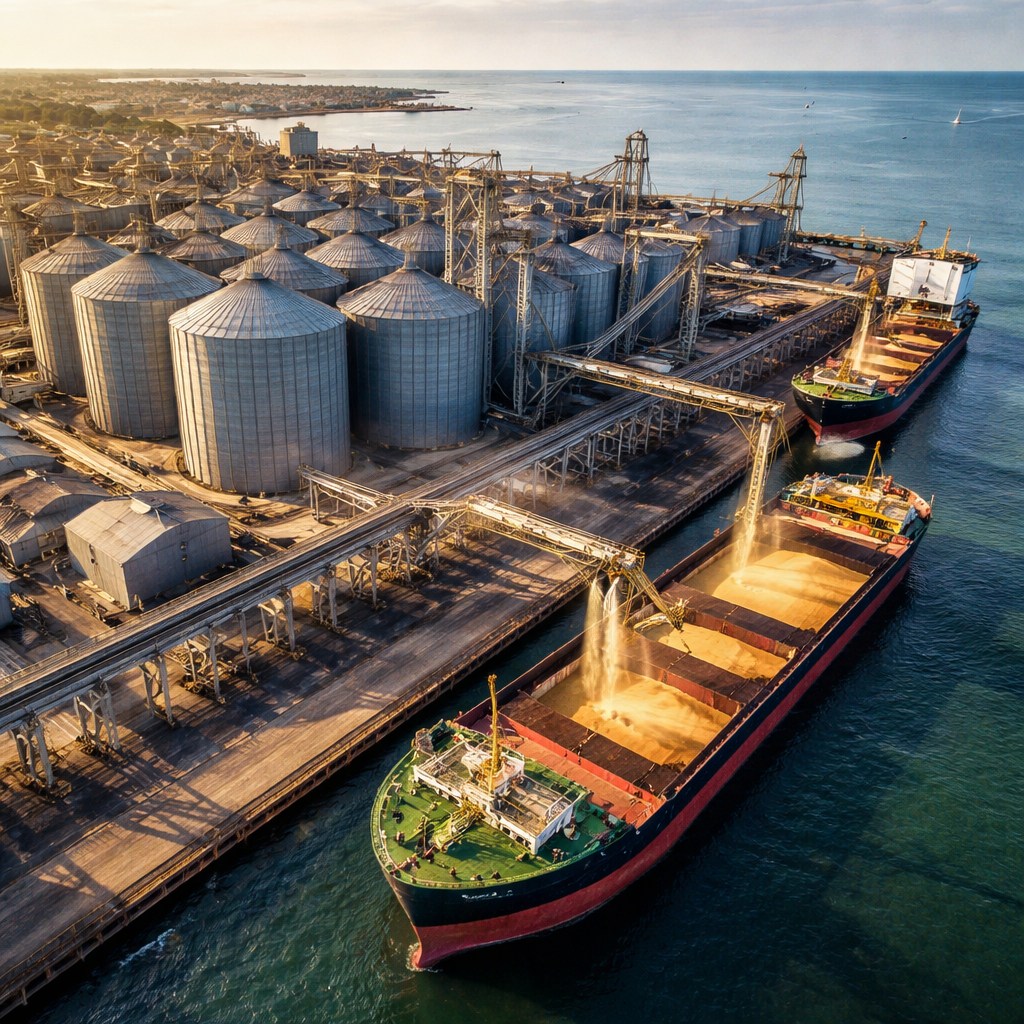

Saudi Agricultural and Livestock Investment Company (SALIC) has committed approximately $500 million to expand grain handling and export infrastructure across Ukraine’s Black Sea logistics corridor, marking one of the most significant agribusiness infrastructure investments in Eastern Europe since the reopening of alternative export routes.
The investment targets the acquisition and expansion of high-capacity grain terminals, storage facilities, and inland logistics assets designed to stabilize export flows for wheat, corn, and barley. SALIC’s strategy focuses on controlling critical nodes of the food supply chain rather than upstream farmland ownership, reinforcing its role as a long-term food security investor for import-dependent markets.
Ukraine remains one of the world’s most strategically important grain exporters. However, constrained port capacity, disrupted shipping routes, and fragmented inland logistics have reduced throughput efficiency. SALIC’s capital injection is aimed at restoring scale by modernizing silos, upgrading conveyor and loading systems, and integrating rail-to-port logistics to reduce bottlenecks during peak harvest periods.
For SALIC, the investment secures physical access to export volumes rather than exposure to volatile spot markets. For Ukraine, it injects foreign capital into infrastructure that directly converts agricultural output into export revenue — a critical priority as the country works to stabilize its economy and retain its role in global food markets.
The expansion is expected to lift terminal throughput capacity by several million tonnes annually, improving shipment reliability to destinations across the Middle East, North Africa, and Asia. These regions remain structurally dependent on Black Sea grain for price stability and food security, particularly amid climate volatility and supply chain realignments.
This move also signals a broader shift in global agribusiness strategy. Sovereign-linked investors are increasingly prioritizing logistics ownership — ports, terminals, and storage — recognizing that control over food flows is as strategically valuable as production itself. In a fragmented global trade environment, infrastructure has become the decisive asset.
SALIC’s Ukraine investment underscores how capital is being deployed not to speculate on food prices, but to industrialize resilience across the global food system — ensuring that grain moves, markets clear, and importing nations remain supplied regardless of geopolitical disruption.


