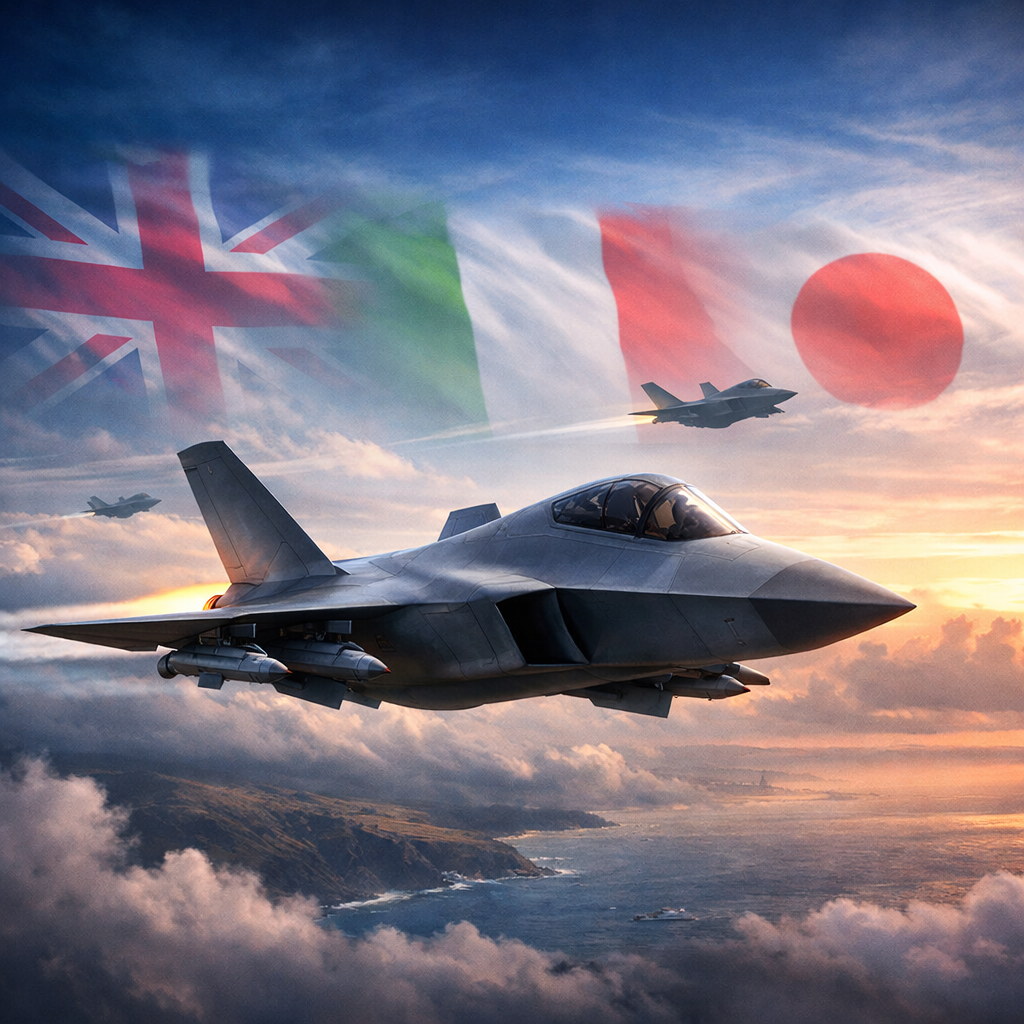

The three-nation Global Combat Air Programme has crossed a significant industrial threshold. On 1 April 2026, the GCAP International Government Organisation, which represents the governments of the United Kingdom, Italy, and Japan, awarded a £686 million contract, approximately $905 million, to Edgewing, the trilateral joint venture formed by BAE Systems, Leonardo, and Japan Aircraft Industrial Enhancement Co. Ltd., to lead the design and development of GCAP’s sixth-generation combat aircraft.
The award is the first time the three partner nations have issued a single, unified contract to Edgewing. Until now, national governments had funded their contributions separately. The joint programme office announced the signing of the contract on Thursday, with GCAP Agency Chief Executive Masami Oka stating that “activities previously conducted under three nations’ contracts will now be carried out as part of a fully-fledged international programme.”
A Structural Shift in Multinational Defence Procurement
The significance of this contract extends beyond the monetary figure. Edgewing will act as the design authority for the aircraft, overseeing engineering, airworthiness, and certification across all phases of development, a governance model designed to prevent the fragmented management that has stalled other multinational fighter programmes.
Under the new structure, manufacturing and final assembly will be subcontracted to BAE Systems in the United Kingdom, Leonardo in Italy, and Mitsubishi Heavy Industries in Japan, preserving national industrial capabilities while centralising the functions most likely to derail complex programmes: configuration control, system integration, and lifecycle design authority.
Industry analysts have noted the contrast with the Franco-German-Spanish Future Combat Air System, where ongoing industrial disagreements continue to delay consolidation. GCAP’s model, a single international prime with distributed national manufacturing, represents a more disciplined structural approach.
Programme Scope and Strategic Timeline
GCAP is not being developed as a standalone fighter but as a “system of systems” operating across air, land, sea, space, and cyber domains, with a crewed combat aircraft serving as the central command node coordinating with uncrewed systems, including collaborative combat aircraft. The programme maintains a target in-service date of 2035, replacing the Eurofighter Typhoon in the United Kingdom and Italy, and Japan’s F-2 multi-role fighter.
For Italy, involvement extends beyond Leonardo to include MBDA Italia, Avio Aero, Elettronica, and a network of SMEs, universities, and research centres, with expected industrial spillovers across the national aerospace and high-technology sectors.
Funding Uncertainty and the UK’s Defence Investment Plan
The contract runs only through 30 June 2026, a shorter duration than the programme had anticipated. The GCAP Agency had expected to award the first contract to Edgewing in December 2025 or early January, but delayed publication of the UK government’s Defence Investment Plan held up approvals. The plan, now more than eight months overdue, has held back key defence procurement and rearmament decisions, with no clear indication from the UK government on when it will be finalised.
The plan’s delay has been attributed to a public spending crunch and a reported £28 billion funding gap in the UK defence budget. The interim nature of the current contract signals that a longer-term international funding agreement remains to be concluded once the UK’s fiscal position is clarified.
Canada’s Observer Interest
The programme’s footprint may soon expand beyond its three founding nations. Canadian observer status was reportedly the main topic of a meeting on 6 March 2026 between Japanese Defence Minister Shinjiro Koizumi and Canada’s Minister of National Defence, David McGuinty. As an observer, Canada would gain access to classified programme information, opening a path toward deeper participation in manufacturing, development, and eventual procurement. A multilateral meeting scheduled for July 2026 is expected to formalise the arrangement.
Industrial Weight at Scale
The contract consolidates what has until now been a politically significant but structurally fragmented programme into a single industrial command. A spokesman for Edgewing stated that the joint venture is “now fully empowered to drive the programme forward as its industrial lead,” with priority placed on ensuring engineering work continues to meet planned milestones.
For the defence industrial supply chains of three of the world’s most advanced economies, and potentially a fourth — the shift from national contracts to a single international prime marks the moment GCAP transitions from a political commitment into an executable industrial programme.