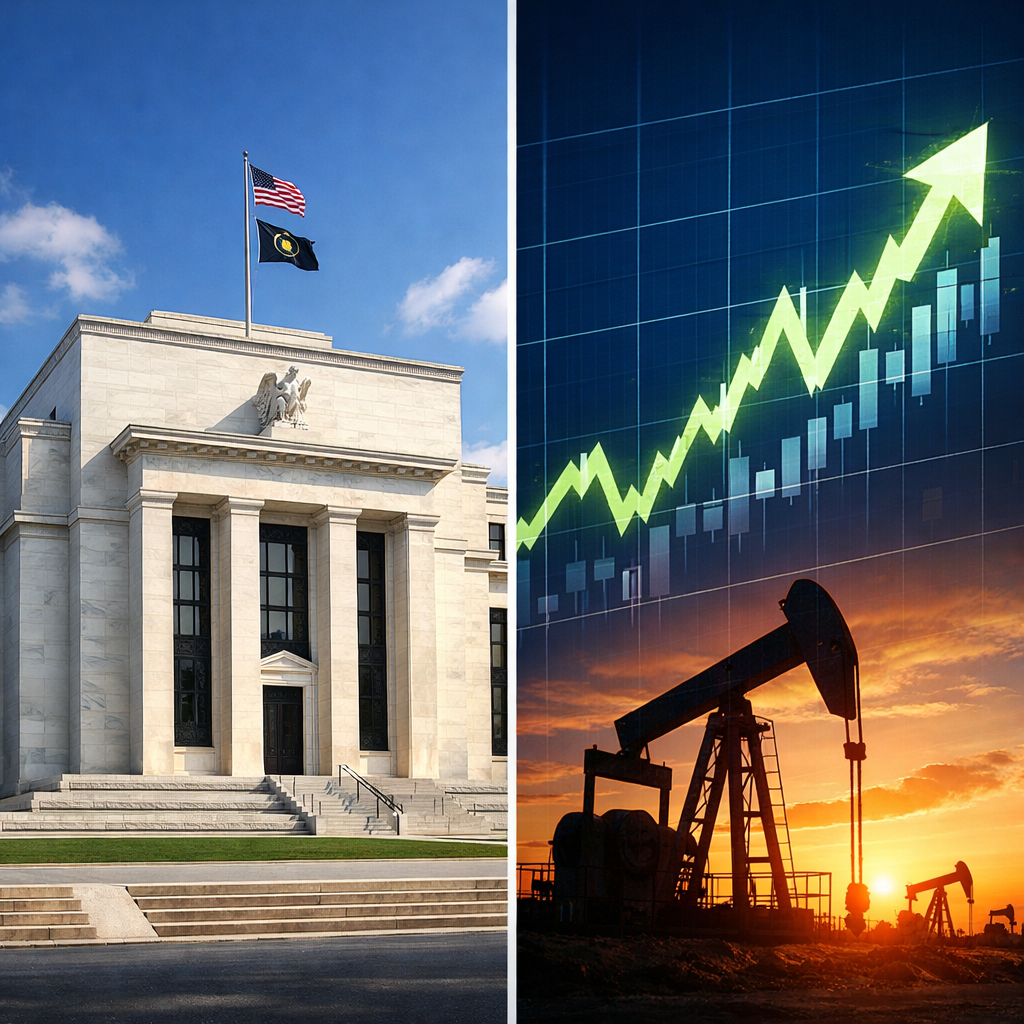

The United States inflation rate accelerated sharply in March, reaching its highest level in nearly two years and delivering a stark reminder that the Federal Reserve’s path to rate cuts remains hostage to geopolitical forces well beyond its control.
The Bureau of Labor Statistics released the March Consumer Price Index on Friday, April 10, showing that headline inflation rose 0.9% on a seasonally adjusted basis for the month, the largest single-month increase in nearly four years, pushing the annual rate to 3.3%. That figure compares with 2.4% recorded in February and represents the highest annual reading since April 2024.
Energy Drives the Surge; Core Holds
The index for energy rose 10.9% in March, led by a 21.2% increase in gasoline prices, which accounted for nearly three quarters of the monthly all-items increase. The spike traces directly to the U.S. military conflict in Iran, which began in late February and disrupted oil flows across the Persian Gulf, pushing Brent crude above $110 per barrel.
The more reassuring signal came from core inflation. Excluding food and energy, core prices rose just 0.2% for the month and 2.6% from a year ago, both 0.1 percentage point below forecast, indicating that underlying inflation remained contained. There were even pockets of outright price declines, as medical care, personal care, and used cars and trucks all fell during the month.
That split, a surging headline driven entirely by war-related energy costs alongside a subdued core, has shaped both the market response and the Fed’s immediate calculus.
The Federal Reserve: Locked, Not Pivoting
The March CPI print effectively removes any near-term possibility of a Federal Reserve rate cut. The Federal Funds Rate remains at 3.50%–3.75%, and the data has effectively locked in a hold for the May meeting. Traders who were once expecting a June cut have now pushed their expectations for easing into the fourth quarter of 2026.
Interest-rate swaps on Friday showed traders pricing in a roughly one-in-four chance of a quarter-point rate cut this year, slightly lower than before the data. Treasuries edged lower after the report, with yields rising two basis points across maturities.
At its March 18 meeting, the Federal Open Market Committee kept the federal funds target range at 3.50% to 3.75% and said economic activity had been expanding at a solid pace. The FOMC also noted that the implications of developments in the Middle East for the U.S. economy are uncertain, a statement that brought energy prices and geopolitics more directly into the policy discussion.
Goldman Sachs Asset Management offered a tempered read on the data. Alexandra Wilson-Elizondo, global co-CIO of multi-asset solutions at the firm, noted that the Fed has room to be patient and every reason to exercise it, adding that while the March number buys the Fed time, the real test lies ahead.
Bond Markets Signal Caution on What Comes Next
Tom di Galoma, managing director at Mischler Financial Group, warned that the March CPI data will not support bond prices, as the next month’s inflation report is expected to reveal additional headaches for both investors and the Fed.
Anders Persson, chief investment officer and head of global fixed income at Nuveen, noted that the ceasefire and ongoing negotiations are critically important for markets, and that shorter-dated Treasuries are likely to remain more volatile as traders continue to price in moving oil prices, the potential inflation impact, and the probability of either a Fed cut or a hike.
The ceasefire announced on April 7 between the U.S. and Iran provided a brief reprieve, sending crude prices lower and offering bond markets momentary relief. But with peace talks fragile and Brent crude still elevated, the relief is partial and conditional.
Structural Risk: From Energy Shock to Broad Inflation
The central question for markets and policymakers is whether the current energy-driven surge remains contained or begins to filter into the broader economy. The market rally is currently built on the assumption that the Fed will eventually cut rates in 2026; if the energy shock persists and begins to leak into core inflation, that assumption will be shattered.
Services inflation, which the Fed monitors as a proxy for demand-side pricing pressure, showed measured movement. Services excluding energy rose 0.2% for the month and 3.0% from a year ago, a level that signals ongoing stickiness but not a broad breakout.
Against this backdrop, the Fed’s policy path has become more uncertain. The easing cycle began in 2024, followed by a pause, and resumed in late 2025. In total, the Fed has reduced interest rates by 1.75 percentage points over the past two years, from a range of 5.25%–5.50% in August 2024 to the current 3.50%–3.75% range. That accumulated easing now functions as a buffer, but one that buys time rather than immunity.
What This Signals
The March CPI release is the first data print to formally reflect the economic impact of the U.S.-Iran conflict. It confirms a bifurcated inflation picture: a headline number distorted by war-driven energy costs, and a core reading that remains broadly aligned with the Fed’s longer-run objectives. That distinction is keeping rate hike fears at bay, but it is also extinguishing rate cut expectations for at least the next two quarters.
For global markets, the implications extend well beyond U.S. borders. Elevated U.S. rates and a stronger dollar compound financing costs for emerging market economies, including those across sub-Saharan Africa, where dollar-denominated debt servicing pressures are already elevated. Should the Iranian ceasefire hold and oil prices recede, the second half of 2026 presents a narrow window for the Fed to resume easing. Should the conflict re-escalate, stagflation risks, last seen in force in the 1970s, return to the centre of the macro debate.
The April 29 Federal Open Market Committee meeting will deliver the next policy signal. Until then, the data holds the floor.